Stash and grab

A couple of weeks ago I found a shawl pattern that whispered sweet words in my ears. I saved it for later, but it kept poking me for attention. I realized I had all the yarn I needed for it in my handspun stash. It also dawned on me that I had some more in knits that I havenโ€™t looked at for years and could rip. The pattern inspired me to go through my stash and grab all the handspun yarn I needed.

Lace mitochondria

The pattern is Waiting for rain, by Sylvia Mc Fadden. It is a crescent shape garter stitch shawl, beginning with ten stitches and ending with 438. The interesting thing is the short row lace sections. Just listen to it: Short row lace, isn’t it intriguing! It just starts in the middle of a row and opens up the garter stitch, revealing a sweet lace window to peek through.

The lace sections remind me of mitochondria โ€“ just a big blob with an intricate pattern in the middle of something completely different.

Contrasts

The shawl was originally knit up in one colour, but the pattern designer also had suggestions for a two-colour play, where she had knit the short row lace sections in a different colour. Furthermore, she had added extra rows of the second colour as stripes in the garter sections. I love the contrast between the simple garter base, the sheer lace blobs and the track pant-like stripes.

The yarns

I was very keen on the idea of making the shawl in stashed and reused handspun yarns only. Here are the players I chose and the decisions I made for my shawl.

Rutan the Vรคrmland 2-ply

For the main yarn I chose a grey yarn I created in 2021 from a variegated Vรคrmland fleece (from a ewe named Rutan). I spun it a few years ago, and divided the fleece into piles of different shades of grey for a gradient from light to dark grey.

Four skeins of yarn in different shades of grey.
The gradient yarn I created from a variegated grey fleece of Vรคrmland wool back in 2021..

I had saved it for a suitable fair-isle pattern that would turn up when I at least expected it, but I realized that this shawl was the perfect candidate for the pattern. As a bonus, the meterage was just right. I chose to knit it as a gradient too, from dark at the neck to light at the bottom.

Burning the midnight oil

Another stashed yarn was actually spun from an industrially prepared blend. I donโ€™t have many of those and I never use them these days.

A handspun yarn in intense blue, beside a supported spindle with some of the yarn on the shaft.
Burning the midnight oil, a mulberry silk/merino blend, from 2016.

Years ago, though, I asked a wool store to make me a blend with the colour of oil in a puddle. It sounds nasty, but if you consider the colour stripped from its ugly context itโ€™s a quite fascinating colour mix. I loved the result and spun a lot of it on train rides. Held double, the fine yarn was a perfect match for the somewhat rustic looking grey Vรคrmland wool.

Rip and rip some more

Sometimes you have a vision of a garment and when you put it on it looks just wrong. Thatโ€™s what happened with my Stevenson Sweater by Kate Davies. I spun a lovely yarn with white and dyed Swedish Jรคmtland wool and some natural fawn Shetland wool. Once I had made a hank of the I soaked the ripped yarns I soaked it, used the blue (Held double) for the shawl and saved the white for later. I did save the matchning gauntlets, though. I use them when I work from home on cold days.

The story repeated itself with a shawl pattern I found in a knitting magazine, the Merging ripples shawl by Kyoko Nakayoshi. It looked so stylish on the model, but like a random piece of fabric across my shoulders when I had finished knitting it. This too was Jรคmtland wool where I had actually succeeded in creating a lovely teal dye. This yarn too got a place among the lace blobs.

Dyed and redyed finull yarn

My fourth candidate for the lace sections was a finull yarn that I spun last year. I had saved it to dye with my homegrown indigo. I actually did dye it with the very last batch of fresh leaves, but it was way too much wool in the dye pot, and way too late in the season. It barely got dyed at all. You can see the sad colour as the first couple of light green stripes near the neck. I overdyed it with some Aijozome indigo from Loop of the loom into a lovely colour (the lace section at the bottom of the shawl).

Stripes and drape

Since the lace sections are knit in short rows, the contrasting colours leave a stripe throughout the width of the shawl. Just like in one of the knit shawls in the pattern, I played with this, and added several stripes before and after the lace. It gave a very interesting effect and helped me keep count of the rows between the short row sections.

Despite the eye catching lace, most of the shawl is the garter base. Garter stitch pulls the material together lengthwise, so to get length in the shawl there needs to be more rows in garter stitch than in other techniques. This makes the shawl very drapey and feel very safe and comfy in its weight. I love the curled ends, they remind me of the tips of lamb locks.

It took me 40 minutes to bind off the 438 stitches. I chose to do that too in a contrasting colour and I am very happy with that decision, it makes a neat finish.

โ€Block aggressivelyโ€

That was the last sentence of the pattern descrition, block aggressively. I used a gazillion pins, rearranged both them and the blocking pieces several times and spent about an hour crawling around on the floor until I was happy. Well, not entirely on the floor, I skipped up and down the stairs several times too to see from above how the blocking turned out.

The stripes actually helped me in the blocking as they served as a guide for the shape of the shawl. When I eventually decided I was finished I knew the time I had spent was totally worth it. I was also very grateful for blocking wires.

Stash and grab-friendly patterns

I have done quite a few stashbusting projects this fall. Some of them are excellent for small amounts or single skeins of handspun yarn:

  • The Seguin top, knit from a ripped sweater in a commercial yarn
  • The Ursina top, knit from leftovers from an earlier handspun project
  • Hats! The Algae hat is on my needles right now, with the leftovers from the Waiting for rain shawl. And the Hipster hat on another set of needles with a handspun Shetland yarn. I might make another two hats before the holidays.

Older stash and grab projects from my handspun yarns are

  • The Lamina wrap, perfect for small batches of yarn in the same weight
  • Enchanted Mesa sweater, where I have mixed commercial and handspun yarns
  • The Daisy crescent shawl, perfect for your smallest skeins of flowery colours.

The feeling of cleaning out the handspun stash is the sweetest. Like a rinse, a spring rain or a deep exhale.

Happy spinning!


You can find me in several social media:

  • This blog is my main channel. This is where I write posts about spinning, but also where I explain a bit more about videos I release. Sometimes I make videos that are on the blog only. Subscribe or make an rss feed to be sure not to miss any posts.
  • My youtube channel is where I release a lot of my videos. Subscribe to be sure not to miss anything!
  • I have a facebook page where I link to all my blog posts, you are welcome to follow me there.
  • I run an online spinning school, welcome to join a course! You can also check out my course page for courses in Sweden or to book me for a lecture.
  • On Patreon you can get early access to new videos and other Patreon only benefits. The contributions from my patreon only benefits. The contributions from my patrons is an important way to cover the costs, time and energy I put into the videos and blog posts I create. Shooting and editing a 3 minute video takes about 5 hours. Writing a blog post around 3. You can read more about my Patreon page here.
  • Follow me on Instagram.  I announce new blog posts, share images from behind the scenes and post lots of woolliness.
  • Read the book Knit (spin) Sweden! by Sara Wolf. I am a co-author and write in the fleece section about how I spin yarn from Swedish sheep breeds.
  • I am writing a book! In the later half of 2025 Listen to the wool: A why-to guide for mindful spinning will be available. Read more about the book here.
  • In all the social media I offer, you are more than welcome to contact me. Interacting with you helps me make better content. My private Facebook page, however, will remain private.
  • I support Centro de textiles tradicionales del Cusco, a group of talented textile artists in Cusco, Peru who dedicate their work to the empowerment of weavers through the revitalization and sustainable practice of Peruvian ancestral textiles in the Cusco region. Please consider supporting their work by donating to their causes.

New socks

I’m not a sock knitter. I love the idea of hand knit socks, but I rarely wear them and I find the knitting quite boring. But then came cold baths. And suddenly I need lots of new socks.

I love Irene Waggener’s book Keepers of the sheep. A couple of years ago I knit myself a pair of pants from the book. Another project I wanted to knit was the new socks.

Socks in the bath tub

I take baths in my lake every day of the year. When the water temperature sinks, the energy in the body rushes to the vital parts โ€“ the torso. The outer ends of the extremities are left โ€“ literally โ€“ in the cold. Hands and feet get very cold when the body works very intelligently to protect the torso. This is where socks and mittens (and a hat) come in handy in the cold bath.

I know cold is a relative term here, but for me that temperature is around 13 degrees for my hands and a couple of degrees below that for my feet. During the autumn as the water temperature sinks I put on neopren gloves and wool socks in the bath. When I saw the new sock pattern in Irene’s book I realized they would be perfect for cold bathing.

Tqasher Jadeed

Eventhough I haven’t knit very many socks in my life I realize that the engineering of the Tqasher Jadeed โ€“new socks โ€“ is different than the models I have seen. As with all the other patterns in Irene’s book, this one is built up as a try-as-you-go process where you need to be confident enough to trust your instincts when it comes to the fit. All of the parameters โ€“ needles, yarn thickness and numbers โ€“ are sort of fluid in a very compelling way. The technique for toes and heels are there of course, but the rest is up to the knitter to balance.

A book page featuring a photograph of a pair of white hand knit socks with a ribbed leg. A twisted yarn end ties the socks around the calf.
Tqasher Jadeed, new socks. A lovely pattern in Keepers of the sheep. Photo published with permission from the author.

Elsa the Gestrike sheep

I had the perfect wool to match the socks, from Elsa the Gestrike sheep. I got the fleece a couple of years ago when I helped out on shearing day at my friend Claudia’s sheep farm. Elsa had beautiful grey wool with lots of variations in her fleece.

I divided the fleece into categories of different staple types. The biggest pile was with long, conical staples with around 50 per cent undercoat and 50 per cent outercoat. They were the perfect match for my socks. When I met Irene Waggener this summer I brought some of the wool to show her what breed I had knit the pants with and would knit the socks with.

Yarn and socks

I carded the wool into rolags and spun quite fine singles with an English longdraw. To get the strength I wanted for the socks I 3-plied them with more twist than I would for a different kind of project. The yarn is around sport weight.

I really loved the resulting yarn โ€“ rustic but smooth and with a blueish grey sheen to it. It was a joy to knit with, very straightforward and sweetly rounded.

A bath

Happy as a clam I skipped down to the dock with my new socks the other day, the ties secured around my wrists. I knit the socks quite large, which suits me perfectly for my bath. In the mid winter when both water and air temperatures are considerably lower than 8 ยฐC, taking off the socks after the bath needs to go fast. I need to get clothed quickly and my hands lack some dexterity in those temperatures, so too snug a snug fit on wet socks isn’t ideal.

These were very easy to take off dripping wet after the bath (I change into dry socks for my four minute walk back home). Still, I am considering fulling the socks slightly for just a tad slimmer fit. I’ll think about it after tomorrow’s bath. The water temperature has just sunk below 8 ยฐC.

At the dock

I had some shots of the socks at the dock from last week, but the other morning the fog left a beautiful light across the lake and I wanted to take just a couple of more. I mounted the camera on the flexible tripod and set the timer on a picture every three seconds. To start, I took a few pictures on my feet as I was about to get in the water. That done, I wanted just one more picture of my socked feet in the water. I put the tripod on top of my head, as I have several times, and walked down the ladder.

A very blurry picture taken from the sea bed.
I call this “Lake Mรคlaren seen from the sea bed”.

In a split second the tripod with my phone fell in the water. I gasped for air and just stared down into the darkness, astounded by the fact that I hadn’t been able to catch it in the fall. It was really actually no kidding on the sea bed. I fumbled around with my feet, but I could’t feel it. The lake bed is very steep by the ladder, I can stand just below the lowest step but not ten centimeters further out. I was paralyzed. My bathing friends noticed the commotion and came to me, they had been in the water for a while as I had been fiddling with the first camera setup. Gunilla offered to dive once to see if she could find the camera. She did, but she could neither see nor feel anything.

A thousand thoughts rushed through my head, all too fast and too unreasonable to get a hold of. Mostly about how ridiculously vain I had been, chasing a good shot and ruining both my camera and my sweet dip. I gasped for air again. All my previous knowledge about breathing techniques to calm down were blown away the second the camera broke the surface. I felt again with my feet around me as far and as deep as I could reach, and I found something. It could be a leg of the tripod, and it could be a branch. The weight was no clue as other rules of gravity reigned in the water. I grasped it with my feet and hoisted whatever it was up. My still shocked breath mixed with a deep sigh of relief as I had the camera in my hand. It was still taking pictures.


Irene, I know you wanted to see my new socks together with the Sirwal pants, but that will have to wait a couple of months. They are still way too warm, I usually wear them to my walk down to the dock when the air temperature sinks below -6 ยฐC. I can’t wait for winter!

Happy spinning!


You can find me in several social media:

  • This blog is my main channel. This is where I write posts about spinning, but also where I explain a bit more about videos I release. Sometimes I make videos that are on the blog only. Subscribe or make an rss feed to be sure not to miss any posts.
  • My youtube channel is where I release a lot of my videos. Subscribe to be sure not to miss anything!
  • I have a facebook page where I link to all my blog posts, you are welcome to follow me there.
  • I run an online spinning school, welcome to join a course! You can also check out my course page for courses in Sweden or to book me for a lecture.
  • On Patreon you can get early access to new videos and other Patreon only benefits. The contributions from my patreon only benefits. The contributions from my patrons is an important way to cover the costs, time and energy I put into the videos and blog posts I create. Shooting and editing a 3 minute video takes about 5 hours. Writing a blog post around 3. You can read more about my Patreon page here.
  • Follow me on Instagram.  I announce new blog posts, share images from behind the scenes and post lots of woolliness.
  • Read the book Knit (spin) Sweden! by Sara Wolf. I am a co-author and write in the fleece section about how I spin yarn from Swedish sheep breeds.
  • I am writing a book! In the later half of 2025 Listen to the wool: A why-to guide for mindful spinning will be available. Read more about the book here.
  • In all the social media I offer, you are more than welcome to contact me. Interacting with you helps me make better content. My private Facebook page, however, will remain private.
  • I support Centro de textiles tradicionales del Cusco, a group of talented textile artists in Cusco, Peru who dedicate their work to the empowerment of weavers through the revitalization and sustainable practice of Peruvian ancestral textiles in the Cusco region. Please consider supporting their work by donating to their causes.

Serial blue

This weekend I harvested the very last of my indigo leaves for a final extraction. Throughout the season I have dyed for a serial blue.

To learn more about fresh indigo dyeing, pop in at the Dogwood dyer‘s!

This is my first real season of both woad (European and Chinese) and Japanese indigo (Maruba and Kojoko) and it has been such a beautiful experience. I did try both woad and Japanese indigo a few years ago, but the Japanese indigo never germinated and the woad was eaten by flea beetles, so I donโ€™t even count that.

Woad woes

There was some trouble with the woad in the beginning. Our local city fox decided to investigate the pantry properties of the hugelkultur where I had planted my woad. Nighty pantry digging raids resulted in severely damaged plants. Twice. Of the few plants of Chinese woad I had from the beginning I was left with only three. The European woad plants were more from the beginning and I ended up with around eight.

A hand holding three balls of ground and compressed woad leaves. A mortar and pestle in the background.
I made some lovely woad balls out of a whole harvest, but they molded quite quickly.

At one point I harvested all my European woad โ€“ over 500 grams โ€“ to make woad balls, but they started to mold after just a couple of days. I did a final extraction of the autumn harvest kast week, but it only resulted in a blue tint in the coffee filter. Still, I have lots of seeds left and I am counting on the existing plants to grow another year in the hugelkultur. And oh, they are accompanied by a sweet plant of madder now too.

Extractions

All through summer I have harvested a small amount of leaves. My first try was a cold water extraction, but the most common method of extraction has been a semi-warm fermentation โ€“ 35 ยฐC in the water and a double boiler “thermos” of around 45 ยฐC. The extraction has taken around 18 hours.

When I have decided that the extraction was finished I have removed the leaves and started oxidizing the liquid. This is the most fun part. With just an alkaline addition and some oxygen the liquid turns magically blue and I know I have secured some pigment for future vats.

Baby steps

The reason why my extractions have been so small is practical โ€“ my buckets and pots aren’t large enough to ferment the whole harvest in one go. I was a bit annoyed by this in the beginning, but then I realized that multiple extraction for a serial blue has its advantages, at least for me as a beginner. By making small batches I ensure that I can extract some pigment. If one extraction fails I still have the other ones. Had I done it all in one go there would be a risk of it all going down the drain.

A person pouring a blue liquid from a bucket into a pot. In the background are green plants.
Oxidizing my indigo extraction is the most fun part! My small indigo garden to the right.

Another advantage is that I have learned a lot by doing the multiple extractions. I know the signs to look for, I know what the liquid is supposed to smell like and I know how much lime to add in the alkalization stage. I have also created a routine for the extractions that has worked well for my context and my tools.

A small mason jar with a blue liquid in it. The liquid has separated in the top few millimeters.
One of my first Maruba extractions.

After the very last (perhaps tenth all in all?) extraction this week, just before the frost covered the ground in a sparkling blanket, I measured my serial blue dried indigo pigment to around 5 grams. It’s not much, but I have made it all by myself and I am ridiculously proud of every grain of blue.

Fresh leaf dyeing

In the beginning, before I had enough leaves to make extractions, I did some fresh leaf dyeing. I used both the salt rub and the blender method and enjoyed myself tremendously.

As I started extracting I took advantage of the fermented leaves too. The ones that still looked fresh still had some dyeing potential, and I used them with the blender method. Every batch got a small skein of handspun silk and a few linen buttons.

Serial blue

I got some lovely greenish blue skeins in the fresh leaf baths and light blue buttons. However, it was when I started to overdye that the real fun began. By dyeing skeins and buttons two or three times I got a darker and deeper dye from both indigo and woad.

I realized that I could play a lot with this โ€“ any skein that ended up too light or unevenly dyed went back into the next bath.

A wooden board with 14 small skeins of handspun silk. They are all in different shades of greenish blue, one is purple. On the ground beneath the board are yellow maple leaves.
Serial blue โ€“ multiple dips of my handspun silk yarn in fresh leaf baths.

The colour differs between the two Japanese indigo types and the woad, the Kojoko being a little more vibrant than the Maruba and the woad a little lighter and earthier than the Japanese indigo. On the picture above you can see woad on the fourth from the right. The second and third from the right and the first, second and fifth from the left are Kojoko, the rest is Maruba. The somewhat tousled skeins are dyed with the salt rub method (where the fresh leaves are massaged into the skeins) and the others with the blender method (where the skeins are soaked in leaves that have been blended with ice cold water).

Indirubin

The purple skein is a result of having added some heat and a little alkalinity to already extracted leaves. This can, if you are lucky, bring out the indirubin, which is purple. I did this several times, but this skein was the only one that was worth saving. The second from the left is an overdye from another bath that wasn’t as successful in extracting the indirubin. You can still see some traces of purple in the skein.

Until next year

All the dye pots are stored away now. Of the plants in the garden are just a few stalks left. But on the windowsill in my home office are two pots, one with Kojoko and one with Maruba plants. A few stalks rise high above the others, displaying a multitude of flowers. These are my heroes and seed producers for next year’s dye garden.

A stalk with green leaves and small pink flowers.
Pink flowers on my Maruba plants. The Kojoko flowers are white.

Seeds of Japanese indigo need to be fresh to germinate, so for every season I need to grow new seeds for the next. If I succeed and if the seeds germinate I will have a dye garden of blue in 2024 too, and lots more experience than with this first one.

My play with fresh leaf indio on my handspun silk is over and I do have plans for the skeins. I will also experiment with vat dyeing with the indigo pigment I did manage to extract, which will be a whole new adventure. I’ll keep you posted!

Happy spinning!


You can find me in several social media:

  • This blog is my main channel. This is where I write posts about spinning, but also where I explain a bit more about videos I release. Sometimes I make videos that are on the blog only. Subscribe or make an rss feed to be sure not to miss any posts.
  • My youtube channel is where I release a lot of my videos. Subscribe to be sure not to miss anything!
  • I have a facebook page where I link to all my blog posts, you are welcome to follow me there.
  • I run an online spinning school, welcome to join a course! You can also check out my course page for courses in Sweden or to book me for a lecture.
  • On Patreon you can get early access to new videos and other Patreon only benefits. The contributions from my patreon only benefits. The contributions from my patrons is an important way to cover the costs, time and energy I put into the videos and blog posts I create. Shooting and editing a 3 minute video takes about 5 hours. Writing a blog post around 3. You can read more about my Patreon page here.
  • Follow me on Instagram.  I announce new blog posts, share images from behind the scenes and post lots of woolliness.
  • Read the book Knit (spin) Sweden! by Sara Wolf. I am a co-author and write in the fleece section about how I spin yarn from Swedish sheep breeds.
  • I am writing a book! In the later half of 2025 Listen to the wool: A why-to guide for mindful spinning will be available. Read more about the book here.
  • In all the social media I offer, you are more than welcome to contact me. Interacting with you helps me make better content. My private Facebook page, however, will remain private.
  • I support Centro de textiles tradicionales del Cusco, a group of talented textile artists in Cusco, Peru who dedicate their work to the empowerment of weavers through the revitalization and sustainable practice of Peruvian ancestral textiles in the Cusco region. Please consider supporting their work by donating to their causes.

Stash top

Several coincidences led me to knitting this stash top โ€“ a weekend in need of a knit. A stashed handspun yarn in need of a project. Hands and mind in need of wool on long work meetings.

The idea for this sweater project started quite a while ago, but was sparked by a weekend in need of a knitting project.

Yoga practice

I practice yoga asana every morning and evening. Towards the end I want to put something on to avoid getting cold, but nothing too warm. I started to look for patterns for a cropped top, something to just throw on before the final relaxation of my practice to keep my chest warm. I found the Ursina pattern by Jacqueline Cieslak and saved it for later.

In need of a knit

A few weeks ago I went with my wool traveling club to our annual wool journey. I realized I needed a knitting project for both the train ride and for our hours and hours of chatting.

After browsing Ravelry for a while I found the saved Ursina pattern and decided it was time for it. I had some low twist lopi style handspun yarn left after knitting a Telja sweater by Jennifer Steingass and it was the perfect fit.

Colour scheme

I had five colours left of the yarn โ€“ the natural white, light grey and dark grey and some light blue and medium blue that I had dyed. Stripes was my choice for the project. I picked the smallest yardage for the neckline and changed into increasingly larger yardages as I knit. I added a thin white stripe between each colour shift to avoid a gradient feeling.

A top on a hanger outdoors. The top has a short body and long sleeves. It is striped from light blue at the neckline, through medium blue and dark grey to light grey at the hem. A wood shed in the background.
To optimize the colours in the stashed yarn I decided to make the stash top striped.

I have knit stripes with stashed yarn like this before in my Bianka sweater, and the fiddly part is always after separating body and sleeves. both times I ended up with live stitches on cables in body and sleeves, knitting a couple of rounds at a time to end up in an even stripe across sleeves and body. In the end it’s worth it, though, for a smart striping and efficient use of stashed yarn.

Knit reknit

Due to optimistic measures of gauge I ripped and reknit the top. Twice. But I didnโ€™t mind, it gave me something to knit on meetings at work. I remember some of my colleagues looking at my knitting and wishing they had something to do with their hands too to avoid falling asleep in a stuffed conference room.

Ursina and Jacqueline

I want to tell you about this pattern. Of course I fell for the design โ€“ the cropped body, the brioche stitch triangle at the hem, the brioche stitch faux seams and the sweet V-neck.

But after having bought the pattern and cast on I was astounded by the pattern description. I have never seen a pattern description with such a well-planned structure! Not only does Jacqueline Cieslak accomodate for different body sizes, bust sizes, body shapes and yarn weights, but she has structured the description in a unique and very clear way to make it easy and effortless to find where you are in the pattern. She is a true pattern construction and pattern designer star and I want to knit all her patterns.

My new post-yoga stash top does exactly what I wanted it to do โ€“ it keeps me warm after my practice and is cozy to wear. I may knit another one.

Happy spinning!


You can find me in several social media:

  • This blog is my main channel. This is where I write posts about spinning, but also where I explain a bit more about videos I release. Sometimes I make videos that are on the blog only. Subscribe or make an rss feed to be sure not to miss any posts.
  • My youtube channel is where I release a lot of my videos. Subscribe to be sure not to miss anything!
  • I have a facebook page where I link to all my blog posts, you are welcome to follow me there.
  • I run an online spinning school, welcome to join a course! You can also check out my course page for courses in Sweden or to book me for a lecture.
  • On Patreon you can get early access to new videos and other Patreon only benefits. The contributions from my patreon only benefits. The contributions from my patrons is an important way to cover the costs, time and energy I put into the videos and blog posts I create. Shooting and editing a 3 minute video takes about 5 hours. Writing a blog post around 3. You can read more about my Patreon page here.
  • Follow me on Instagram.  I announce new blog posts, share images from behind the scenes and post lots of woolliness.
  • Read the book Knit (spin) Sweden! by Sara Wolf. I am a co-author and write in the fleece section about how I spin yarn from Swedish sheep breeds.
  • I am writing a book! In the later half of 2025 Listen to the wool: A why-to guide for mindful spinning will be available. Read more about the book here.
  • In all the social media I offer, you are more than welcome to contact me. Interacting with you helps me make better content. My private Facebook page, however, will remain private.
  • I support Centro de textiles tradicionales del Cusco, a group of talented textile artists in Cusco, Peru who dedicate their work to the empowerment of weavers through the revitalization and sustainable practice of Peruvian ancestral textiles in the Cusco region. Please consider supporting their work by donating to their causes.

A year in wool

The other week when I visited Claudia and her sheep flock, I realized that I have a seasonal cycle when I create yarn and textiles. In a year in wool, autumn is the beginning.

In October, when most of the vegetables in the allotment have been harvested, a majority of Swedish wool is also harvested. For the sake of sheep health, the law says sheep are to be shorn at least once a year. Still, many sheep farmers shear their sheep twice a year: In the autumn, before the ram serves the ewes, and in the spring before the lambs are born. The autumn harvest is when my wool year begins.

Shearing seasons

The autumn wool usually has the highest quality. During the winter the sheep has been pregnant and the lamb hogs a lot of the nutrition. The winter in Sweden is cold and the fleece is extra lanoliny, not much different from our own hair in the winter. Perhaps the sheep have been indoors a lot of the time, leaving time for lots of dirt, straw and bedding to find its way in between the fibers. This leaves a winter fleece that can be dirtier, in poorer condition and with more and heavier lanolin in it.

A woman is shearing a sheep. The sheep is lying on the floor and the shearer is bending over it.
Professional shearer Elin Esperi shears Sylvester the Gestrike lamb in the autumn of 2021.

After that winter coat has been shorn off in the spring shearing, the lambs are born, and soon after the sheep gets access to lots of nutritious grass and fresh air, leaving the fleece in a better state for the autumn shearing.

Fleece hunting

The sound of moving shears sparks my year in wool: I look for fleece to buy, just like on any autumn farmer’s market. Or, rather, fleeces sort of find me and look at me with roe deer eyes and whisper: โ€Spin me, spin me!โ€. And so, in late October I find myself with a compost grid on the floor with drying fleece, another fleece in the wash tub and a third dried and waiting to be picked.

A white fleece is drying in front of a fireplace.
The fleece of Lotta the Svรคrdsjรถ ewe is drying in front of the fireplace. Behind the camera are bags with fleeces of the Gestrike sheep Hรคrvor and Doris, waiting to be picked.

This means that I do a lot of wool preparation and spinning during October, November and the first weeks of December. When the pantry is filled to the brim with newly harvested vegetables, I do my best to take care of the oldest fleeces before I dive into the freshly shorn. It is hard, but sometimes I succeed.

A tree

In late december a tree with glittering ornaments moves into the house, right where my spinning wheel usually stands. This is a quite time of year when I like to turn to weaving in the local weaving room. I get to destash and get out of the house during my two weeks or so of holidays.

A green twill weave in a local weaving room, three floor looms in the background.
Towards the end of the year I like to spend some time in the local weaving room.

When the tree is all glistened out and transformed to fire logs I get my spinning wheel back, and return to spinning. The sun is slowly coming back and lights up the living room again. I plan what to sow in the community garden allotment, alongside planning my spinning projects for the spring.

When the sun returns

The returning sun brings sprouts out of the soil and new inspiration into my mind. At this point I want to do everything at once. Weave! Nalbind! Two-end knit! Weave some more! I want to get outside and create textiles, and the spinning wheel gets a little dusty. My life moves outdoors step by step.

Close-up of a braid that is tied in one end around a toe. A person is braiding the braid.
Small projects I can work on outdoors start to poke me in the head in the spring.

At the same time the fleeces in my wool queue start to squeak in the back of my mind and I get a bit concerned about the risk of the oldest fleeces going brittle.

Make room for flax

In the summer when the temperature rises and the crops are more independent than the tiny sprouts just a couple of weeks earlier, I like to take my spinning outdoors in one shape or form. I dust off my flax wheel and spin on the balcony in the afternoon shade.

I also prepare smaller projects to bring to vacations and excursions โ€“ spindle spinning projects, band weaving, two-end knitting and nalbinding. Usually around five parallel projects or more.

Late summer collision

Towards the end of the summer, a lot of the vegetables in the garden need picking, all the while work has started after the summer holidays. I have harvested the flax, started lots of textile projects and need to finish some to ease my mind.

When autumn has settled and the most critical vegetables are taken care of, I have finished some of the parallel projects that sprouted in the spring. The wool queue is shorter and neater and I forget all about it when shearing season is back again.

What is your year in wool like?

Happy spinning!

You can find me in several social media:

  • This blog is my main channel. This is where I write posts about spinning, but also where I explain a bit more about videos I release. Sometimes I make videos that are on the blog only. Subscribe or make an rss feed to be sure not to miss any posts.
  • My youtube channel is where I release a lot of my videos. Subscribe to be sure not to miss anything!
  • I have a facebook page where I link to all my blog posts, you are welcome to follow me there.
  • I run an online spinning school, welcome to join a course! You can also check out my course page for courses in Sweden or to book me for a lecture.
  • On Patreon you can get early access to new videos and other Patreon only benefits. The contributions from my patreon only benefits. The contributions from my patrons is an important way to cover the costs, time and energy I put into the videos and blog posts I create. Shooting and editing a 3 minute video takes about 5 hours. Writing a blog post around 3. You can read more about my Patreon page here.
  • Follow me on Instagram.  I announce new blog posts, share images from behind the scenes and post lots of woolliness.
  • Read the book Knit (spin) Sweden! by Sara Wolf. I am a co-author and write in the fleece section about how I spin yarn from Swedish sheep breeds.
  • I am writing a book! In the later half of 2025 Listen to the wool: A why-to guide for mindful spinning will be available. Read more about the book here.
  • In all the social media I offer, you are more than welcome to contact me. Interacting with you helps me make better content. My private Facebook page, however, will remain private.
  • I support Centro de textiles tradicionales del Cusco, a group of talented textile artists in Cusco, Peru who dedicate their work to the empowerment of weavers through the revitalization and sustainable practice of Peruvian ancestral textiles in the Cusco region. Please consider supporting their work by donating to their causes.

Flax yield

When I talk to people about my experimental flax patch I often get the question of yield โ€“ how much flax do I get per square meter of harvest? I have never been able to answer the question since I havenโ€™t documented the numbers. But this year I tried to estimate a flax yield.

It is a relevant and interesting question. But, as always, there are many parameters that need consideration and there is a lot more than just a figure. I will however give you some numbers and then challenge them.

Unprocessed weight

This year I planted two of my community garden allotment beds with flax. They are approximately 3 square meters in total. After I had harvested, dried, retted and dried again I had 900 grams of flax. I have nothing to compare it with, but of the ten harvests I have had it was at least one of the top three in harvested flax.

Newly water retted flax that, after drying, resulted in 900 grams.

Despite careful checks I managed to underret my flax this year too. More than usual, actually. While the fibers were very soft from the water retting, as well as long and fine, there was a lot of waste. The fibers were very strong, so the waste was in the amount of fibers (lots of plants where the fibers hadnโ€™t separated) rather than in length.

Processed weight

After breaking, scutching and rough and fine hackling I had 72 grams of prepared flax. I arranged the flax in two stricks, one with the long first hand quality and one with the second hand hackle waste that I rehackled. In addition to that there was a lot of waste that ended up as mulching in the garden beds.

Parameters

So, I have listed some interesting parameters to challenge and break down these numbers. Some of which I can experiment with and improve and others that I just have to deal with. Some of which spell C-A-T-S.

Area, distribution and height

While I can measure the flax patch area there are lots of parameters that I canโ€™t really influence. I aim at fine fibers, so I plant quite tightly, but I donโ€™t measure the distance between the plants. Depending on my deweeding diligence there can be more or less weed between my flax plants.

I buy the seed that is available that particular year. Sometimes it is a higher plant sort and sometimes a lower.

Height and fineness

Even if the seed has an estimated height, the individual plants can of course vary. The further the distance between the fibers, the more space the plant gets to grow, and the taller and rougher the plant will grow. This is especially clear in the edges of the flax patch where the plants have lots of space to grow. But height through roughness isnโ€™t necessarily what I want. Where the plants have grown tighter the fibers will be finer, but also shorter. The tighter growing plants will also have less branching and a higher quality than the tall and branched rough plants. Finer fibers would also result in a lighter yield.

Last yearโ€™s flax was quite uneven in height.

Some years the plants are very different in height and I havenโ€™t got the slightest clue to why. But perhaps it has something to do with the soil? I have read that flax likes to be planted on an even surface and so I try to make it as flat as I can by walking over the whole patch after sowing, pressing the soil even.

The weather

No matter how well I tend my flax patch, the weather always has the final say. Whether it is too wet, too dry or too windy, the weather will influence the quality of the flax. This year, for example, we had some very heavy rain in a couple of early August weeks. The flax laid flat and got too heavy to rise. Flax lying flat on the ground can result in mold or retting while it is still in the ground.

Retting

The retting, oh, the retting. How it eludes me. I have managed to underret most of my harvests so far. It seems like I need to overret it once to understand what perfect retting is supposed to look and feel like.

I did so many retting tests, but I still managed to underret it. Again.

When the flax is underretted there will be more fibers that still stick together in a band. These will make the hackling more exhausting for me and result in more tangles and broken fibers. A lesser quality, no doubt, and, in the end, more waste.

Cats

Iโ€™m not joking here. The more the neighbourhood cats that take naps in the flax field, the more bent the plants will get, resulting in the same disaster as heavy wind or rain. And no one has any say in the catdom other than the cat.

My flax patch has been terrorized by both cats and heavy rain. Screenshot from video.

This year Findus the neighbourโ€™s cat trotted around in one of my flax patches as I tried to harvest it, resulting in tangled plants and lots of fuss. The main fuss was caused by heavy rain, though.

Waste or tow?

I have to admit Iโ€™m not very good at taking care of the hackle waste. I do try to unwaste the longer hackle remains and rehackle it into shorter bundles. But I am certain I could make more of an effort with the tufty tow and make a rougher yarn with it. This is actually a parameter where I can step up and turn some waste into unwaste.

Experimental

My flax patch has been experimental from the start back in 2014. My main aim is to learn, which I do every year, sometimes with varying degrees of pain. The more I learn the better quality my flax gets. There was a lot of waste this year. From the 900 grams I started with I ended up with 72 grams of prepared flax. That makes a yield of less than one per cent from the original dry weight. I have nothing to compare it with, but it sounds very low. Still it isnโ€™t as simple as only numbers. I am very happy with the quality of those 72 grams.

Retting is and will always be a factor that heavily influences the yield and a constant adventure. Soil, fertilizing, weather and weeds are others. And cats.

I have written quite a lot of flax posts through the years. Use the search field to find them.

Happy spinning!


  • This blog is my main channel. This is where I write posts about spinning, but also where I explain a bit more about videos I release. Sometimes I make videos that are on the blog only. Subscribe or make an rss feed to be sure not to miss any posts.
  • My youtube channel is where I release a lot of my videos. Subscribe to be sure not to miss anything!
  • I have a facebook page where I link to all my blog posts, you are welcome to follow me there.
  • I run an online spinning school, welcome to join a course! You can also check out my course page for courses in Sweden or to book me for a lecture.
  • On Patreon you can get early access to new videos and other Patreon only benefits. The contributions from my patreon only benefits. The contributions from my patrons is an important way to cover the costs, time and energy I put into the videos and blog posts I create. Shooting and editing a 3 minute video takes about 5 hours. Writing a blog post around 3. You can read more about my Patreon page here.
  • Follow me on Instagram.  I announce new blog posts, share images from behind the scenes and post lots of woolliness.
  • Read the bookย Knit (spin) Sweden!ย by Sara Wolf. I am a co-author and write in the fleece section about how I spin yarn from Swedish sheep breeds.
  • I am writing a book! In the later half of 2025 Listen to the wool: A why-to guide for mindful spinning will be available. Read more about the book here.
  • In all the social media I offer, you are more than welcome to contact me. Interacting with you helps me make better content. My private Facebook page, however, will remain private.
  • I support Centro de textiles tradicionales del Cusco, a group of talented textile artists in Cusco, Peru who dedicate their work to the empowerment of weavers through the revitalization and sustainable practice of Peruvian ancestral textiles in the Cusco region. Please consider supporting their work by donating to their causes.

A book deal

Dear readers, I have a book deal. In about two years I will release my very own book, Listen to the wool: A why-to guide for mindful spinning. It has been a long ride so far, a road that has been especially eventful these past nine months.

While there are lots of how-to spinning books on the market, Listen to the wool is more of a why-to book where I talk about why we take certain steps from fleece to yarn and what we can learn in each step from a unique fleece. I will encourage the reader to do the donโ€™ts, challenge their preconceptions and embrace their mistakes, all the while I hold their hand. The book also has a wider perspective in why we spin (or craft) at all in a world where we don’t need to to feed and clothe our families. If you have read my blog I think you will recognize my relationship to the wool and my writing style.

Way back when

For many years I have had a book in my heart. It has been humming in the background since then, but lately it has moved on to buzzing. In 2019 I started to loosely plan it, mapping out topics to write about.

A first documented step towards a book, back in 2019.

I remember creating a mind map of topics I wanted to cover and asking a few trusted friends to read a chapter or two when the time came. I have come back to the mindmap every now and then, changed a few things and then procrastinated some more. Writing a book has been a theoretical priority, but has never made it into a practical one โ€“ there have always been other things like blog posts, online courses, articles with deadlines. All things that I love and thrive doing, but still shadowing my quite book dream.

Writing an email

During the pandemic I incorporated writing in my daily morning ritual. Just a couple of hand written pages in a journal, letting the words flow and settle down onto the page.

In the 2022 December solstice email I sent to my readers I wrote a couple of lines about writing and how it can help me understand the development of a thought process, dive deeper into the wool and share my reflections with you. I got a reply from Jane who recommended me to look up Beth Kempton, an author, course creator and Japanologist. I did, and found some lovely stuff.

The way of the fearless writer, by Beth Kempton has helped me a lot as I have unleashed my writing heart onto the page. The title of the notebook underneath is Write whatever wants to be written, as Beth Kempton inspires to.

I bought Beth Kemptonโ€™s book about writing, The Way of the Fearless Writer, and loved every page of it. I also joined her ten day winter writing sanctuary and thrived in daily writing into the new year.

A masterclass

I kept writing and loved the notion of writing what wants to be written, to allow the writing to write me. In March I enrolled in Beth Kemptonโ€™s four week online course, the Book Proposal Masterclass. There was lots of challenging assignments in the course and it took a lot of time and energy. But it also gave me so much more than I had ever imagined. A lesson in mapping out all my ideas on a wall (or underneath a staircase) gave me endless aha moments. It also made me realize that this could all be real one day.

One of the most mentally challenging assignments in the Book proposal masterclass was to brainstorm and bundle topics for the book.

One month after the month long course had ended I had a finished 40 page book proposal. Whatโ€™s more, I had a structure and a shape for a book that until then had only been a blob. Through poking the blob from different angles throughout the course I managed to shape it into something real, something that could actually become a book.

Trusted friends

I went back to my trusted friends a couple of new ones. I asked them to read my 40 page book proposal and give me feedback from different angles. Their thoughts about the proposal helped me enormously and I sharpened the proposal according to their observations.

An agent

At first I thought I could just send my book proposal to a publisher, but during the book proposal masterclass I realized that I would need an agent. I am writing this book in English, since no Swedish publisher would ever publish a book for an audience as small as the Swedish spinning community. So my aim was the English speaking world, which of course widens the audience enormously, and especially the U.S. market where more than half my readers come from. I know absolutely nothing about the book publishing industry, and even less about U.S. and worldwide publishing, so I realized an agent could guide me through this vast jungle.

My presentation on Creative Authors’ website.

In July I found my agent, Isabel Atherton of Creative Authors. She is English but lives in Manhattan. When I looked her up she specified craft books as a particular interest. I sent her my book proposal and she happily agreed to take me on. She is my champion and explains everything to me about the business and contracts with great patience.

Isabel will do what she can to help me find a publisher that will provide my Swedish readers with a Swedish translation.

A book deal

Quick as an eagle, Isabel sent my proposal to various publishers, and just this week I signed with the U.S. publisher Stackpole, an imprint under Rowman and Littlefield. Stackpole has published craft books for many years, mainly in textile crafts and a couple of those about spinning. Their crafts editor (swoon!) Candi Derr was very excited about my book proposal just as it was, including having my husband Dan take all the pictures for the book.

To celebrate my book deal I bought a whole stack of books about writing and I am eagerly waiting for them to arrive. Tomorrow Dan and I will go to a friend’s pastures for our first photo shoot for the book.

Onwards!

This is huge for me. I am over the moon and terrified. There will be a lot of writing on my book now. The buzz from the book now has a wide spectrum between whale song and nails against the blackboard. One year from today my editor will have my manuscript. The book will be published around a year after that. Watch this space.

Thank you all for cheering me on, for asking questions and for making me a better spinner and writer. This book is for you.

Happy spinning!


You can find me in several social media:

  • This blog is my main channel. This is where I write posts about spinning, but also where I explain a bit more about videos I release. Sometimes I make videos that are on the blog only. Subscribe or make an rss feed to be sure not to miss any posts.
  • My youtube channel is where I release a lot of my videos. Subscribe to be sure not to miss anything!
  • I have a facebook page where I link to all my blog posts, you are welcome to follow me there.
  • I run an online spinning school, welcome to join a course! You can also check out my course page for courses in Sweden or to book me for a lecture.
  • On Patreon you can get early access to new videos and other Patreon only benefits. The contributions from my patreon only benefits. The contributions from my patrons is an important way to cover the costs, time and energy I put into the videos and blog posts I create. Shooting and editing a 3 minute video takes about 5 hours. Writing a blog post around 3. You can read more about my Patreon page here.
  • Follow me on Instagram.  I announce new blog posts, share images from behind the scenes and post lots of woolliness.
  • Read the book Knit (spin) Sweden! by Sara Wolf. I am a co-author and write in the fleece section about how I spin yarn from Swedish sheep breeds.fleece section about how I spin yarn from Swedish sheep breeds.
  • In all the social media I offer, you are more than welcome to contact me. Interacting with you helps me make better content. My private Facebook page, however, will remain private.
  • I support Centro de textiles tradicionales del Cusco, a group of talented textile artists in Cusco, Peru who dedicate their work to the empowerment of weavers through the revitalization and sustainable practice of Peruvian ancestral textiles in the Cusco region. Please consider supporting their work by donating to their causes.

Wool Journey 2023

in 2014 I started a wool traveling club with four friends. Since then we have gone on an annual wool journey together. This year we went to one of the membersโ€™ house to weave.

Today I launch a new short online lecture about picking fleece! Welcome to my online school!

To be able to tell you about the 2023 wool journey I need to go back first. The 2022 wool journey went to Dala-Floda where we learned a local embroidery technique called pรฅsรถm. The teacher we hired for the course, Anna-Karin Jobs Arnberg, also arranges fulling workshops in the local 17th century fulling mill.

Weaving for fulling

A fulling mill is a mill that uses water to operate giant beams that stomp into larger troughs. Loosely woven wool cloth is placed in the troughs โ€“ 20 meters in each trough, and is fulled by the beams. You can read more about the fulling mill here and watch a video I recorded around the fulling mill back in 2018.

At the 2022 course we decided to weave together on the 2023 wool journey with the aim of fulling our woven cloths on the 2024 wool journey at the fulling mill. Boel invited us all to her house to weave.

Boelโ€™s house

Boelโ€™s house is to die for. Smack in the middle of nowhere, still cozily tucked between green hills, forests and pastures. A flock of her parentsโ€™ Gotland sheep graze right around the yard and bind the perfect picture together with their quiet munching and sweet bleating.

Itโ€™s been a while since I met sheep and I was overjoyed at the opportunity to cuddle Boelโ€™s sweet ladies. Being with sheep is such a serene place to be. Their warmth, their wool, the smell of lanolin, grass and sheep poo calmes me and makes my heart sing. Or bleat.

Gotland sheep

If you are outside of Sweden and have come in contact with Gotland sheep in your country, chances are their wool is softer than the wool of Swedish Gotland sheep. The Swedish breed standards encourage breeding for strong and lustrous Gotland wool to provide for beautiful skins. The Swedish Gotland wool is truly beautiful, but I rarely spin it since it is quite rough and at the same time very slippery.

Since I had the perfect opportunity, I bought a skin from Elton, the allegedly mean ram. He had done his job and fathered three seasons’ lambs. Rumour has it that he tasted good. And his skin is magnificent โ€“ large, silvery with a blueish tint and with a darker stripe down the mid back, an eel in the language of Gotland fleece.

Looms and projects

For this yearโ€™s wool journey in preparation for next yearโ€™s we didnโ€™t hire a teacher or attend a course. We just got together at Boelโ€™s house to weave. Anna and I came with our rigid heddle looms on the train, Kristin brought her rigid heddle loom in her car and Boel had her floor loom in her house. Ellinor couldnโ€™t make it this year.

Weaving in Boelโ€™s conservatory overlooking the sheep pastures. The bosom friend I’m wearing is my handspun. It is available as a pattern in the spring 2022 issue of Spin-Off magazine. Screenshot from video by Kristin Jelsa.

I didnโ€™t use a handspun yarn for this weave, I didnโ€™t have one ready. I did however have lots of Shetland yarn I bought at a clearance after a lady who was the first in Sweden to import Shetland yarns. My plan is to turn the fulled cloth into a pillowcase. I have lots of yarn left and my idea is to use the three colours but in a different order and in different patterns for a collection of pillowcases.

Together in our hands

The members of the wool traveling club usually donโ€™t meet between the wool journeys, so we have a lot to talk about when we do meet. About wool and crafting of course, but also about families, relationships and the ways of the world. Children growing up โ€“ there are eleven children between us, from 2 to 22 years old. Joys, frustrations, we talk about everything and anything.

Cats happen at Boelโ€™s house. This one found a tolerable napping space. Photo by Boel Dittmer.

Crafting and talking is such a sweet space to be a part of. Being in our hands together gives an extra dimension to the room, something more, deeper, more sincere. I cherish these moments and am very grateful for them and for my sisters in craft.

We have different lives and live in different parts of the country, yet when we come together we take part of each otherโ€™s realities with warmth. When the journey is over we go back to our regular lives, and the following year we pick up where we left off.

Breathing

It was so quiet. Not a human-made sound, just the buzzing of bees, bleating of sheep, fluttering of leaves and bare feet in the grass. Breathing in the air in a place like that must be extra nourishing. I like to think that the air I breathe when I get up at five a.m. is unused, crisp like a new sprout. But this, here, is something extra.

Knitting outdoors in the September sun, listening to the silence and resting my eyes on trees and pastures with the needles dancing in my hands was such a bliss. Kristin and I sneaked out both mornings for a lovely dip in a nearby lake. That too a lovely space to be, in the water with a friend in the early hours.

Ready to full

As I got back home to Stockholm I finished the last stripes of my weave. The next weave to full will hopefully be a handspun one.

A few days after I got home I finished the last of my weave.

I have actually already finished one that has been waiting for a couple of years by now to be fulled. I canโ€™t wait to get to the fulling mill!

Now go and enroll in that online lecture about picking fleece!

Happy spinning!


You can find me in several social media:

  • This blog is my main channel. This is where I write posts about spinning, but also where I explain a bit more about videos I release. Sometimes I make videos that are on the blog only. Subscribe or make an rss feed to be sure not to miss any posts.
  • My youtube channel is where I release a lot of my videos. Subscribe to be sure not to miss anything!
  • I have a facebook page where I link to all my blog posts, you are welcome to follow me there.
  • I run an online spinning school, welcome to join a course! You can also check out my course page for courses in Sweden or to book me for a lecture.
  • On Patreon you can get early access to new videos and other Patreon only benefits. The contributions from my patreon only benefits. The contributions from my patrons is an important way to cover the costs, time and energy I put into the videos and blog posts I create. Shooting and editing a 3 minute video takes about 5 hours. Writing a blog post around 3. You can read more about my Patreon page here.
  • Follow me on Instagram.  I announce new blog posts, share images from behind the scenes and post lots of woolliness.
  • Read the book Knit (spin) Sweden! by Sara Wolf. I am a co-author and write in the fleece section about how I spin yarn from Swedish sheep breeds.fleece section about how I spin yarn from Swedish sheep breeds.
  • In all the social media I offer, you are more than welcome to contact me. Interacting with you helps me make better content. My private Facebook page, however, will remain private.
  • I support Centro de textiles tradicionales del Cusco, a group of talented textile artists in Cusco, Peru who dedicate their work to the empowerment of weavers through the revitalization and sustainable practice of Peruvian ancestral textiles in the Cusco region. Please consider supporting their work by donating to their causes.

Water retting

Since I started my experimental flax patch 2014 I have dew retted my harvest. This year I try water retting for the first time.

Every year I have been nervous about retting. About the retting process in itself because it is such a vital part of the quality and yield of the harvest, but also about something happening to the flax on the lawn.

Lawn issues

We do have a lawn right outside our house. The tricky part though, is that it is not our lawn. Our house is situated in sort of a park area through which people can stroll โ€“ there are practically no gardens and no fences. The lawn is also part of the whole row of four town houses.

Dew retting in 2022.

Last year our neighbours were renovating their kitchen. I had laid my flax out to dew ret the day before they started ripping out the old furniture and dumping it uncomfortably close to my flax. It all worked out in the end, but it is a challenge to hog the lawn for three weeks for something people have no idea what it is. To them it is just straw in rows on the ground.

Enter: The kiddy pool

As I went out every day last year to check on the flax and the threat of the renovation bags, I read about my friend Christiane Seufferleinโ€™s water retting. For water retting, a creek or a lake is recommended, so that the water is not still. Christiane did her water retting in a kiddy pool, though.

We live very close to a lake, but I wouldnโ€™t dare to leave my flax where passers-by can see it. We also have a creek, but there is only water running in it in the early spring from melting snow. So a kiddy pool was the perfect solution. I wouldnโ€™t bother the neighbours, I wouldnโ€™t have to worry so much about the flax being trampled on and the retting wouldnโ€™t take three weeks.

Most of the kiddy pools on the market seem to come with either Disney motifs or inflatable palm trees. Or both. I did manage to find a plain rectangular pool, though.

Water retting

I harvested my flax on August 7th, but due to heavy and frequent rain it wasnโ€™t dry until late August. I rippled it and started the retting on August 30th. I threw some soil in the bottom of the pool to get the retting a head start. To keep the flax bundles from surfacing I covered them with a couple of compost grids and some bricks. When I had it all organized I covered the arrangements with hose water of around 20 ยฐC.

To trick the pool into believeing it was a real creek, I removed a bucket of pool water and added a bucket of hose water every day.

Testing

As the days went by, the water got increasingly gunky. Luckily, water retting is usually a lot faster than dew retting. Christiane had told me to check daily once the make-believe creek started to smell. On day 6 I took out a few strands, dried them and checked how the fibers came off the core. It had definitely started but was not finished.

Drying some test strands on day 6.

End of process

I tested again on day 8, but it was on day 9 I decided to stop the process. The fibers came off the cellulose core with ease. On some strands the fibers had come off by themselves.

Knot test not failed.

I also tested the strength of the fibers by tyeing a knot and pulling. If the fibers break close to the knot the fibers are strong. My fibers broke just by the knot. Happy as a clam I removed the flax bundles from the pool, sprinkled them with the hose and put it all to dry around the base of our oak tree.

Our big oak watches over the drying water retted flax.

The weather was warm and dry during this time and the bundles dried quite fast. The stems weighed 900 grams when fully dried.

Breaking and scutching

I have no idea if I will get the time to process the flax before it gets too cold. However, I like to at least break and scutch it before the winter so that it takes up less space indoors.

Breaking flax is quite laborious, but also something I look forward to doing. My 1821 flax break was made for a shorter person and my back wined a bit. After I felt the first blister in my hand I put on a biking glove. Neither pretty nor contemporary, but sometimes style needs to take a step down. I did take it of for the photo shoot, though.

For the scutching I used my beautiful scutching knife, custom made for me last year by master carver Frej Lonnfors.

Test hackling

As I scutchted I started to suspect that the flax was underretted after all. Even if most of the boon came off, the fibers didnโ€™t seem to separate. I decided to hackle a couple of stricks to investigate.

I ran the flax through rough and fine hackles and I was right. Despite the experience of ten harvests I obviously still havenโ€™t learned how to ret properly. There were still lots of strands with the fibers glued together and there was quite a lot of waste, in both rough and fine hackling.

Baby soft

But the softness, oh the softness. I have never had a flax harvest as smooth as this! I read that water retting can make the fibers softer than dew retting and in this case it seems to be correct.

The colour is beautifully golden, in contrast to the more subtly silvery brown dew retted flax I am used to. Despite the high waste I expect to get more hackled flax than I have before. I had two flax patches this year, each around 1.5 square meters, and the flax quite high and even in length.

Next summer, sweet flax, you and I. Next summer.

Happy spinning!


You can find me in several social media:

  • This blog is my main channel. This is where I write posts about spinning, but also where I explain a bit more about videos I release. Sometimes I make videos that are on the blog only. Subscribe or make an rss feed to be sure not to miss any posts.
  • My youtube channel is where I release a lot of my videos. Subscribe to be sure not to miss anything!
  • I have a facebook page where I link to all my blog posts, you are welcome to follow me there.
  • I run an online spinning school, welcome to join a course! You can also check out my course page for courses in Sweden.
  • On Patreon you can get early access to new videos and other Patreon only benefits. The contributions from my patreon only benefits. The contributions from my patrons is an important way to cover the costs, time and energy I put into the videos and blog posts I create. Shooting and editing a 3 minute video takes about 5 hours. Writing a blog post around 3. You can read more about my Patreon page here.
  • Follow me on Instagram.  I announce new blog posts, share images from behind the scenes and post lots of woolliness.
  • Read the book Knit (spin) Sweden! by Sara Wolf. I am a co-author and write in the fleece section about how I spin yarn from Swedish sheep breeds.fleece section about how I spin yarn from Swedish sheep breeds.
  • In all the social media I offer, you are more than welcome to contact me. Interacting with you helps me make better content. My private Facebook page, however, will remain private.
  • I support Centro de textiles tradicionales del Cusco, a group of talented textile artists in Cusco, Peru who dedicate their work to the empowerment of weavers through the revitalization and sustainable practice of Peruvian ancestral textiles in the Cusco region. Please consider supporting their work by donating to their causes.

Knit, rip, reknit

Have you ever knit a garment, not really used it, ripped it and reknit it into something else? I hadnโ€™t until just recently. Today I knit, rip, reknit and rejoice. Spoiler alert: There is no spinning in this post.

A while ago, when I was looking for inspiration for linen knits, I stumbled upon a top that I really wanted to knit. My plan was to knit it with my handspun linen yarn.

Knit, 2014

However, I did have a top that I had knit back in 2014 in a commercial yarn that was the same as the yarn required in the pattern for this new top. The commercial yarn was a beautiful linen yarn by Quince & co. that I had ordered from the U.S. for the 2014 sweater.

Back in 2014 I knit the East end top by Alicia Plummer. It’s a lovely top, but I didn’t wear it very much. Photo by Dan Waltin.

I did love the top back when I knit it, but when I wore it, it was quite fiddly. The neck was a bit on the wide side and there was always a risk of body parts or bra straps showing. It never occurred to me back then to alter the fit. Therefore I didn’t use it very much.

Rip, 2023

When I found the new pattern requiring the same yarn, I decided it was time to rip the old top. Ripping linen yarn was a bit of a detangling challenge, but after some fiddling and occasional secret cutting, I managed to undo the whole top. To even out the phone cord curls I soaked the squiggly yarn overnight and hung it to dry, lightly weighted. It worked very well, reknitting with it felt no different than when I knit with it the first time.

Reknit, 2023

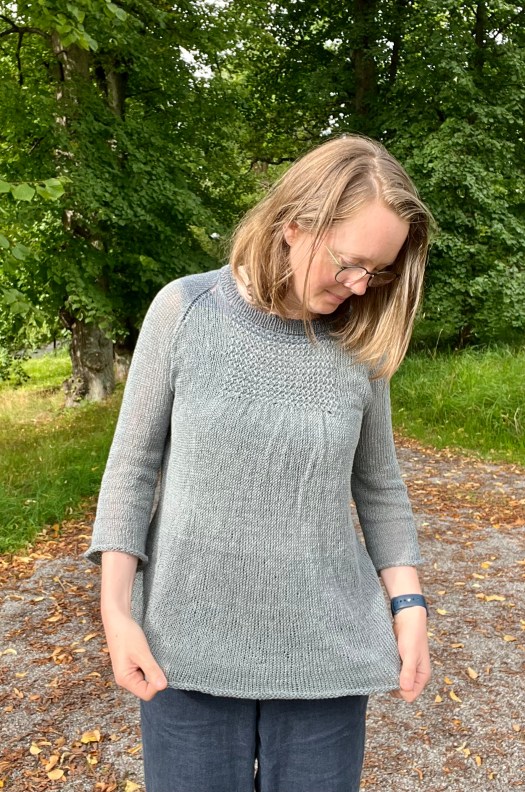
The new pattern is the Seguin top, by Quince. & co. It is a simple bottom-up knit in the round stockinette raglan sweater with rolled up cuffs and hem and a simple 1×1 ribbed neck band. The detail that makes the whole sweater interesting is a rectangular chest panel in sort of a tight oats pattern. The one over two cable repeat pulls the fabric together, making it look like decreased stitches underneath the panel, but itโ€™s exactly the same amount of stitches.

I really like this detail, that shapes the whole yoke and gives some flare from the bust down. In combination with the simple stockinette and rolled hems it is the perfect everyday want-to-live-in kind of a top.

Shortage and abundance

The further I knit on the Seguin top, the more I realized that I might need to buy a couple of extra skeins. I found an online shop in France that carried the yarn in the same colour. I bought two to be safe, but I ended up using only a quarter of a skein to finish the sweater.

A colour shirt where I needed to join a quarter of a skein of new yarn is a sweet reminder of the thriftiness that is the core of this top.

I knew there was a risk that the colours of the used, ripped and washed 2014 yarn and the new 2023 yarn wouldn’t exactly match, but it didn’t bother me. It would just be a quirky conversation starter in the name of sustainability and making do and mend.

I was right, there is a colour shift from the old to the new yarn, and I quite like it. Ripping and reknitting has been a way of taking care of precious yarn and clothe your family through rough times. Knitting in the round works very well for this purpose โ€“ once a garment has been mended and patched until it can’t be mended anymore, it has been frogged and reknit into something else.

Happy spinning!


You can find me in several social media:

  • This blog is my main channel. This is where I write posts about spinning, but also where I explain a bit more about videos I release. Sometimes I make videos that are on the blog only. Subscribe or make an rss feed to be sure not to miss any posts.
  • My youtube channel is where I release a lot of my videos. Subscribe to be sure not to miss anything!
  • I have a facebook page where I link to all my blog posts, you are welcome to follow me there.
  • I run an online spinning school, welcome to join a course! You can also check out my course page for courses in Sweden.
  • On Patreon you can get early access to new videos and other Patreon only benefits. The contributions from my patreon only benefits. The contributions from my patrons is an important way to cover the costs, time and energy I put into the videos and blog posts I create. Shooting and editing a 3 minute video takes about 5 hours. Writing a blog post around 3. You can read more about my Patreon page here.
  • Follow me on Instagram.  I announce new blog posts, share images from behind the scenes and post lots of woolliness.
  • Read the book Knit (spin) Sweden! by Sara Wolf. I am a co-author and write in the fleece section about how I spin yarn from Swedish sheep breeds.fleece section about how I spin yarn from Swedish sheep breeds.
  • In all the social media I offer, you are more than welcome to contact me. Interacting with you helps me make better content. My private Facebook page, however, will remain private.
  • I support Centro de textiles tradicionales del Cusco, a group of talented textile artists in Cusco, Peru who dedicate their work to the empowerment of weavers through the revitalization and sustainable practice of Peruvian ancestral textiles in the Cusco region. Please consider supporting their work by donating to their causes.