Here it is, finally. My second bigger video project Slow fashion 2 – from sheep to shawl.
Slow fashion and the value of a craft
I wanted to make another video on the slow fashion theme. Also, I wanted to show some other aspects of crafting. I have seen people sell handmade items for basically the cost of the material, which is such a shame. There is so much talent, time, effort and experience behind a handmade item. People don’t give it a second thought in a society where we expect to have stuff and we are in turn expected to buy more stuff (that has preferably been shipped three times around the globe). Giant store buildings are popping up like mushrooms because we don’t have any space left for all our stuff. This video is about the value of good craftmanship and all the time, tradition, skill and effort that lie behind it.
In the studio, with garden chairs as camera stands. Photo by Dan Waltin
For the love of spinning
The video is also about the love of spinning. I try to capture the way spinning gives me that meditative feeling, how the motions and the touch of the fibers gives me serenity and a sense of weightlessness.
The leading fleeces
The fiber in the shawl is from two natural colour Shetland fleeces. The warp was spun worsted on a spinning wheel from hand-combed tops and 2-plied. The weft was spun woolen on a Navajo spindle from hand-carded rolags into a singles yarn. The shawl was woven on a 60 cm rigid heddle loom on double width.
The finished shawl. Photo by Dan Waltin
For tools and designers, see this post. For a connection to Outlander, look here.
There was a spinning competition at the wool fair I visited today.
Competing yarns. Winner 4th from the right, third prize to 5th or 7th from the right, I can’t really tell them apart in this pictureAnother set of competing yarns, mine 4th from the right
I love spinning competitions. The competition today was about spinning a yarn (beforehand and send it in), any kind of yarn, from Swedish sheep and adding a recycled material. Also, you needed to describe what the yarn was intended for. A really nice idea!
One of the reasons why I love spinning contest is that it gives me a chance to widen my horizons. I am forced to think outside my go-to yarn box. And this contest in particular. In the crafts section of my book shelf I have The spinner’s book of yarn designs by Sarah Anderson. I have learned so much by reading it and there is one yarn in particular that I always have wanted to try to spin, but I have never thought of a proper use for it. And now I had my chance. It was the pigtail yarn. You Z-spin two singles, one with more twist that the other. As you ply, you let the overspun single ply back on itself at suitable intervals to make intentional pigtails. You can also add pre-strung beads to the ends of the pigtails.
So, I spun thick singles from hand-carded rolags on my Navajo spindle. The wool was from the finewool sheep Engla from Överjärva gård.
Spinning singles on a Navajo spindle
At first I was playing with the idea to pre-string the overspun single with washers and add them to the top of each pigtail, but I realized that this would be too difficult. After all, I have never spun an art yarn before. My wool traveling friend Ellinor suggested chicken feathers instead. And I loved the idea.
I had planned to ply the singles on the Navajo spindle, but after a while I came to my senses and used the wheel instead. Plying was a really mad task. The yarn was too heavy and too voluminous and the bobbin wouldn’t pull up the yarn properly (probably because I had the wrong tension). And the pigtails were quite difficult to get right.
Plying intentional pigtails
When the singles were finished, I was left with a bobbin with disastrously stiff phone wire. So, I let the yarn go through the wheel again in the opposite direction to unwind the overply a little. And it worked!
Ellinor sent me a packet of beautiful feathers from her chickens.
Chicken feathers with chicken postage stamps
After experimenting with different ways to attach the feathers to the pigtails, I ended up sewing them through the core of the feather and onto the ends of each pigtail and it worked out perfectly. But it took me three weeks to sew them on. At least they won’t fall off!
Attaching feathers onto pigtails, one by one
I imagine the yarn being used as knitted-on edge on a collar on a cardigan knit in a bulky white yarn. The feathers will make it look almost like a lion’s mane. Hence the name – The sheep, the chicken, the pig and the lion.
The sheep, the chicken, the pig, the lion and the spinner
The sheep is the Swedish finewool sheep Engla who provided me with the fiber, the chicken is the previous owner of the feathers, the pig is the model for the pigtails and the lion is the look of the wearer with the yarn in the collar.
So, there were about 27 yarns in the competition.
The contestants had been very creative in their yarns. They had attached fibers from clothes, cassette tape, buttons, silk flowers etc. The winner was a beautiful core spun mohair yarn with hand dyed silk fibers and hand crocheted silk flower buttons. The third prize was wool spun together with human hair, also beautifully done.
And how did I do? Well, I came in second!
The yarns were auctioned for charity. At this moment I don’t know if anyone bought my yarn. But I’d love to see it in a project!
Yummy Swedish finewool (scoured) from Solkustens spinnverkstad
The first ever fleece I bought was from the Swedish finewool sheep Pia-Lotta at Överjärva gård. She was a lamb back then and it was the wool I learned to spin with. I have managed to get hold of her fleece twice more (the last time I shore her myself). Finewool has become my house fiber. It is the fiber I feel most comfortable spinning and my hearts jumps a beat whenever I get my hands on finewool fluff.
At the wool traveling club‘s wool journey 2016 I bought some really yummy finewool at Solkustens spinnverkstad and a couple of days ago I started preparing it for spinning. I know it is a year later, but that’s my fleece queue at the moment – one year from purchase to process if I keep the queue order.
A good finewool fleece is really crimpy with superfine fibers. It is moderate in lanolin and usually only needs scouring in cold water before processing. It is wonderfully soft, silky to the touch and a very good candidate for carding for a warm and airy woolen yarn. The ends can be a bit brittle and break in the preparation. Therefore it’s a good idea to make sure that doesn’t happen, to avoid nepps and noils in your yarn. I flick card the tip ends of every staple. Any brittle tips stay in the flick card instead of in the yarn.
Crimly staples of finewool
I have spun my first yarn in this fiber from hand-carded rolags on my spinning wheel and I love the result.
Fingering weight finewool yarn spun with long draw from hand-carded rolags, 3-ply, 48 g, 113 m
I also plan to make a 3-ply yarn spun on a Navajo spindle. When I spun this yarn on the wheel, I realized that I have learned so much about long draw from spinning on a Navajo spindle. I wouldn’t have been able to spin singles this consistent if I hadn’t practiced long draw as much as I have on the Navajo spindle. At that insight, my heart skips a beat again.
I bought a kilo of heckled flax from Växbo lin a year ago, but I have been a bit intimidated by it. I have read a lot about flax spinning but I haven’t had the courage to start spinning.
Reading up on flax spinning and husbandry
Also, I didn’t have a distaff, so I asked around and finally got a comb distaff. It was hand-carved in the -80’s after an old original. But I had no holder for it and I started playing with ideas how and where to arrange it. We have a floor lamp in the living room and I thought it might be a good idea to tie the distaff onto the lamp shaft.
I wanted to get some sort of container for water to be able to wet-spin the flax. My idea was to hang the container on my spinning wheel, so I needed something with a handle. Last week we went to a flea market and I found a pretty copper cauldron that would be a perfect candidate for the job.
A cauldron for wet spinning
Today I decided it was the day to face my flax fears and start spinning. When I looked at the lamp to figure out how to attach the distaff to it, I saw my blocking wires behind the lamp, neatly stored in their one meter tube. And it was the perfect distaff stand!
So I started spinning with the distaff tube tucked under my arm. It was a little awkward, trying to spin, hold on to the tube and wisp away flying flax fibers at the same time. I realized that I had to spin outdoors and organize myself. So, I moved my equipment out to the terrace and folded up the parasol against the sun and the showers in the ambivalent weather. And I found the perfect floor stand to the distaff tube in the lounge furniture!
Spinning flax with inventive distaff holder and stand. Photo by Dan Waltin
Finally, I was able to spin. I was happy as a clam, spinning away in my perfect little arrangement. The rain was pattering cozily against my parasol canopy and the bobbin slowly turned into a treasure in pale gold.
A golden thread. Photo by Dan Waltin
And I’m really happy with my first flax yarn. And now there is only 974 g flax left of my 1 kg!
I just came home from vacations out of town. First we had a wonderful week in Austria, hiking and seeing my relatives. We flew to Vienna and then took the train to Salzburg. So, when it came to craft planning I didn’t want anything in my hand luggage that any security staff could take away from me. My standard in-flight craft is nalbinding. A blunt wooden needle (or, in this case, bone) and yarn. It doesn’t take much space either. And my loved ones are always in need of warm and wind-proof mittens. These particular mittens will be for my brother-in-law. They were also a perfect companion for hiking.
Nalbinding at Postalm, Austria. Bone needle from Birka. Yarn is my handspun 3-ply from finewool/rya crossed sheep from Åsebol sheep farm.
We had to stay overnight in Vienna, so I could rearrange my luggage and have access to both spindles and knitting projects for the train ride. And I do love spinning on the train.
Spinning on the train between Vienna and Salzburg. Spindle from Neal Brand, spinning disk from John Rizzi. Fluff is merino/tussah silk from Vinterverkstan.
Lots of knitting was done also at the B&B we stayed at. I couldn’t not knit the 2017 Shetland wool week pattern, even though I’m not coming this year either.
Knitting the Bousta beanie by Gudrun Johnston, the 2017 Shetland wool week pattern. Yarn is my handspun from Shetland fleece from Jamieson & Smith Shetland woolbrokers (greens) and Jämtland sheep (grey).
And, oh, I also found the house spinning wheel at the B&B! A little beauty that had been used for both flax and wool spinning by the owner’s mother in the early 1900’s.
A pretty spinning wheel, next to a flax distaff.
The second vacation was in a log cabin in Tiveden in Sweden at the Åsebol sheep farm. They have finewool, Texel and Rya sheep.
Beautiful Rya sheep.
We came by car and I brought a lot more crafting stuff on this trip. The car was quite full. I had a basket of carders and combs between my feet on the floor. But it was worth it, this farm is one of my favourite places on earth.
Nalbinding away by the creek.
We did some hiking there as well, and I brought the nalbinding.
Nalbinding again.
We spent a lot of time at the farm, just enjoying the silence and the occasional Baah. And i did a lot of spinning. I brought five spindles plus carders and wool combs and enjoyed them all.
Wool production at Åsebol sheep farm: Dark grey singles (on Roosterick Navajo spindle and leftmost toilet roll), five skeins of thick singles finewool yarn spun on Navajo spindle (and all of the fluff for it combed and carded on the log cabin porch), Shetland singles on drop spindle from Bosworth (I am planning to Navajo-ply it), Finewool on Jenkins Turkish spindle, merino/tussah silk on supported spindle from Malcolm Fielding, nalbinding mittens and some secret stuff on the rest of the toilet rolls. Photo by Dan Waltin
Two more weeks of vacation at home. And there will be spinning!
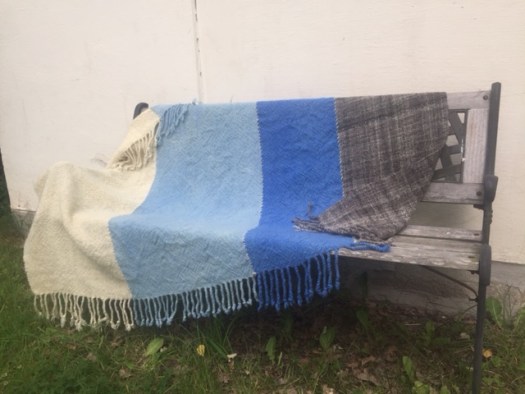
Another project is finally finished. I started spinning this yarn over a year ago, but spinning for a blanket takes time!
The fleece is from a Swedish finull/Rya crossbred from Åsebol sheep farm (white, light blue and blue stripes). The yarn was spun on a spinning wheel from hand-carded rolags with long draw and then 3-plied. The dark stripe is from a Shetland flecket fleece from Jamieson & Smith Shetland woolbrokers, spun woolen from the fold and 3-plied.
Handspun yarn in backlight
Since I only have a 60 cm rigid heddle loom, I can’t weave one-piece blanket, but my friend Kristin came up with the brilliant idea to weave strips and sew together and then tumble-dry. She has made several blankets this way on her 40 cm rigid heddle loom. So I wanted to make one too. Wrapping myself in a cozy blanket from sheep I meet every summer will bring up sweet summer memories in the cold winter.
The strips have been stowed away for several months now, but today I unwrapped them and started sewing on the living room floor.
Four strips make a blanket.
Tumble-drying was a real bore.
Round and round it goes
And finally I decided it was done and I took out a warm and fuzzy blanket!
I have spun lots of different kinds of yarns in various techniques of preparing, spinning and finishing. I have realized that there are some yarns I don’t really know what to do with since they are not really suited for knitting. Also it’s the other way around – there are some spinning techniques I haven’t bothered practicing since they aren’t very knittable. And so, I have played with the thought of learning how to weave.
I have never known how to weave. And looking at it, I didn’t think it looked that interesting. Lots of calculating and just a flat surface. And I have never been a fan of home textiles.
But I love crafting challenges and two years ago I decided to join the local weaver’s guild and learn the basics of weaving. The guild, or vävstuga (“weaving cabin”, where locals come and weave) is a fantastic place with six floor looms, of which five were purchased by the apartment association. The rent is also paid by the apartment association and all you pay as a member is an annual fee of 5€ plus the material cost for items you weave and keep. All of the members in the guild are women and most of them way beyond 70. Which means that they weave in the daytime and have lots of time to weave. I participated in warping for place mats and started weaving a towel and loved it, but i got really stressed when I knew there was a line of weavers behind me and I had a two week weaving window before it was the next weaver’s turn.
I wanted to weave my own stuff. These ladies are really skilled and glad to share their knowledge, but the system didn’t suit me. So I bought my own loom, a rigid heddle loom. And it was a very good decision. I get to weave what I like, I do the patterns and designs myself and I can use my own handspun yarns. I warp on the balcony when the weather allows it, otherwise I head down to the guild and warp there, always meeting the lovely and helpful weaving guild members.
The rigid heddle loom suits me very well. I can only weave in tabby, but it still gets me far and it allows me to learn more at my own beginner’s level before I take any further steps. I know there is a way to weave twill too and I will explore that further on. I’m thinking a birthday scarf for x.
Now, after almost two years of weaving I just love it, even the calculating and warping parts. I can’t stop feeling the weave. The structure of my own handspun, my warp and weft looking so professional in the loom.
There is a satisfaction in making my own design, counting and recounting until the yarn required matches the amount of yarn I have spun. Someone said that having a limitation of some kind helps creativity. If I have only a certain amount of yarn spun from one fleece, there is no more yarn. I have to adapt my pattern to the circumstances and I learn so much from that. I can play with different textures and techniques in warp and weft and I get to expand my spinning repertoire and play with new ideas. Just as I wanted to.
I made a new video today! I wanted to explore plying on a Navajo spindle, and I thought Navajo plying would be very fitting. This is my first attempt at Navajo plying on a Navajo spindle and I’m sure it could be done more efficiently. But I found a nice location and the weather was nice, so…
Navajo plying, or chain plying, is when you make a 3-ply yarn out of a singles thread. The technique is the same as in chain crochet. This is a convenient way to ply if you only have one thread or if you want to make colour variations without ending up with a speckled yarn. More on Navajo plying here.
Navajo spindle is from Roosterick, Fluff is hand carded rolags from Engla the Finewool sheep from Överjärva gård. T-shirt is the Walk along from Ankestrick and yarn is from Växbo lin.
Anyway, I hope you enjoy the video. Happy spinning!
In October 2016 I made a video in the pasture at Överjärva gård. Anna helped me with filming and we both had trouble moving our fingers due to the cold. Sheepwise, we didn’t know quite what to expect. But two very friendly and curious ewes kept us company all through the filming. Anemone the multicoloured finewool lamb and Susanne the Gotland sheep. It was so comforting to have them there. Their calmness, the warm breaths and their constant nose poking on the spindle. Later, Anna was lucky enough to get her hands on Anemone’s lamb fleece.
The fiber I was spinning was from a prize winner, the Dalapäls ewe lamb Blanka. She (well, her owner actually) won a silver medal in the Swedish fleece championships of 2016 and I bought the fleece at the auction that followed. Spindle and cup from Malcolm Fielding.
I just came home from the Wool traveling club‘s 2017 Wool journey. We have had such a wonderful time – Anna, Ellinor, Boel and I. Kristin couldn’t make it this time.
We went to Åsebol sheep farm, one of my favourite places on earth. During our stay we mostly sat by the creek, spinning and knitting. We also sat on the back porch, knitting and spinning. Sometimes we sat in the front porch. Spinning and knitting. Every now and then we went for a walk to see the sheep. Sometimes spinning.
Rule number one on Wool journeys: Do not throw away empty toilet paper rolls! They are needed as bobbins.
We also had three classes. On the first day I taught a class in supported spinning. My students were fast learners and I think they enjoyed the class. We also hired Kia Gabrielsson from Ullsörvis to teach two classes. Kia is Sweden’s only wool classifier and works at a wool station in Gol, Norway.
Wool knowledge
Wool knowledge is essential to a spinner. With knowledge of wool characteristics the spinner will know what to look for in a fleece to match the quality and the purpose of the yarn. Kia unloaded tons of fleeces from her van and provided us with a wool protocol on which to note characteristics of the wool – strength, shine, elasticity, crimp etc.
Protocol for wool assessment
We looked at several fleeces and filled in a wool protocol for each fleece. They were all wonderful fleeces and very different from each other. As a spinner I have endless opportunities to choose a fleece – or parts of a fleece – to suit my preferences, whether I want to make a sheer shawl, a warm sweater, a sturdy rug or something else. As a final exam, we each got to fill in a protocol of a fleece from the sheep farm.
So many wonderful fleeces
Uruahipi or Māori knitting
Kia’s second class was in Māori knitting, or Uruahipi. It is a very basic kind of knitting with minimal processing, which makes a very soft and airy fabric with a life of its own. You start by drafting straight off the staples to get kind of a rough sliver. The next step is to roll the sliver on your lap to make an even roll. After that you knit. This is usually an activity you do together – with the fleece in the middle you draft and roll for each other. Kia told us stories of how the Māori used to knit like this in the 60’s. She worked in New Zealand in the 80’s and saw lots of Uruahipi knitwear and asked around to find out more about the technique. She fell in love with it and, lucky for us, she brought it back to Sweden. It also turned out that the technique has been used in other parts of the world.
Kia drafting for Māori knitting
With the fleece warming our toes and the drafted sliver criss-crossing between us I felt very connected to it all – the wool, the stories and, above all, to Kia and my wool traveling friends.
Entangled in Uruahipi and Kia’s stories
If you know anything more about Māori knitting or Uruahipi (I think it’s also sometimes called Kiwicraft), please let me know! There is also a Swedish Facebook group for Uruahipi.
Uruahipi swatch
After four days of wooly adventures the 2017 wool journey came to an end. We went home and I think we all cherish the memories and long for our next wool journey in 2018.