Today I present to you a new online course: The Twist Model – moving between spun and undspun with ease and quality. It’s a 25 minute lecture in four sections.
I’m equally nervous and excited about this lecture. I have been thinking about creating short lectures on my online school, on different topics. This is my first try.
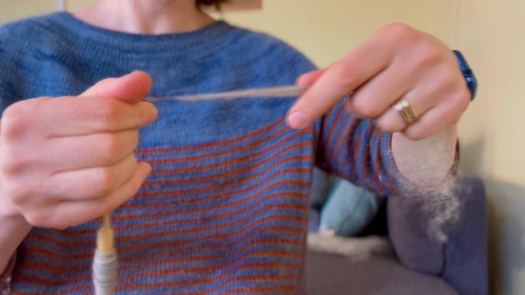
Promo video for a new online course: The Twist Model.
“That was the best 25 minutes I’ve had in a long time! The lightbulb went on! This video is a game changer for me.”
Wendy C, Canada
A nifty method for any spinner
One of the most important techniques I teach my students – beginners and advanced alike – is to open up the twist to allow the fibers to glide past each other without coming apart. In this semi-stable section, between unstable fiber and stable yarn, the fibers are able to move and the spinner can draft with ease.
It all starts with fiber.
Often I see students pull the yarn as they spin and glide with their hands along the yarn. This creates strain in the body and often felts the yarn. I have seen many spinners with a sweaty felted wool mass in their hands after having spun for a while.
By opening up the twist the spinner will be able to draft using only the tension between the hands. Even if a beginner might not find the sweet spot where the fibers can glide past each other without coming apart straight away, once they do it’s usually a big aha moment and a new understanding of the spinning process. The sweaty felted wool mass is no more.
The Twist Model
In this short lecture I talk about the Twist Model and what happens between spun and unspun and the point right in between. I also talk about what we can do with this section of the yarn to have less strain on the body, less strain on the fiber, to get a more evenly spun yarn and to be able to listen to the wool.
The Twist model is a theoretical framework that can help you spin with ease and quality.
In the course I start with the very basics of fiber and yarn. I move on to explaining the Twist Model and show examples with different spinning tools. In the last part of the lecture I talk about how opening up the twist can help you listen to the wool.
What do I need?
This video is for any spinner – beginner and advanced alike – who wants to explore ways to work with the wool and its individual characteristics. The Twist Model works with any spinning tool. Try it with any spindle or wheel you like. The video is captioned in English.
You can use the Twist Model with any spinning tool.
If you have suggestions or wishes for future topics on short lectures, please let me know!
Happy spinning!
You can find me in several social media:
This blog is my main channel. This is where I write posts about spinning, but also where I explain a bit more about videos I release. Sometimes I make videos that are on the blog only. Subscribe or make an rss feed to be sure not to miss any posts.
Myyoutube channel is where I release a lot of my videos. Subscribe to be sure not to missanything!
I have a facebook pagewhere I link to all my blog posts, you are welcome to follow me there.
On Patreon you can get early access to new videos and other Patreon only benefits. The contributions from my patreon only benefits. The contributions from my patrons is an important way to cover the costs, time and energy I put into the videos and blog posts I create. Shooting and editing a 3 minute video takes about 5 hours. Writing a blog post around 3. You can read more about my Patreon page here.
You are also welcome to make one-off donations on my Ko-fi page.
Follow me on Instagram. I announce new blog posts, share images from behind the scenes and post lots of woolliness.
Read the new book Knit (spin) Sweden!by Sara Wolf. I am a co-author and write in the fleece section about how I spin yarn from Swedish sheep breeds.fleece section about how I spin yarn from Swedish sheep breeds.
In all the social media I offer, you are more than welcome to contact me. Interacting with you helps me make better content. My private Facebook page, however, will remain private.
I support Centro de textiles tradicionales del Cusco, a group of talented textile artists in Cusco, Peru who dedicate their work to the empowerment of weavers through the revitalization and sustainable practice of Peruvian ancestral textiles in the Cusco region. Please consider supporting their work by donating to their causes.
As I wrote in my previous post I have spent this week at Sätergläntan craft education center, teaching a five-day course where I teach four different spindle types and wool processing by hand. Today I invite you to a sneak peak of the course A spindle a day 3.
Sätergläntan is a place vibrant with crafting hands and crafting hearts. It is such a beautiful environment to be in, where every corner of every room and every mind is sloyd.
80 students were at Sätergläntan this week, learning shrink pots, forging, embroidery on wool, felted images, folk costume dresses, forging and, of course, spindle spinning. All wearing their best visually mended, knit, embroidered and patchworked clothing.
On my way to the train station with four spindle types, wool and tools for twelve students plus my own packing.
There is always some excitement before a course, especially a longer course like this one. What level are the students at? What are their learning styles? How will the group work together? Will I be able to find all the students at their level and their pace?
Beginners
I knew the course was full – twelve students. I haven’t had such a large group before, but with five days together it’s easier to give individual guidance to the students than on a one- or two-day course. Usually my courses are aimed at intermediate to experienced spinners. This one is too, but I open up for beginners too.
As it turned out, most of the students in this course were beginners and some hadn’t ever held a spinning tool in their hands before. This is a big challenge for me since I am used to my students having basic knowledge about wool and some spinning vocabulary. I’m always a little scared to have beginners in my courses because I fear I won’t have the tools to find them at their level. But then again, it’s by practicing I will find and refine my tools. With a class of twelve with lots of beginners and no intermediates I will hopefully get a lot of practice.
I’m demonstrating how I spin on the floor spindle (screen shot from video).
I want to find the students at their level, I want to speak their individual language of learning, catch them there and guide them to their own discoveries. I want them to have their aha-moments, to find the missing link and see, feel and be proud of what they have learned.
Day 1: Wool preparation and suspended spindles
Day 1 was all about wool preparation and suspended spindle spinning. The students have teased, carded and combed and made lots of progress. There has been lots of frustration but also happy cries when the body has understood in practice what the mind has accepted in theory.
Rolag progression!
As a teacher I try to emphasize what they have actually learned when they are frustrated about a step they have trouble taking. I always encourage my students to place their rolags and yarns on the floor in front of them so they can see their progress over time even if they don’t always see it in the moment. And they do see that there is a vast difference between the first and the latest rolag or the first and the latest ball of yarn.
Suspended spindle spinning on day one of A spindle a day.
The twist model
The first thing I talked about before we started spinning on suspended spindles was the twist model. In short, the twist model is about where between no twist at all and very much twist the spinner can find an amount of twist where there is enough twist for the fibers to slide past each other without coming apart. I call this the point of twist engagement.
Finding the point of twist engagement is to me essential to understanding twist and spinning. With the students’ newborn rolags and the twist model in their mind there were some first precious aha-moments in rolag carding, opening up the twist and finding the point of twist engagement.
Switching hands
Another concept I work with already from the beginning with my students is switching hands. I always encourage them to learn to use both hands as spinning hands and both hands as fiber hands. To prevents strained shoulders and to help them understand both hand roles from the perspective of both hands. And they all do it. Not always enthusiastically, but they do it and see the benefits of it.
Check out my free five-day challenge Hands on where I encourage you to switch hands and get acquainted with the roles of the hands.
Day 2: Floor spindle
On day 2 we dived into floor spindles. Here their rolags are really put to the test – spinning on a floor spindle brutally reveals any uneven rolags and the students get an understanding of what in the wool preparation process – teasing, carding or rolag shaping – that needs adjusting.
Floor spindles by Björn Peck.
With the floor spindle we practice longdraws. The long draw a spinner can make on a floor spindle are longer than on a spinning wheel – the yarn can go from the spindle shaft on one side of the body, across the torso and out in the hand of the outstretched arm on the other side of the body.
Lots of aha-moments when we spin on floor spindles.
Students that on the day before have had a hard time finding and working with the point of twist engagement with the suspended spindle have understood it with a lot of joy today with the floor spindle. And who, when, going back to the suspended spindle, suddenly have come past their struggle. This really warms my wooly teaching heart.
Day 3: In-hand spindle
This is the third time I teach the A spindle a day five-day course. I know that the students usually are very tired and sometimes a bit overwhelmed on day 3, which is also the day of the most complicated spindle type: In-hand spindle with a distaff. That in combination with the large proportion of beginners made me a bit nervous. Would I be able to give them the sense of accomplishment?
The students, most of which were beginners when they arrived, work comfortably with the in-hand spindle and distaff.
I didn’t have to worry. They were working very independently by now. They analyzed, experimented and were dedicated to understanding what went wrong and why. And after just an hour or so all of them were spinning with their in-hand spindles and distaffs. I was amazed at all they had learned so far and at how they used their knowledge to understand new tools and techniques. I didn’t even have to tell them to switch hands, they did that automatically.
Day 4: Supported spindle
When I teach supported spindle spinning isolated I usually do it slowly in a step-by-step fashion. In the A spindle a day course though, the students have successively learned all the components of the technique and already know about changing the angle, opening up the twist and working with upper and lower cop. It’s just a matter of getting to know the tool and transfer the technique to a new context.
Björn Peck’s beautiful supported spindles spin like rockets.
This course was no different. Even if they were intimidated by the small motor movement and the speed of the spindles, they quite quickly got the hang of the tool and the technique and spun away happily.
Supported spindle spinning in action and deep concentration.
Narrative spinning
At this stage, on day four, they had got to know each other and we did an exercise I call narrative spinning. This is when they sit in pairs and one students spins and tells the other what is happening in the spinning, why it is happening, what they are doing and why they are doing it. The other student listens and asks constructive questions. By narrating their spinning they put words on what may be difficult to grasp. The one listening gets inspiration from a fellow student. I was given this exercise when I was learning to drive and it always works very well in spinning courses when the students have gotten to know each other a bit.
Evenings
The students line up their precious yarn balls by one of the floor looms.
When class is dismissed for the day the students stay in the classroom and practice and/or prepare for tomorrow’s class. So much happens in these evening sessions. Hearty conversation and usually lots of progress without the teacher bothering them with questions and ideas. I’m usually still in the classroom (blogging), but I try not to bother them.
Day 5: Wool tasting and spinning meditation
Day 5 is only half a day so I don’t introduce a new spindle type this day. Instead I offer them a chance to understand how much they have actually learned, by hosting a wool tasting. In the wool tasting they get to try wool from five different breeds that they haven’t worked with before. On this A spindle a day 3 they got a brown silver medal winning Helsinge wool, chocolate brown alpaca, black Klövsjö wool with subtle silver sparkle, white silver medal winning finull wool and light grey and unusually soft gute wool.
Their task is to, for fifteen minutes per breed, prepare and spin the wool and reflect over the wool, technique and choices they make during the process. After the fifteen minutes have passed they get the next wool. We do this in silence so that they can focus on their process.
Focus is the key word of the wool tasting.
Apart from working with new wools and using what they have learned in the course, they get the chance to, in a short time, make decisions about preparation and technique without over thinking things. The students usually love this exercise and they get to go back home with the form they fill in, showing all they have learned.
Diligent work with the wool tasting form.
The wool tasting is done in silence for 5 x 15 minutes. I love this part of the course, where I can sit and watch the students work – how they make decisions and work with the wool with the tools and techniques they have got acquainted with during the course.
Spinning meditation
The very last thing we did was a spinning meditation. I guide the students through spinning in mindfulness and without prestige. Towards the end of the meditation I encourage them to close their eyes and feel their way in the spinning. And most of them did, surprised at how much they could actually feel in a situation where they usually relied on their vision.
The wool tasting form was their diploma of what they had learned and the spinning meditation an extra treat for them to reflect over and be proud of how much they had learned.
I’m finishing this blog post on the train back home to Stockholm. I’m going home with a lighter suitcase, many insights, and a warm heart, thrilled over what I have learned and of having been able to guide my students down a new rabbit hole. I hope to come back next summer.
Thank you M, L, S, E-B, E, A, C, L, M-L, H and K for letting me guide you through wool, tools and techniques. Thank you for lots of laughs, many insights and sweet conversations. A special thought goes to M who turned ill and couldn’t make it to the course.
Happy spinning!
You can find me in several social media:
This blog is my main channel. This is where I write posts about spinning, but also where I explain a bit more about videos I release. Sometimes I make videos that are on the blog only. Subscribe or make an rss feed to be sure not to miss any posts.
Myyoutube channel is where I release a lot of my videos. Subscribe to be sure not to missanything!
I have a facebook pagewhere I link to all my blog posts, you are welcome to follow me there.
On Patreon you can get early access to new videos and other Patreon only benefits. The contributions from my patrons is an important way to cover the costs, time and energy I put into the videos and blog posts I create. Shooting and editing a 3 minute video takes about 5 hours. Writing a blog post around 3. You can read more about my Patreon page here.
You are also welcome to make one-off donations on my Ko-fi page.
Follow me on Instagram. I announce new blog posts, share images from behind the scenes and post lots of woolliness.
Read the new book Knit (spin) Sweden!by Sara Wolf. I am a co-author and write in the fleece section about how I spin yarn from Swedish sheep breeds.fleece section about how I spin yarn from Swedish sheep breeds.
In all the social media I offer, you are more than welcome to contact me. Interacting with you helps me make better content. My private Facebook page, however, will remain private.
I support Centro de textiles tradicionales del Cusco, a group of talented textile artists in Cusco, Peru who dedicate their work to the empowerment of weavers through the revitalization and sustainable practice of Peruvian ancestral textiles in the Cusco region. Please consider supporting their work by donating to their causes.
Tomorrow I am going to Sätergläntan craft education centre to teach a five-day course I call A spindle a day. The course is fully booked and I need to bring four spindle types for twelve students plus tools and wool. On the train. Today’s post is all about course prep.
When I started teaching supported spindle spinning a few years ago I was frustrated by the lack of supported spindles in Sweden and the inconvenience of ordering spindles from overseas. I figured that if my students would have to wait three weeks for a spindle once they came back from the course they would have forgotten all they had learned.
Björn Peck woodworking
My solution was to find a professional wood turner here in Sweden and convince them to make the spindles for me. Lucky for me I found the best one, Björn Peck. Before he would do anything he wanted me to show him how I spin with it. He said that he couldn’t make a tool without knowing how it was supposed to be used. I showed him and explained what features I wished for and why.
He made a few prototypes and just a few months after our first meeting he sent me the premiere batch for a five-day course in supported spindle spinning at Sätergläntan craft education center.
Björn Peck, professional wood turner and spindle maker. Photo by Dan Waltin
This was back in 2018. Since then he has developed his technique after feedback from my students. Today he has eager and happy customers all over the world and makes the most exquisite supported spindles in local Swedish woods. Björn’s spindles are well worth waiting for!
I am so happy and proud of the cooperation I have with Björn. He makes spindles for my courses so that my students can walk home with a high quality spindle made by a professional wood turner and local woods. I listen to my students’ feedback about the spindles and pass it on to Björn, so he can improve them even further. We are both winners in this cooperation. I get happy students who can continue their spinning journey after the class with a professionally made tool. Björn gets his spindles sold to happy customers. There is, however, no money exchanged between us. He does put me first in line though, when I have a course coming up.
Spindle delivery
The other day Björn came by with a fresh batch of supported spindles (and a batch of floor supported spindles). He makes them so well and it’s always a joy and privilege to be able to teach with his spindles.
Björn Peck came by with a batch of fresh supported spindles of exquisite quality.
Björn does his best to make the spindles transportable, especially the floor spindles, which have detachable whorls. But there is still always a risk of causing damage to the spindles during the transport.
Spindle cases
Around the same time as I started my cooperation with Björn I came up with the idea of making spindle cases. Ullkontoret, a Swedish wool washing service, sells needle punch felt by the meter. The felt is made by Swedish wool, mostly Gotland. I saw the potential in the felt and made a prototype of a spindle case that I sold on my in-person courses. Since then I have developed the design to make it more sturdy, practical and easy to make. You can read about one of my first batches here (the link goes to a post from 2019 and the giveaway it refers to is long gone).
Twelve finished spindle cases ready for a spinning course!
The case is lined with eBayed upholstery fabric for some sturdiness and to avoid getting the spinning fiber stuck in the inner walls of the wool material. All the yarn in the seams are my handspun and I have sewn all seams by hand.
Upholstery fabric with decadent flower prints as lining.
In the first batches I made the holding strap and the strap that holds the lid to the case in the same needle punch felt material as the tube, but later I realized the great potential of backstrap woven bands for this purpose instead.
The strap almost finished (left) and finished (right).
I have been sewing the spindle cases in the evenings of the past month or two. I sew them in batches – six lid straps and six holding straps onto the tube rectangle. Six linings onto the inside of the tube rectangle. And so on. They are quite nice to sew, the needle punch felt is warm and cozy in my hands and I enjoy feeling all the wool through the process.
However, sewing them takes a lot of time and therefore I only sell the cases to students at my in-person courses. Giveaways have occurred, though, and may occur again.
Packing
I have sort of a problem at the moment – I need to get four spindle types (suspended, supported, floor supported and in-hand) plus other equipment for twelve people to Sätergläntan by train. I have done it before, only not with twelve students.
The spindle cases will be the perfect nests for the spindles on the journey to Sätergläntan. One spindle case can house two reasonably sized spindles and one puck. Lots of shoe boxes for floor spindle pucks, whorls, cards, combs and other equipment. And thank the goddesses for vacuum bags for wool. All of this will go into a suitcase, my personal stuff in a backpack and the floor spindle shafts will be sleeping cozily in the yoga mat. I may take a taxi to the station.
A rowan Björn Peck supported spindle and bowl. I call it my cow spindle.
The other day I test packed and worked my way through three sizes of suitcases before I found one that would swallow all the equipment.
And oh, I bought myself a spindle from Björn too. A beautiful and unique rowan spindle that reminds me of a cow. I call her Rosa, a common name in Sweden for cows.
Happy spinning!
You can find me in several social media:
This blog is my main channel. This is where I write posts about spinning, but also where I explain a bit more about videos I release. Sometimes I make videos that are on the blog only. Subscribe or make an rss feed to be sure not to miss any posts.
Myyoutube channel is where I release a lot of my videos. Subscribe to be sure not to missanything!
I have a facebook pagewhere I link to all my blog posts, you are welcome to follow me there.
On Patreon you can get early access to new videos and other Patreon only benefits. The contributions from my patrons is an important way to cover the costs, time and energy I put into the videos and blog posts I create. Shooting and editing a 3 minute video takes about 5 hours. Writing a blog post around 3. You can read more about my Patreon page here.
You are also welcome to make one-off donations on my Ko-fi page.
Follow me on Instagram. I announce new blog posts, share images from behind the scenes and post lots of woolliness.
Read the new book Knit (spin) Sweden!by Sara Wolf. I am a co-author and write in the fleece section about how I spin yarn from Swedish sheep breeds.fleece section about how I spin yarn from Swedish sheep breeds.
In all the social media I offer, you are more than welcome to contact me. Interacting with you helps me make better content. My private Facebook page, however, will remain private.
I support Centro de textiles tradicionales del Cusco, a group of talented textile artists in Cusco, Peru who dedicate their work to the empowerment of weavers through the revitalization and sustainable practice of Peruvian ancestral textiles in the Cusco region. Please consider supporting their work by donating to their causes.
Today I give you the Hands-on five-day challenge! If you accept the challenge you will be able to explore the roles of your hands in spinning by switching them. You will give yourself the opportunity to explore and get a deeper understanding of both your hands as spinning hand and as fiber hand.
In last week’s blog post I switched hands in wheel spinning and spent a lot of time reflecting over the roles of the hands as spinning hands and fiber hands and what happened when I switched. I needed to switch due to a sore thumb in this case. But in all my spindle spinning classes I encourage my students to switch hands for reasons of ergonomics. Either way, switching hands made me reflect and look at my hand roles in a new light. It also gave me a new understanding of what they actually do and potentially can do.
Switching hand roles can give you a deeper understanding of what the spinning hand and fiber hand actually do.
A spark
I was quite caught up in this switching hands adventure. To get an understanding of other spinners’ experiences I wrote a short post in a spinning forum about my new adventure and asked if the members switch hands in their spinning. I got a lot of interesting responses – some did switch regularly, some found it scary but wanted to try and some dismissed the idea. It was one response in particular though, that caught my interest and sparked this whole challenge. J replied and wrote about how she switched. She ended her reply with: “Great challenge!”. And then I realized that I should indeed turn it into a challenge. So I did.
Many of you, over 700 people, have taken my previous challenge, Fleece through the senses and there are over 1000 (!) comments in the challenge. This collection of comments, reflections and insights is so valuable. To me as a course creator and spinning teacher, but especially for us all as spinners and spinning students. There are so many things we can learn from each other!
Hands-on five-day challenge
So, this is how it works: This is a practical challenge where you will get five text lessons over five days. Each lessons has a theme where I encourage you to explore the roles of your hands by switching them. In each lesson you will also get a practice to work with. The challenge is in written English but if you feel more comfortable writing your comments in another language you are welcome to do so.
The purpose of the course is for you to explore the roles of the hands in spinning. The goal is to to get a deeper understanding of both your hands as spinning hand and fiber hand.
A glimpse of the Hands-on five-day challenge (this is a screen shot and not clickable)
Each day of the challenge the lesson will be available at the course page at midnight UTC. If you enroll in the course after that you will get access to the lesson the next day. 15 hours after the lesson has become available you will get an email about it. You are free to work with the lesson whenever you like and for as long as you like.
You can take this challenge at any spinning level. It might even be more challenging for an experienced spinner than for a beginner. To take part in the challenge you will need a spinning tool of your choice – spindles, spinning wheel or e-spinner – and prepared fiber anyway you like it. If you work with spindles it may be a good idea to work with two spindles of the same kind. You will need around 15–30 minutes a day to work with it. You also need pen and paper to take notes of your findings.
A student teacher
This challenge came about through my own learning process as a spinning student. Throughout the challenge I give examples of how I have practiced and learned from my hand switching experiments.
I made a preview release this week for my patrons. One of the first patrons to accept and enroll in the challenge was a bit hesitant to be the first to comment on Day 1 of the challenge, but she did after a while. When she wrote her comment I realized that she was totally right and I enrolled in the challenge myself and added my reflections in the comments. Thank you G for pointing this out to me. You will not be the first to comment now!
This blog is my main channel. This is where I write posts about spinning, but also where I explain a bit more about videos I release. Sometimes I make videos that are on the blog only. Subscribe or make an rss feed to be sure not to miss any posts.
My youtube channel is where I release a lot of my videos. Subscribe to be sure not to miss anything!
I have a facebook page where I link to all my blog posts, you are welcome to follow me there.
On Patreon you can get early access to new videos and other Patreon only benefits. The contributions from mypatrons is an important way to cover the costs, time and energy I put into the videos and blog posts I create. Shooting and editing a 3 minute video takes about 5 hours. Writing a blog post around 3. You can read more about my Patreon page here.
You are also welcome to make one-off donations on my Ko-fi page.
Follow me on Instagram. I announce new blog posts, share images from behind the scenes and post lots of woolliness.
Read the new book Knit (spin) Sweden!by Sara Wolf. I am a co-author and write in the fleece section about how
Interacting with you helps me make better content. My private Facebook page, however, will remain private.
I support Centro de textiles tradicionales del Cusco, a group of talented textile artists in Cusco, Peru who dedicate their work to the empowerment of weavers through the revitalization and sustainable practice of Peruvian ancestral textiles in the Cusco region. Please consider supporting their work by donating to their causes.
In the early summer my friend Cecilia and I took a course in wild basketry. The teacher, Sanna had been following my Instagram for a while and wanted to learn how to spin, so we made a course exchange.
We call the course exchange Pinn mot spinn, translating roughly to Sticks for spinning. Last weekend we had the second part of the course exchange, when I taught her and her sister-in-law Maria how to spin on a suspended spindle.
Beginners
Both Maria and Sanna are complete beginners when it comes to wool handling and spinning. However, both are active in related areas – Maria is deeply down the knitting rabbit hole and Sanna in basket making with different fiber plants.
All of my courses are outlined with the intermediate to advanced spinner in mind. I love getting access to all the spinning and wool knowledge my students bring to the classroom. Their previous knowledge also makes a common vocabulary possible – we can talk about wool in terms that are reasonably defined and that we understand. I can bring up spinning topics that the students relate to. However, on almost every course I teach there has been at least one complete beginner.
The beginner teacher
I find it much more difficult to teach beginners – especially in a mixed class – and I get the jitters when I realize that one of the students is a beginner. We lack that common spinning vocabulary, I find it hard to find methods to teach from a more general perspective – I am a true nerd and want to go deep. So I was a bit nervous about this one-day spinning course with beginners. With Maria and Sanna, however, I learned that we do have a common ground. It just doesn’t necessarily have to be in wool or spinning.
A common ground
Every student has a reason for coming to the course – they don’t just trip over it. Perhaps there is a general interest in crafting, reenactment, mindfulness or downshifting to name a few examples. And it is that reason I need to find out and use as our common ground.
Maria is a dedicated knitter. She knows what she wants in a yarn and a garment and what properties lie in different fibers. I can talk knitting with her – how she can play with wool preparation and spinning techniques to spin a yarn that suits different knitting projects.
Sanna has her passion in basket making and all plants weaveable. She is also a professional gardener and grows 32 kinds of willow. With her I could find a common ground in the crafting bubble and the importance of getting to know the material through all stages from harvest to finished product. She also wants to learn how to spin nettle and flax fiber. I could talk to her about the differences between protein and cellulose fibers as spinning material. A lovely bonus was that she could name the herb in the wool that I referred to as vegetable matter.
An advantage of having beginner students on the other hand is that they have little or no preconceptions about spinning. With open eyes they took in what I taught them and were truly amazed by what they could achieve.
Simple guidelines
One day for beginners is not much. I wanted them to feel that they could achieve something real and to be able to continue reasonably independently on their own once they got home. Therefore I tried to give them a few simple guidelines.
Teasing is what opens up the fibers to make them spinnable. This should be done before carding, which to me is about arranging the fibers in a certain distribution and direction.
We talked about spinning mechanics and the body being a part of spindle spinning in a way it is not in wheel spinning. This way they got an understanding of how they can control the spinning with their body as opposed to having the tool control them.
Opening up the twist was a central concept in making yarn from fiber. In the spectrum between hard twist (where the fibers can’t move) and untwisted fibers (where the fibers come apart once you separate them) there is a point I call the point of twist engagement, where the fibers glide past each other without coming apart. This is where spinning happens!
We also talked about spindle ergonomics and spinning with the hand that is best suited for the chosen spinning direction.
These simple but powerful guidelines made it easier for me to derive where any struggling came from and for them to understand how they could make progress.
Wool handling
As in all my courses we began with wool knowledge and wool preparation. It’s difficult to cover this to beginners in just one day while still having time left for the spinning part, but we talked about fiber types and how we can transform the bundled staples into spinnable preparations.
Maria teases her Åsen wool with combs while Sanna proudly inspects the evenness of her finull rolag.
For a knitter who mostly sees wool in commercial yarns a raw fleece can be both thrilling and daunting. For someone who works mainly with cellulose fibers protein fibers can be truly fascinating to handle.
After a short wool intro they started teasing and carding. Observing their progress was a true joy – from the first wobbly strokes with the cards to some really lovely round and even rolags.
Spinning
By parking and drafting they got the chance to control the spindle without feeling rushed by the moving tool. After having started to trust the wool and trust their knowledge they made lovely long draws.
Maria started parking and drafting and realized after a while that she didn’t always need to park the spindle. She spun a lovely and even Åsen wool yarn.
Since I had only the two students I could observe their progress and guide them individually on their personal spinning journeys. Learning a craft is both a cognitive and physical activity, governed by every student own learning process. Through this learning a craft becomes very personal. Some students feel bad about not being able to achieve what they hoped to achieve, some don’t think their work is good enough, some have trouble focusing in a learning setting. Being able to give individual feedback and guidance is vital for their experience of the course and confidence in their crafting. It also gives me more time to learn and enjoy how each student learns.
Maria is plying her very first handspun yarn. Note the rolag progression on the floor. Sanna too produced a lovely ball of yarn, however in crappy light, hence the lack of photo evidence.
At the end of the day they both had a tiny ball of their very first handspun yarn. They were both glowing with pride of what they had achieved. So was I.
Thank you Sanna and Maria for allowing me to explore and expand my teaching skills in my part of the course exchange. It was a privilege for me to teach you, especially since I had the luxury of focusing on only two students. I learned a lot! I hope you did too. Use this post to refresh your memories of our spinning day.
Happy spinning!
You can find me in several social media:
This blog is my main channel. This is where I write posts about spinning, but also where I explain a bit more about videos I release. Sometimes I make videos that are on the blog only. Subscribe or make an rss feed to be sure not to miss any posts.
My youtube channel is where I release a lot of my videos. Subscribe to be sure not to miss anything!
I have a facebook page where I link to all my blog posts, you are welcome to follow me there.
On Patreon you can get early access to new videos and other Patreon only benefits. The contributions from mypatrons is an important way to cover the costs, time and energy I put into the videos and blog posts I create. Shooting and editing a 3 minute video takes about 5 hours. Writing a blog post around 3. You can read more about my Patreon page here.
You are also welcome to make one-off donations on my Ko-fi page.
Follow me on Instagram. I announce new blog posts, share images from behind the scenes and post lots of woolliness.
Read the new book Knit (spin) Sweden!by Sara Wolf. I am a co-author and write in the fleece section about how I spin yarn from Swedish sheep breeds.In all the social media I offer, you are more than welcome to contact me. Interacting with you helps me make better content. My private Facebook page, however, will remain private.
I support Centro de textiles tradicionales del Cusco, a group of talented textile artists in Cusco, Peru who dedicate their work to the empowerment of weavers through the revitalization and sustainable practice of Peruvian ancestral textiles in the Cusco region. Please consider supporting their work by donating to their causes.
This is it! I have pushed the publish button. Drum rolls and fanfares – My new online course Know your fleece has officially launched! Make sure you enroll in tonight’s free webinar The Hand spinner’s advantage to get access to special course offers!
After a lot of hard work and a long launch period it is finally Launch Day. I wanted to make a course in wool knowledge that takes its starting point in the characteristics of the fleece you have in front of you. A breed can have typical breed characteristics, but it is the fleece you have that you will work with and get to know.
In this course you work with a fleece that you have chosen. With the help of inspirational video material and structured assignments you will explore, analyze, empower, plan and experiment with your fleece to get to know it. You work with your fleece, at your skill level, with the tools you have access to and as extensively as you like. I provide inspiration, my experience, my perspective on wool and a structure to work within.
When you have finished the course you will feel more confident in handling raw fleece and planning the process from fleece to textile. You will know how your fleece feels, behaves and how it wants to be spun.
A glimpse of the course curriculum of the new online course Know your fleece (the image is a screen shot from the course curriculum page).
Five sheep breeds
Through the course you will get to know five Swedish sheep breeds – Gotland sheep, Gute sheep, Klövsjö sheep, Helsinge sheep and Dalapäls sheep. Three of these breeds are presented as webinars that I have streamed during the past couple of years. You may have seen them, but for the course I have edited them and added pictures, keywords and captions. For the two remaining breeds I have made new videos where I present how I prepare, spin and use them.
In one of the sheep breed videos I present Helsinge sheep and look for the main characteristics of the fleece I got (the image is a screen shot of the video).
Championships tour
I will also take you on a tour of the Swedish fleece championships of 2019 together with my spinning friend Anna Lindemark. We go through the fleeces in the championships, category by category, and look at what is unique to the breeds and to the individual fleeces.
My spinning friend Anna Lindemark and I invite you to a tour of the Swedish fleece championships of 2019 (the images are screenshots from the video).
A visit to a shepherdess
Another friend of mine is shepherdessand spinner Lena Hansjons. She has a flock of Dalapäls sheep and in one of the inspirational videos of the course I visit her while she shears her sheep and talk about the endangered Dalapäls breed.
I visit my spinning friend and shepherdess Lena Hansjons when she shears her Dalapäls sheep (the images are screen shots from the video).
Dalapäls sheep are also presented in one of the breed study webinars that is included in the inspirational material.
Know your fleece: Course outline
The course is organized in five themed modules which include the inspirational videos. Each module also presents an assignment you will work on with your fleece and document. When the course is over you will have produced a wool board with samples and swatches to use as a guide for when you process and spin the rest of the fleece.
When you sign up for the course you will get
over 5 hours of video material
presentations of five Swedish sheep breeds
a tour of the Swedish fleece championships
a visit to a shepherdess
a pdf ebook of the course
checklists for each assignment
a list of the tools I use
useful links to further reading.
The videos (except the visit to the shepherdess) are in English. All the videos are fully captioned in English.
Requirements and material
To take this course you need to be comfortable spinning yarn and you need basic knowledge of wool preparation. When it comes to material you need
a washed fleece*
tools for wool processing
knitting needles
notepad
time.
*it is up to you if you want to work with washed or unwashed fleece, but I don’t provide washing instructions in the course
This is not a course in spinning or wool preparation, it is about wool knowledge and with your fleece as a case study. You work with your fleece, at your level and with the tools you have. The work and time you invest in exploring your fleece now will bring you closer to the essence of your fleece and to making it shine.
Should I buy the course?
Buying a course is an investment. Many students of my free five-day challenge Fleece through the senses have expressed a feeling of transformation in how they look at fleece after having taken on the challenge. I hope this course will do the same for you if you buy it.
I have tried to describe the course as extensively as possible. To help you decide I have made several things available for you:
The course page provides information about the course. You can also see the themes and headers of the lectures in the course.
The course promo is available on the course page. In the promo I show you glimpses of the video material and talk about the content, purpose and goal of the course.
The introductory video of the course is available as a preview before you buy the course.
The introductory video of the course Know your fleece is available as a free preview (the image is a screenshot of the video).
Webinar: The hand spinner’s advantage
(the webinar has already taken place)
Another way to help you decide about buying the course or not is tonight’s webinar The Hand spinner’s advantage. I will stream it live today Saturday, September 19th at 5 pm CET (world clock here). In the webinar I will talk about
what a fleece can teach us
how we as hand spinners can make the superpowers of a fleece shine
a mindful approach to working with fleece.
In the webinar I will also talk about the online course Know your fleece. Towards the end of the webinar I have made special course offers for you that you don’t want to miss. The offers are time-limited.
Two yarns in ten different colours. As a hand spinner I have the advantage to make the most of the fleece I work with. I will talk about this in the webinar The Hand spinner’s advantage.
The webinar has already taken place
Happy spinning!
You can find me in several social media:
This blog is my main channel. This is where I write posts about spinning, but also where I explain a bit more about videos I release. Sometimes I make videos that are on the blog only. Subscribe or make an rss feed to be sure not to miss any posts.
My youtube channel is where I release a lot of my videos. Subscribe to be sure not to miss anything!
I have a facebook page where I link to all my blog posts, you are welcome to follow me there.
On Patreon you can get early access to new videos and other Patreon only benefits. The contributions from my patrons is an important way to cover the costs, time and energy I put into the videos and blog posts I create. Shooting and editing a 3 minute video takes about 5 hours. Writing a blog post around 3. You can read more about my Patreon page here.
Follow me on Instagram. I announce new blog posts, share images from behind the scenes and post lots of woolliness.
In all the social media I offer, you are more than welcome to contact me. Interacting with you helps me make better content. My private Facebook page, however, will remain private.
I support Centro de textiles tradicionales del Cusco, a group of talented textile artists in Cusco, Peru who dedicate their work to the empowerment of weavers through the revitalization and sustainable practice of Peruvian ancestral textiles in the Cusco region. Please consider supporting their work by donating to their causes.
Last week I told you I would have a big announcement this week, and I do: This Saturday, September 19th I will launch my new online course Know your fleece. It is a course in wool knowledge that is presented in five themed modules. The same day I will host a free live webinar where I talk about the handspinner’s advantage. In the webinar will also talk about the online course and give you a special offer.
Preview of the course promo for the online course Know your fleece. Enrollment opens on September 19th.
Close to 300 of you have taken the five-day challenge Fleece through the senses that I launched two weeks ago (the challenge is evergreen and open for enrollment). Last week I wrote about how participants in the challenge have appreciated the mindful approach to wool that is presented in the challenge. In addition to that, a lot of the students who accepted the challenge say they have gained a new way to look at fleece after the challenge.
The hand spinner’s advantage
As hand spinners we have the opportunity to look for the essence of a fleece and make the most of it. We can choose to divide the fleece on the basis of colour, fiber type or staple type or make one yarn quality from the whole fleece. We can investigate and find the superpowers of the fleece and make it shine.
We have an advantage, a privilege and an opportunity to get to know the fleece. By exploring a fleece we can make choices for preparation and spinning that are based on our knowledge and experience as spinners.
To me, this is a happy place. I want to be with my hands and my mind in the fleece and discover its hidden treasures. The joy of finding the soul, the essence of a fleece is what drives me to create this course. To me, working with a fleece gives me as much joy and peace of mind as spinning. It is not just something I go through to get to the spinning part. The degree to which I get to know the fleece determines how well I can portray it in a way that makes it justice. The sheep has given me the fleece and I want to make it shine. This perspective is what I want to share with you.
New online course: Know your fleece
Know your fleece, a new online course. Enrollment opens on September 19th.
In the course Know your fleece you will join me on my journey from fleece to yarn with the help of five Swedish sheep breeds –Gotland sheep, Gute sheep, Klövsjö sheep, Helsinge sheep and Dalapäls sheep. I invite you to investigate a fleece of your choice through five assignments. This means a lot of work for you but at the same time lots of opportunities to learn more and get a deeper understanding of working with fleece in general and your fleece in particular. I invite you to explore, investigate and be curious about the fleece you have in front of you. There is no right or wrong in this. Your fleece is unique, just as your skill level and the wool preparation and spinning tools you have available.
The purpose of this course is for you to feel more confident in handling raw fleece and planning the process from fleece to textile. The goal is to produce a wool board to use as a guide for preparing and spinning your chosen fleece.
The course is organized in five themed modules with assignments where you work with your fleece and document your findings. After the course you will be able to use your wool board as a guide when you process the rest of the fleece. The work and time you invest in exploring the fleece now will bring you closer to the essence of your fleece and to making it shine.
Requirements
To take the course you need to feel comfortable in spinning yarn and you need basic knowledge in wool preparation. This is not a spinning course and not a course in wool preparation. It is a course in wool knowledge.
Material
You need:
a washed* fleece to work with during the course
Tools for wool processing – hand cards, combs, flick cards etc. You don’t need all of the tools and not from the start. Perhaps you can borrow some from a spinning friend or from a nearby guild or buy along the way.
Knitting needles
An area to work by where you have room for your fleece.
Time! Invest time in this course to work with your fleece.
*You can by all means choose to work with an unwashed fleece. However, the course doesn’t cover fleece washing.
What you will get
When you enroll in the course you will get
videos with five Swedish sheep breeds
a video tour of the Swedish fleece championships
a video where I visit a shepherdess
five assignments
an ebook version of the course
downloadable assignment checklists
useful links to further reading.
The total playing time of the videos is over 5 hours. The videos are fully captioned in English.
Launch webinar
Two yarn types in ten colours from one single fleece. The hand spinner has the advantage to find the superpowers in a fleece and make it shine. Register for The hand spinner’s advantage – a live webinar about what a fleece can teach us.
(the webinar has already taken place)
The course launches on September 19th, which also happens to be World wide spin in public Day! To celebrate the launch and the special day I will host a live webinar for you! The theme is The hand spinner’s advantage. In the webinar I will talk about
what a fleece can teach us
how we as hand spinners can make the superpowers of a fleece shine
a mindful approach to working with fleece.
I will also talk about the online course Know your fleece. There will be a special course offer in the webinar. The offer is time-limited and you might want to stick around until the end of the webinar to get access to the offer. But regardless of whether you buy the course or not I hope you will enjoy the theme of the webinar!
The webinar streams live on September 19th at 5 pm CET.
The webinar has already taken place
So, to sum up– here are ways to help you decide whether you want to buy the course or not:
This blog is my main channel. This is where I write posts about spinning, but also where I explain a bit more about videos I release. Sometimes I make videos that are on the blog only. Subscribe or make an rss feed to be sure not to miss any posts.
My youtube channel is where I release a lot of my videos. Subscribe to be sure not to miss anything!
I have a facebook page where I link to all my blog posts, you are welcome to follow me there.
On Patreon you can get early access to new videos and other Patreon only benefits. The contributions from my patrons is an important way to cover the costs, time and energy I put into the videos and blog posts I create. Shooting and editing a 3 minute video takes about 5 hours. Writing a blog post around 3. You can read more about my Patreon page here.
Follow me on Instagram. I announce new blog posts, share images from behind the scenes and post lots of woolliness.
In all the social media I offer, you are more than welcome to contact me. Interacting with you helps me make better content. My private Facebook page, however, will remain private.
I support Centro de textiles tradicionales del Cusco, a group of talented textile artists in Cusco, Peru who dedicate their work to the empowerment of weavers through the revitalization and sustainable practice of Peruvian ancestral textiles in the Cusco region. Please consider supporting their work by donating to their causes.
Last week I launched a free five-day challenge I call the Fleece through the senses challenge. Every day for five days the students get a text lesson where I reflect over an aspect of working with fleece, some examples and a task to fulfill with their own fleece as a case study. The lesson and the task takes around 15–30 minutes a day to finish. In the challenge I inspire the students to take notes of what they find when doing the tasks.
Challenge accepted
Over 200 people have enrolled in the challenge and I get new students every day. This is mind-blowing in itself – I am so thrilled that so many people are taking this opportunity to spend time with their fleeces. But in this case there was something more going on than an accepted challenge.
Comments
What I wasn’t prepared for was the response in the comments. So many students have shared their thoughts and experiences with the rest of the class. They read and get inspired by each other’s comments and I learn so much about what people are struggling with and what background they have with fleece. The classroom is packed with knowledge and experience!
It seems like students have been inspired by the previous comments to write more than they thought they would. My impression is that many students have taken the tasks seriously and spent time and energy to do the tasks thoroughly and mindfully.
A Swedish Åsen fleece, ready to be explored.
The teacher in the classroom
When I teach in-person classes I love being the teacher. Discovering each student’s learning style and watching them develop and blossom fuels my teacher’s engine. As a course creator, though, I spend a lot of time creating the course, but once I launch it the students are to a large extent alone in the classroom. However, from the comments in this challenge I have been able to take part of the students’ individual journeys through the challenge. I get to be with them as they discover their fleeces and I get to be the teacher in the classroom! So thank you for letting me in!
Confidence to start
Many students in the challenge say that they haven’t felt they have had the confidence to start working with a fleece. This is something I have seen on a larger scale too. Some say that a fleece has felt overwhelming. Others say they have spun from fleece but have seen the pre-spinning part as something they want to skip to get to the spinning part.
I think that this feeling is quite common, especially if you have learned to spin with commercially prepared fiber. But spinning from fleece is a wonderful way to get to know the fiber, regardless of your spinning skill level. When I started spinning eight years ago I didn’t know anything about spinning. I certainly didn’t know a thing like commercially prepared fiber even existed. I got a box of newly shorn wool in my lap, a spindle and a pair of hand cards. Now, getting to know the fleece is to me an integral part of spinning that I love just as much as shaping the fibers into yarn. I can’t have one without the other.
During my spinning career I have made lots of mistakes. But I wouldn’t have learned if I hadn’t made those mistakes. Doing something that looks good tells me that it looks good. But by making a mistake I can learn why the mistake happened and how I can avoid it in the future. I have said it before and I say it again: Your mistakes are a map of what you have learned.
Sweet Rya lamb’s locks waiting to be discovered.
Respect your learning process
It is easy to get frustrated by a perceived lack of knowledge. But there is knowledge! All the students in the challenge are spinners at some level. They know how to spin and how to work with the wool. Working with fleece is an opportunity to get to know the wool from the very start. And when you do take the time to get to know it, it will teach you how it wants to be spun. Or, as a student wrote, “To jump in where you are and begin learning Is the best place to start. This means right now today”.
Teaching intermediate students means dealing with the frustration many students can express when they think they should know one aspect of a field just because they are experienced in another. But I think it is important to respect your own learning process – you can’t know all about a field from the start. You can build on what you know but you can’t take your knowledge for granted over the whole field.
Read your mind
Many of the students in the challenge have been fascinated by what they read when they take notes of what they discover in their fleeces. This happens to me every time I write a blog post. By making notes of my thoughts I need to articulate them. The thoughts become more clear in writing and when I read what I have written I make more realizations. This seems to have been the case for the students too. They have been very clear in their descriptions of how they experience their fleece and by that they have been able to make conclusions or explore further aspects.
Shades from white to dark grey and staples from crimpy to wavy in one single Värmland fleece.
Transformation
During the course of the five-day challenge many students seem fascinated by the transformation of the fleece from a mass of locks to something that can actually teach them something. By listening to the wool they discover the potential in the fleece and learn to understand it.
In this there also seems to be something of a personal transformation. A lot of the students say they have a new way of looking at fleece after the challenge. They see the potential of the fleece. Or, rather the potential of a potential that they will discover if they take the time to explore it. This new perspective will have a significant influence on how they look at fleece in the future. Students say they will continue to take the time to listen to and get to know the fleece and let it lead the way.
I hold this transformation particularly close to my heart. The seed to this course is the love of fleece and what it can teach us. If the challenge has helped only one person to this transformation I am over the moon.
Elin the Gestrike fleece is full of potential.
Confidence to continue
While many students have expressed a lack of confidence to take on a fleece in the first lesson of the challenge, they also say they have a new confidence in the fifth and final lesson. I feel they have gained a new respect for themselves as learning beings. With open minds they show a curiousity about what their fleeces can tell them. They know that every new fleece is a journey of learning that they now are more than happy to make. And that truly warms my woolly heart.
My friend Sara wrote a blog post about her participation in the challenge together with her Gute lamb Elvis. You can read the post here.
Are you tempted to join the challenge? Find a fleece and come to the Fleece through the senses classroom!
This blog is my main channel. This is where I write posts about spinning, but also where I explain a bit more about videos I release. Sometimes I make videos that are on the blog only. Subscribe or make an rss feed to be sure not to miss any posts.
My youtube channel is where I release a lot of my videos. Subscribe to be sure not to miss anything!
I have a facebook page where I link to all my blog posts, you are welcome to follow me there.
On Patreon you can get early access to new videos and other Patreon only benefits. The contributions from my patrons is an important way to cover the costs, time and energy I put into the videos and blog posts I create. Shooting and editing a 3 minute video takes about 5 hours. Writing a blog post around 3. You can read more about my Patreon page here.
Follow me on Instagram. I announce new blog posts, share images from behind the scenes and post lots of woolliness.
In all the social media I offer, you are more than welcome to contact me. Interacting with you helps me make better content. My private Facebook page, however, will remain private.
I support Centro de textiles tradicionales del Cusco, a group of talented textile artists in Cusco, Peru who dedicate their work to the empowerment of weavers through the revitalization and sustainable practice of Peruvian ancestral textiles in the Cusco region. Please consider supporting their work by donating to their causes.
Lately I have been working a lot with course creation. I have a number of things in the pipeline, but first up is a free five-day challenge! I call it the Fleece through the senses challenge.
The challenge of a fleece
I love working with fleece. It gives me the opportunity to discover its characteristics layer by layer. From the questions people ask me I get the sense that many spinners are afraid of doing things the wrong way when it comes to working from a raw fleece. My usual answer to questions about how to do this or that is to try, compare and see what happens. Experiment and analyze, let your hands explore and see what information they can get from listening to the wool.
I know that there is so much to learn from really digging deep into a fleece. Every time I meet a new fleece I learn something new that helps me understand how wool works in general and the fleece that I work with in particular. I want to share the joy of working from raw fleece all the way to a spun yarn. At the same time, I realize that the thought of approaching a fleece can seem a bit daunting if you haven’t done it before. To offer some support and structure I have created this five-day challenge where you work with your own fleece (or part of a fleece) as a case study.
Listen to the wool. It has a lot to teach us.
Fleece through the senses
I call the challenge the Fleece through the senses challenge. I do believe in experiencing a fleece through looking, feeling and especially listening to the wool and all it can tell me if I just let it. This challenge is intended for both spinners who are curious about working with a fleece and spinners who do work with fleece and want to try a new approach.
Five-day challenge
In the challenge you will get five text lessons over five days. Each lessons has a theme where I write about an aspect of working with a fleece through the senses. In each lesson you will also get a task to work with. My recommendation is that you work 15–30 minutes with the task, but nothing stops you from working longer than that of course.
This is what you will see when you get to the course page (this is a screen shot).
Each day of the challenge the lesson will be availableat the challenge page at midnight UTC. If you enroll in the challenge after that you will get access to the lesson the next day. 15 hours after the lesson has become available to you you will get an email about it.
You need a fleece or part of a fleece (washed or unwashed) to go through the challenge and around 15–30 minutes a day to work with it. You also need pen and paper to take notes of your findings.
The purpose of the challenge is for you to learn more about the knowledge you can get access to if you give yourself time to discover a fleece with your senses. The goal is to peel the layers of a fleece of your own and write down what you have found. My hope is that after you have finished the challenge you will get a sense of what working with a fleece can be like or, even better, you want to continue approaching fleece the way I have come to love.
This blog is my main channel. This is where I write posts about spinning, but also where I explain a bit more about videos I release. Sometimes I make videos that are on the blog only. Subscribe or make an rss feed to be sure not to miss any posts.
My youtube channel is where I release a lot of my videos. Subscribe to be sure not to miss anything!
I have a facebook page where I link to all my blog posts, you are welcome to follow me there.
On Patreon you can get early access to new videos and other Patreon only benefits. The contributions from my patrons is an important way to cover the costs, time and energy I put into the videos and blog posts I create. Shooting and editing a 3 minute video takes about 5 hours. Writing a blog post around 3. You can read more about my Patreon page here.
Follow me on Instagram. I announce new blog posts, share images from behind the scenes and post lots of woolliness.
In all the social media I offer, you are more than welcome to contact me. Interacting with you helps me make better content. My private Facebook page, however, will remain private.
I support Centro de textiles tradicionales del Cusco, a group of talented textile artists in Cusco, Peru who dedicate their work to the empowerment of weavers through the revitalization and sustainable practice of Peruvian ancestral textiles in the Cusco region. Please consider supporting their work by donating to their causes.
At the moment I am teaching a course series in supported spindle spinning. I get so proud when I see the progress my students are making – from the initial wobbliness, through understanding what is going to happen to actually managing to control the spindle and in a relaxed motion. It is a journey I have the privilege of being a part of and I feel so lucky to be able to be learning by teaching and seeing their development first hand.
If you are curious about my spinning courses, have a look at my course page where I have both online courses and face-to-face courses (in Sweden).
All is set for spinning class. I want the students to feel like they are in a candy store for spinners. The spindles and bowls in the front are made by Björn Peck.
Learning by teaching
The thing is, I learn as much as they do. I learn about different learning styles, how to get a message through and how to live up to the students’ expectations. Most of all I learn through the communication with my students.
Learning styles
Every time I interact with a student I need to understand how this individual learns things best. This is a bit difficult in shorter courses, but when I teach the same people for a longer time, like I am in the current course, I get the chance to really understand how to structure my content in a way that makes the most sense to each and every one of them.
Their progress is my reward. When I see improvement from start to present I know that the message has gone through and that I have been able to coach them into finding a way that works for them.
Students making progress!
For every wobbling spindle, uneven rolag or breaking yarn I see I try to understand where the missing link is and how this particular student can understand why something is happening and how they can get past the problem.
Teaching spinning direction
I teach about spinning direction. I make my students learn how to spin with both hands as spindle hand and fiber hand. If you have followed my blog for a while you know I am an advocate of pulling the spindle towards the hand rather than pushing it (if you haven’t, you can read this post about spinning direction and ergonomics or watch this webinar). So for my students to be able to both spin and ply or spin in both directions they need to learn how to do it with both hands, pulling the spindle.
I make all my students learn how to use both hands as spindle hand and fiber hand. Their reward is a better sense of both tasks for both hands. Mine is their understanding and progress.
Not only do they learn how to flick the spindle with both hands, they also learn how to handle the fiber with both hands. Today one of the students was amazed at how much more sensitive her right hand was when handling the fiber. Epiphanies like this make my heart sing – moments when my students understand something and can make progress.
New tool for skilled spinners
Most of the spinners I teach have been spinning for a while. I never direct my courses to beginners (that takes more teaching skills than I have). Occasionally, though, new spinners take my courses. I love the level I can discuss fibers and spinning techniques with my students. It is so rewarding to talk spinning with people who are really good at it. They know how to spin, just not with this particular tool.
However, being a beginner in a field you are normally skilled in can be very frustrating. I need to remind my students to be kind to themselves. Sometimes I need to tell them not to expect to succeed after having tried a new technique for a few minutes.
This student was a very skilled suspended spindle spinner before my course and is now just as skilled at supported spindle spinning.
Sometimes they get so focused on this new technique that they forget that they know other skills like drafting and holding the fiber. We have talked about the baby bird: how to hold the fiber as if it were a baby bird – firmly enough not to let it escape and loosely enough not to crush it. To emphasize the importance of the light grip of the fiber I even asked them to name their bird. Am I being cruel?
You’ve prepared your wool now spin it
I believe in preparing your own fiber. It may take longer to prepare your fiber in the classroom and you may get less meterage spun but the reward is a deeper understanding of the fiber and how it behaves in the drafting.
In the spinning class we prepare our own fiber. Note the arrows on this student’s hands – counter-clockwise on the left hand and clockwise on the right for ergonomic supported spindle spinning.
I know how much fiber processing has helped me understand how fiber behaves. How could I not teach wool processing with this knowledge? It also helps the students understand the importance of wool processing when they spin. An uneven top or rolag will make a difference in the yarn.
In the beginning I taught supported spindle spinning with combed top or carded batts. Since I have started teaching carding and combing and letting the students process their own fiber in the classroom I see a deeper understanding of the processing itself and the importance of good processing for a good spinning result. All of them could show me a row of rolags with the first one uneven and loose and the last even and well defined. And they could make a clear connection between the quality of the processing, the spinning experience and the resulting yarn.
There’s fleece in the candy store!
Common challenges
Every time I understand the reason for a problem in the classroom I make a new deposit to my experience bank that I can use in future classes. I get to understand common problems, why they occur and how I can change my teaching to make the learning smoother. Problems will occur and to a large extent the same ones. But if I understand what is causing them and how I can coach different students in how to get past them I will become a better teacher. For every time I understand a common challenge I can add it to my curriculum to the benefit of future students in face-to-face and online courses.
Questions help me understand
Whenever a student asks a question I need to find their perspective in my reply. Knowing is one thing, explaining to someone requires you to structure and verbalize that knowledge. This helps me explain something from my own perspective – I have acquired skills from my experience and I explain and show these to my students. But when they ask questions it isn’t my perspective anymore and I need to restructure my knowledge. It is like I look at a vase on a glass table. I can describe the vase from when I stand. However, to describe the vase to someone standing on the other side of the table I may need to move or even crawl under the table to understand how they see the vase – and how they don’t see it. Even if crawling under the table may seem uncomfortable I realize that I learn so much more about the vase when I have seen it from another person’s perspective.
Thank you C, N, N and P. You and all my past and future students make me a better teacher.
Homework this week is to spin singles, both clockwise and counter-clockwise and of course with both hands.
Gotta go. Today I’m teaching how to ply on the fly.
Happy spinning!
You can follow me in several social media:
This blog is my main channel. This is where I write posts about spinning, but also where I explain a bit more about videos I release. Sometimes I make videos that are on the blog only. Subscribe or make an rss feed to be sure not to miss any posts.
My youtube channel is where I release a lot of my videos. Subscribe to be sure not to miss anything!
I have a facebook page where I link to all my blog posts, you are welcome to follow me there.
On Patreon you can get early access to new videos and other Patreon only benefits. The contributions from my patrons is an important way to cover the costs, time and energy I put into the videos and blog posts I create. Shooting and editing a 3 minute video takes about 5 hours. Writing a blog post around 3. You can read more about my Patreon page here.
Follow me on Instagram. I announce new blog posts, share images from behind the scenes and post lots of woolliness.
In all the social media I offer, you are more than welcome to contact me. Interacting with you helps me make better content. My private Facebook page, however, will remain private. If you like what I do, please tell all your fiber friends and share these links!