The power of slowness

Spinning your own yarn is a slow process, and the slowest tool is the spindle. I’m not in it for the speed, though. My guess is that few of you are. Spindles are wonderful tools that are easy to bring, affordable and simple in their execution. One of the most powerful benefits of spinning on a spindle is its slowness. Yes, you read that right. The slowness of the spindle is a superpower and a characteristic that we should take advantage of. In this post I celebrate the power of slowness and share my thoughts of the benefits of spindle spinning. If you are reluctant to spindles, this post might convince you to give spindles a chance.

A Navajo lap spindle. Supported by the ground, resting against your thigh. Photo by Dan Waltin.
A Navajo lap spindle from Roosterick. Supported by the ground, resting against your thigh. Photo by Dan Waltin.

Spindle spinning characteristics

Compared to buying a sweater or buying yarn for a sweater, spinning in general is a slow process. But spindle spinning is particularly slow. There are many spindle types around the world โ€“ supported, suspended, lap spindles, in-hand/grasped spindles and more. The names of the types reveal how you operate them.

Common spindle types

Different kinds of spindles are better suited for some spinning techniques and yarn constructions than others and the spindle types are quite different from each other.

  • Suspended spindles hang in the yarn you are spinning. The whorl or weight can be on the top of the shaft or on the bottom. You can sit, stand or walk while spinning on a suspended spindle.
  • Supported spindles are supported in a tiny bowl. You usually sit and spin with the bowl in your lap.
  • Lap spindles are supported by the ground and rest against your thigh. You sit on a chair or on the ground and roll the shaft up your thigh to set the spindle in motion.
  • In-hand or grasped spindles (different names for the same group of spindles) are held in the hand. Usually you spin from a distaff on which the fiber is organized. You can spin grasped, with short or long suspension or supported.
  • Horizontal spindles (in lack of a better word) are held horizontally.
A supported spindle and spinning bowl. Spindle maker is Bjรถrn Peck.
The spindle is a slow tool. Here a supported spindle and spinning bowl by Bjรถrn Peck.

Spindle similarities

Spindles are very old tools that have been used all over the world for at least ten thousand years. They have been developed in their cultural context and thus many spinning traditions have developed a spindle type and spinning technique adapted to the fiber available and the needs of its users. Despite these differences, spindles still have many things in common.

  • Spindles have a simple construction, usually consisting of a spindle shaft and sometimes a whorl.
  • The spindle is operated by your hand.
  • Speed is controlled by your muscles alone. Speed can be facilitated by its construction or by a support from underneath, but there is nothing that accelerates the speed other than your body. Compared to a spinning wheel, a spindle is slow.
  • Tension is governed by gravity (if the spindle is hanging in the yarn you are spinning) or your hands (if you are holding the drafting zone between your hands).
  • The yarn you are spinning is manually wound onto the shaft of the spindle.

The power of slowness

One could argue that spindle spinning is too slow to see any progress. I choose to see the slowness as a superpower. By operating the tool and producing the yarn slowly, your hands and your brain have time to understand what is happening. Especially since you are controlling tool, mechanics and process with your hands.

Drafting

Spinning on a spindle gives you lots of time to focus on your drafting. If you are new to spindle spinning you can even draft when the spindle is not moving at all โ€“ the park and draft method allows you to stop the spindle completely, make the draft and set the spindle in motion again. As you get more experienced you can easily adjust the speed to your drafting skills. You can also use a double drafting technique which, with a few exceptions, is exclusive to spindle spinning. Double drafting is possible on most spindle types, but is most common with Navajo spindles and spindles adapted to cotton spinning like the tahkli and the akha spindles.

At 1:12 you can see the double draft on an Akha spindle.

Tension

When you spin on a spindle you are to varying degrees in control of the tension of the yarn. On a suspended spindle the tension is governed by the weight of the spindle. The tension on a supported spindle is governed by the tension between your hands alone โ€“ by the position and motions of your hands you have sole control of the tension of the yarn. The same goes for a lap spindle like the Navajo spindle. With an in-hand or grasped spindle it can be a mix of both.

The tension on a supported spindle is governed by your hands alone. Look at 0:14.

Speed

You are responsible for the speed of the spindle. With all spindle types you set the spindle in motion with your spindle hand. Well, apart from occasional foot ignition with suspended top whorl spindles. If you set the spindle in motion with force the spindle will spin fast or for a long time. There are features of the spindle that will facilitate speed or duration of the spin, but there is still a one to one relationship between your setting the spindle in motion and the resulting motion in the spindle.

This simple (but definitely not easy) turn of events is fairly easily and quickly intelligible โ€“ you operate a tool and it results in a straightforward action.

With an in-hand or grasped spindle you get lots of time to handle the fiber. Look at 2:31. In fact, I got all the way from Stockholm to Austria on spindles. There’s the power of slowness for ya!

Twist

With the slow action in spindle spinning it is easier to see the twist entering the fiber. With spindle spinning you also have time to control and adjust the amount of twist that goes into the yarn. With the slow speed in spindle spinning it is also easy to experiment and make samples to quickly find the right twist for your yarn. With an in-hand or grasped spindle the spinning process can be quite slow and you can achieve a beautifully lofty and low-twist yarn.

With the in-hand or grasped spindle you have a good view of the drafting zone. You spin slowly and can fine-tune the twist at all times. Start at 0:10.

With the Navajo lap spindle you can easily control twist by adding twist to the yarn for a tighter twist or length for less twist.

A Navajo spindle is a great tool for spinning low twist singles. You have a good overview of the twist and can easily add or remove twist in this technique. The video also shows the double drafting technique used in Navajo spindle spinning.

Understanding through body mechanics

When you control so much of the spinning process at a pace that works for you it will be easier to understand the mechanics of spinning and the process of making yarn. Through controlling the spindle and yarn with your body and feeling the movement of the spindle and the fiber it is easier to understand what is happening than through the mechanics of a spinning wheel. After all, the spinning wheel was invented to facilitate what the body does to handle the spindle. The spinning wheel is a tool to facilitate yarn making for you, but it can also take away some of your muscular memory from the spinning process.

What’s in it for the wheel spinner?

Let’s make a quick and overall comparison of spinning mechanics between spindle spinning and wheel spinning.

Tension

  • Spinning wheel: The tensioning screw moves the mother-of-all further away from the wheel, tensioning the brake band, resulting in a faster in-take of the yarn. The tension is set before you start spinning and can be adjusted during spinning if you stop the wheel.
  • Spindle: You control the tension with your hands. It can be adjusted whenever you like.

Speed

  • Spinning wheel: The size of the pulleys control the speed of the wheel which drives the flyer. You can adjust the speed with your feet to some degree. You can also change the speed by changing pulleys (or change the tension on a scotch tension wheel).
  • Spindle: You control the speed with your hands. You can change the speed whenever you like.

Twist

  • Spinning wheel: The twist is controlled by the speed and tension that you have adjusted before you started your spinning project (see above) and also in the pace with which you feed the yarn onto the bobbin.
  • Spindle: You control the twist with your hands. You can change the tension and speed whenever you like.

Don’t get me wrong โ€“ I love spinning on a spinning wheel. I also love what the spinning wheel can achieve with its mechanics.However,spinning on spindles can help me understand what I need to do on the wheel to get the yarn the way I want. And vice versa โ€“ spinning on a spinning wheel can help me understand how to work the spindle to get the result I want. Thus, the combination of spinning on spindles and on spinning wheels is unbeatable.

Learning by slowness

The simplicity of spindle spinning can help us understand the mechanics of spinning and the yarn making process. This is much due to the fact that you as a spinner are a part of the spinning mechanics. Your fine motor muscles are more involved in the spinning mechanics when you spin on a spindle than when you spin on a spinning wheel. Moreover, you spend more time with the spinning when you spin on a spindle since it takes longer. Due to these circumstances I like to think that your body will incorporate more of the spinning process and learn through the power of slownessof spindle spinning.

Here I spin flax on an in-hand spindle. I spin quite slowly to get time to handle the drafting of the flax fibers. Look at 2:47.

If you haven’t tried spinning on a spindle, go ahead and give it a chance! Perhaps you have tried and decided it’s not for you. Go ahead and give it another chance! If you have tried and decided that you get pains in your hands/arms/shoulders, go ahead and try a different kind of spindle, change hands or try to find a way to avoid the pain. I challenge you to try spinning on a spindle.

Happy spindling!


My course page is down at the moment due to a less successful app update. You can go straight to my Online school for online courses. In Sweden I have a five day summer course at Sรคterglรคntan.


You can follow me on several social media:

  • This blog is my main channel. This is where I write posts about spinning, but also where I explain a bit more about videos I release. Sometimes I make videos that are on the blog only. Subscribe or make an rss feed to be sure not to miss any posts.
  • My youtube channel is where I release a lot of my videos. Subscribe to be sure not to miss anything!
  • I have a facebook page where I link to all my blog posts, you are welcome to follow me there.
  • I run an online spinning school, welcome to join a course!
  • On Patreon you can get early access to new videos and other Patreon only benefits. The contributions from my patrons is an important way to cover the costs, time and energy I put into the videos and blog posts I create. Shooting and editing a 3 minute video takes about 5 hours. Writing a blog post around 3. You can read more about my Patreon page here.
  • Follow me on Instagram.  I announce new blog posts, share images from behind the scenes and post lots of woolliness.
  • In all the social media I offer, you are more than welcome to contact me. Interacting with you helps me make better content. My private Facebook page, however, will remain private.
    If you like what I do, please tell all your fiber friends and share these links!๏ปฟ

Being a creator

Five skeins of handspun yarn from natural white through medium greys to dark grey. Three of the shades have specks of colour in them.

I love being a creator โ€“ blogging, making videos, webinaring (It is a word as of kindanowish), teaching and working with wool. The response I get from you truly warms my heart. I love that I learn so much from doing what I do and from interacting with you. I can’t imagine not doing it and not developing this work. However, it takes a lot of time, energy and money to keep my work going.

This is not a post about spinning. It is about showing you what lies behind the posts, videos, webinars and courses I make and the time it takes. It is also an invitation for you to contribute to the work I do.

The joy and hard work of being a creator

Josefin Waltin spinner is a whole bundle of services for spinners. You can read in-depth blog posts, watch spinning videos, join a webinar or take an online course. If you happen to be in Sweden you can also take face-to-face courses. Hopefully there is something for everyone. While this is something that I love doing it is not done without hard work.

Blog

My fingers itch to write. I have a physical need to write, to shape my thoughts with words. Writing helps me think and deepen my understanding of the subject. Since I know I have many readers I try to be as thorough as possible and do a lot of research, testing and sampling to prepare for a post. I learn a lot from this research process too.

While I do shape and fine tune the post during the whole week, Saturday is the day I make the final adjustments and publish the post. I get up at 7 am to get some time all to myself to finish and publish the post for you.

Average preparation time per post: 3โ€“4 hours.

Videos

I started making videos to share my love for the craft. It still works. When I make a video I explore a technique or process to learn. I also make the video to spread knowledge and encourage you to explore and learn. It is like we are on a quest for new or deeper knowledge together. Finding new angles and ways to tell the story of a particular technique or aspect of spinning drives me to continue exploring spinning through this fascinating media.

A screen shot of a video editing process
Being a creator also requires learning the tech

It starts with an idea โ€“ a technique or tool I am curious about or have got questions from you about. I shoot the video. It can take anything from an hour to a day, depending on how much I need to prepare for the shoot. Sometimes I want to shoot a whole process and then I need to do the whole process even if I only show you glimpses of it in the video. Two examples of this is Slow fashion โ€“ from sheep to sweater and Slow fashion 2 โ€“ from sheep to shawl. After shooting the video I edit, create effects, add titles and music. If I speak in the video I also add captions. It is a subtle balance between being creator and learning and understanding tech and software.

Average preparation time for a 3 minute video: 5 hours.

Webinars

Webinars is my best way to stay connected to you. I’m live and unedited and anything can happen. But to be able to talk to you there and then gives me so much.

There seems to be a high demand on this type of service. I haven’t come across anyone in this field that does webinars and I think it is a very powerful medium that works very well with spinning and wool.

Josefin Waltin drafting wool from a comb
A webinar is a perfect medium for hand spinning

When I prepare a webinar I first make an outline and write a script. Perhaps I need to prepare fiber or spin yarn for the webinar to be able to show you a special technique. I make a promo video, set up registration, send emails and prepare the studio. I rehearse at least three times before the live event.

The studio isn’t ideal, but it’s the best I can manage at the moment. I host the webinars in our tiny study. For the best lighting possible I move all the lamps I can to the room and use a king size bed sheet as a backdrop. I am afraid to move, the room is full of cables, lamps and working material come Webinar Day.

Better lighting solutions for the webinars are a priority as well as the possibility of changing camera angles or zooming.

Average preparation time for a one hour webinar: 5 hours.

Online courses

Many of you have taken my free course How to pick a supported spindle and bowl and some of you have also taken my paid course Spin on a supported spindle or the ebook version of Spin on a supported spindle. I love making these courses and keep exploring the possibilities that an online course can give. I am happy for all the feedback I get from you, it helps me become a better course creator and teacher.

A person spinning on a supported spindle
From the online course Spin on a supported spindle

Making an online course takes a lot of time. I make an outline, write the script and create extra material like pdfs, check lists, glossaries etc. After that I shoot the A-roll (the main angle with me as a talking torso) and the B-roll (closer images to show you details of a technique). I edit, add titles, images and cut the material into lecture-size pieces. I usually make a written pdf version of the whole course. The final part is captioning the whole course. This takes a lot of time since I need to transcribe everything I say and place the text chunks in the right spot with a decent duration. An estimation is that captioning takes me around 10 minutes for every video minute.

Even though the captioning takes a lot of time and energy I will not skip this part. So many people benefit from captioning. Several students who don’t consider themselves sufficient in English have told me that they wouldn’t have been able to take my courses without the written pdfs and the captions. I have not yet found a way to create optional captioning, so for the time being I burn them in and I ask those of you who are annoyed about them to be patient.

Average working time for an online course: Several weeks or months.

Patreon

To those of you who are patrons already: Thank you, from the bottom of my heart. For believing in me enough to make monthly pledges for my creative work. For those who are not patrons: Thank you for believing in me, asking questions, giving me valuable feedback and spreading my work. It warms my heart and keeps me going.

Being a creator makes my heart sing but at the same time it is hard work.Patreon is an online membership platform that allows fans to regularly provide financial support to creators. It also enables fans to get to know the creators better and get access to exclusive material. Here is a video that explains how Patreon works.

I have made four different reward tiers my patrons can choose from. The gist of it is that the more you are able to contribute monthly the better rewards I can offer you for $1, 2, 3 or 5 a month. There is also a fifth option to choose a donation amount of your choice and without rewards.

I say it again: I love doing this work for you and I can’t imagine not doing it. But it does take a lot of my time and energy on top of a family life and a full time job. I would like to be able to spend more time with my family whilst making better content for you. If I could cut back on my day job, I would have a more balanced life and get food on the table. Concrete things I would like to get to make better quality content for you are things like software for different services that makes the job easier, equipment for better audio, video and lighting and captioning services.

The material that is free today will continue to be free โ€“ blog posts, videos, the free online courses and live webinars. But with your contributions I can keep creating for you and still live a balanced life. If you like what I do and want me to be able to continue my work sustainably, consider becoming a patron.

Thank you.

Happy spinning!

Josefin Waltin sitting with a pile of wool. Locks are flying in the air around her.

You can follow me in several social media

  • This blog is my main channel. This is where I write posts about spinning, but also where I explain a bit more about videos I release. Sometimes I make videos that are on the blog only. Subscribe or make an rss feed to be sure not to miss any posts.
  • My youtube channel is where I release a lot of my videos. Subscribe to be sure not to miss anything!
  • I have a facebook page where I link to all my blog posts, you are welcome to follow me there.
  • I run an online spinning school, welcome to join a course!
  • On Patreon you can get early access to new videos and other Patreon only benefits. The contributions from my patrons is an important way to cover the costs, time and energy I put into the videos and blog posts I create. Shooting and editing a 3 minute video takes about 5 hours. Writing a blog post around 3. You can read more about my Patreon page here.
  • Follow me on Instagram.  I announce new blog posts, share images from behind the scenes and post lots of woolliness.
  • In all the social media I offer, you are more than welcome to contact me. Interacting with you helps me make better content. My private Facebook page, however, will remain private.
    If you like what I do, please tell all your fiber friends and share these links!๏ปฟ

Ebook

In the beginning o March I launched my new online course Spin on a supported spindle. Today I release the ebook that is based on the course.

Many spinners have joined the (video based) course Spin on a supported spindle in my online spinning school and those who have finished it are spinning happily on their supported spindles. You can read more about the video course here.

Same information, different media

I can’t promise you that you will learn how to spin on a supported spindle from the ebook alone. However, if you are curious about the supported spindle but you are not sure whether it is something for you, this is your chance. In the 28 page ebook you get the same information as in the online course, but in text and images only. The ebook is sort of a polished transcript of the audio from the video course, together with images. There is no audio and no video in the ebook.

I have included a glossary and a list of spindle makers in the ebook version of the course.

The price of the ebook is $20.

Who is the ebook for?

The ebook will probably not be enough to learn how to spin on a supported spindle if you haven’t tried it before. But there are still many good reasons to buy the ebook:

  • If you are unsure of whether the online course is for you, you can buy the ebook and see if you like it. If you do like it you can buy the online course too.
  • You may have learned the first steps in supported spindle spinning but you feel stuck. If you feel you need some pointers of how to move on to the next level the ebook may be a good start.
  • If you think the online course is over your budget, the ebook is a good option. You will miss out on all the video and audio, but the ebook is still a start.
  • If you don’t have time to take the video course just yet you can buy the ebook to prepare for the video course.
  • If you have purchased the (video) online course on the basic plan and you want a text version you can buy the ebook. You will end up at the same price level as the bonus plan of the video course, which already includes the ebook. The bonus plan also includes two extra videos. If you are on the basic plan and buy the ebook, I will give you the bonus videos for free.
  • Those of you who have purchased the online course on the bonus or VIP level already have access to the ebook.

If you are one of the spinners in the bullet list, go ahead and buy the ebook Spin on a supported spindle. And welcome to school!

Happy spinning!


You can follow me on several social media:

  • This blog is my main channel. This is where I write posts about spinning, but also where I explain a bit more about videos I release. Sometimes I make videos that are on the blog only. Subscribe or make an rss feed to be sure not to miss any posts.
  • My youtube channel is where I release a lot of my videos. Subscribe to be sure not to miss anything!
  • I have a facebook page where I link to all my blog posts, you are welcome to follow me there.
  • I run an online spinning school, welcome to join a course!
  • On Patreon you can get early access to new videos and other Patreon only benefits. The contributions from my patrons is an important way to cover the costs, time and energy I put into the videos and blog posts I create. Shooting and editing a 3 minute video takes about 5 hours. Writing a blog post around 3. You can read more about my Patreon page here.
  • Follow me on Instagram.  I announce new blog posts, share images from behind the scenes and post lots of woolliness.
  • In all the social media I offer, you are more than welcome to contact me. Interacting with you helps me make better content. My private Facebook page, however, will remain private.
    If you like what I do, please tell all your fiber friends and share these links!๏ปฟ

Textile heritage

Flemish tapestry weave with a woman spinning on a spinning wheel.

Sometimes I envy spinners who have a textile heritage. Their mothers taught them how to spin, they spin on their grandmother’s spinning wheel, they learned because everybody did it, that kind of heritage. I have no textile heritage. In this post I will reflect over where our spinning genes come from.

Family

I have no spinners in my family. My mother used to sew a lot when I grew up and I inherited that from her, but I know of no one in the family who has had any kind of interest in spinning. My mother may have taught me how to knit (because that is what you did in the -80’s), but I wouldn’t call her a knitter.

Josefin Waltin knitting a pastel purple sweater in a garden chair 1985.
A 12 year old Josefin knitting. The year was 1985 and I was sitting in my aunt’s summer house garden in Austria.

Somepeople are fortunate enough to have a well defined textile heritage. They can point out a person in their life who taught them how to spin or who has in some other way been important to them when they learned how to spin. I have no inherited tools with a personal history, no treasured family textiles, no tales to tell of old hands showing the motions.

Tradition

Some cultures have a strong textile heritage. Perhaps especially cultures where sheep are an important part of the agriculture and the landscape. With the sheep comes crafting that becomes an important part of people’s cultural and personal history. Textile crafting is a natural part of the culture and anyone who doesn’t craft is the odd person.

Shetland textile heritage

In 2015 I visited Shetland with my wool traveling club for Shetland wool week. Sheep are everywhere in Shetland. I think there are about 10 times more sheep than two-legged inhabitants. The treeless landscape is shaped by the sheep and the infrastructure needs to accommodate for sheep and pastures. Shetland looks like a sheep planet with tiny villages scattered in the landscape for people visiting.

Sheep grazing by the Bressay lighthouse, Shetland. East coast of Mainland Shetland in the background.

It was of course a wonderful week that none of us will ever forget. But the one thing that made the biggest impression on me was the textile heritage. Every Shetlander knows their textile heritage. And I do mean everyone. Their mothers and grandmothers have knitted when walking and shepherding and whenever their hands were not occupied with something else. Because they had to. Knitted items were sold and used as an important means for trading.

Every Shetlander knows what a hap stretcher, jumper board or a knitting belt is. There is a beautiful flora of special knitting terminology with influences from the Norse language and Scots. Hentilagets=Tufts of wool found in the pastures. Sprettin=ripping back (Sprรคtta in Swedish means ripping up a sewn seam). Makkin=knitting.

A person standing behind a stretched Shetland Hap
The Moder Dy hap. Photo by Dan Waltin

The textile heritage is tightly woven into everyone’s cultural and personal history. Since oil happened in Shetland, women haven’t needed to knit to provide for their families anymore, but the heritage is still very strong.

Navajo spinning and weaving

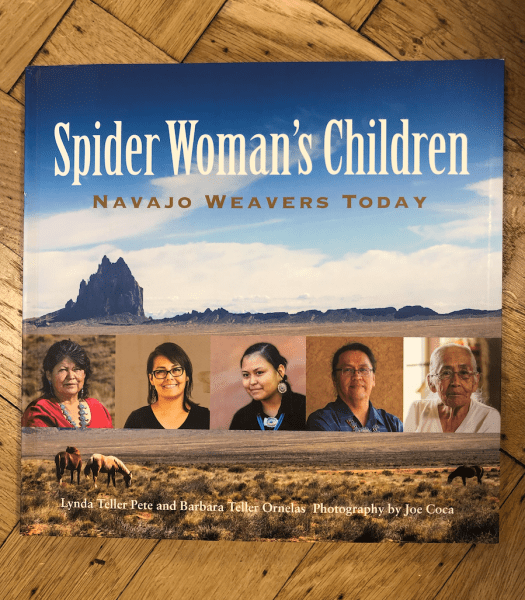
After having read a review of the book Spider woman’s children in the latest issue of Spin-off magazine, I knew I needed to buy the book. I ordered it, and when it arrived it proved to be a beautiful book that warmly told the stories of Navajo women (and a few men) who spin yarn from the Churro sheep.

Spider woman's children by Lynda Teller Pete and Barbara Teller Ornelas
Spider woman’s children by Lynda Teller Pete and Barbara Teller Ornelas

The wool is spun on Navajo spindles and the yarn is used to weave traditional Navajo tapestry rugs. The tradition is passed down from mother to daughter (or son), as are the textile tools and specific patterns or styles. It is a strong matriarchal culture with a true and genuine respect for the craft and the crafter. Many Navajo have spent a lot of time at trading posts where they have sold their rugs. The rugs are well sought after today and sell for thousands of dollars on auctions.

Master Artist workshop: Navajo weaving

Spinning, knitting and weaving in the Andes

This week I bought the video Andean spinning from Interweave. It features the talented Nilda Callaรฑaupa Alveraz in a gentle conversation with Linda Ligon. Nilda shows how the women of the Andes spin sheep’s wool, alpaca and llama on bottom whorl spindles, pushkas. They spin constantly, and usually very thin yarn for weaving. Hands are never idle and there is always some textile crafting going on. The women spin, ply, dye and weave together and create a textile treasure to take great pride in. Men spin bulkier yarn and often in llama wool for weaving potato sacks. Imagine that, storing your potatoes in handspun, hand woven llama sacks. What a potato feast!

Nilda Callaรฑaupa Alveraz tells Linda Ligon about Andean spinning. Short clip from the downloadable video Andean spinning.

They spin the wool on simple hand-carved and very lightweight bottom whorl spindles. Just a stick and a whorl. No hook, you just secure the yarn with a couple of half-hitches and you are good to go. They don’t prepare the wool with any tools other than your hands. They just separate the fibers with their hands and turn them into clouds that they drafts from.

Another video that shows Andean spinning from unprocessed wool.

The process is mesmerizing and my heart was singing when I watched the video. The simplest of tools make the most beautiful, yet sturdy and useful textiles. I instantly felt a need for a pushka spindle. Even as we speak, two pushkas are on the way to me. I intend to get myself a fleece that I can tease and draft directly from without tools. I don’t know what breed they use, but since the Spanish brought the sheep, chances are that there is at least some amount of merino in today’s sheep grazing the Andean slopes. I’m thinking some Jรคmtland wool or Norwegian crossbred, NKS, will do the trick.

Abby Franquemont who grew up in the Andes as a daughter of anthropologists learned the technique from an early age (but shockingly late in the eyes of the locals). She is currently back in Cusco, Peru, and sends daily sweets in the shape of videos from her visit. It makes me want to go to Peru right now and spin with them. Anyone know of a decent train line from Europe to South America?

A Swedish textile community

There are places in Sweden with a cultural textile heritage. The county of Dalarna for example is a region where twined knitting has been the dominant textile technique for centuries. Women were knitting whenever their hands were free to knit. Idle hands were a sin. Many people in this region today can show a treasured vadmal jacket with twined knitted sleeves, safely stored in the attic. And they treasure it.

Future textile heritage

Next generation

My children don’t know how to spin and they don’t share my passion for textiles. But they do have a passive knowledge of spinning and wool. They can tell the difference between a Texel sheep and a Finewool sheep. Probably Rya and Gotland too. They know the names of quite a few of the spindle types I have and they enjoy the sound of the spinning wheel. How many city kids have this knowledge today? Every time I see a sign of this passive knowledge my heart smiles. I know that I have passed a treasured knowledge to them, even if they don’t share my passion.

Urban spinning

Recently I got a new supported spindle and bowl. The bowl had a metal piece underneath to fit a magnet so that the bowl doesn’t slide off my lap when I spin. The other day I went to the hardware store to get a strong magnet. I had brought the bowl to check if the magnet would be strong enough. When I waited in line I imagined what I would answer if the sales person would ask what the bowl was used for. I imagined answering “the line is too long for me to tell you what the bowl is used for”. I was a bit disappointed when he didn’t ask me. Not even after testing the function with my handspun hat between the magnet and the bowl! But he did get me a decent magnet.

Supported spindle and bowl by Bjรถrn Peck
Supported spindle and bowl by Bjรถrn Peck. Few people outside the spinning community know what they are used for, let alone why I would want a magnet for it.

In a culture with a strong textile heritage this situation wouldn’t have occurred. The hardware store would have exposed the magnets in the shop with a sign saying “Get your spindle bowl magnets for safe commuter spinning here!”. Wouldn’t that be something?

Metro crafting

I wouldn’t say that Stockholm has a textile heritage, at least not one that I know of. I don’t often see textile crafting in Stockholm. Whenever I see a person trying to untangle their earphones on the metro my heart jumps because I instantly think they are knitting. But they are not. The irony of this is that they wouldn’t have had to untangle their earphones in the first place had they only had the knowledge to knit them in!

No untangling necessary with knit-in headphones.
No untangling necessary with knit-in earphones. Picture from 2012. Photo by Dan Waltin.

The few times I don’t get around by bike I spin or knit on the metro. First and foremost because I want to, but also to make textile crafting visible. I want people to know that spinning exist. I want people to reflect over what it is that I do, perhaps dig out threads of memories of knitting grandmothers, weaving aunts or just old hands showing how it’s done. Some people are brave enough to ask me what I’m doing, or just seek eye contact and smile. Once I was standing in the metro, nalbinding away. A man in his 60’s was watching what I was doing. After a while he smiled at me and asked “Isn’t that that nalbinding?” I was so shocked I nearly forgot to get off at the next stop. Never have I experienced anyone outside the textile community recognizing nalbinding, let alone a man.

A pair of striped socks in backlight
Nalbinding socks. Photo by Dan Waltin

I treasure moments like these. They give me hope that I can be a part of passing at least a passive knowledge of textile tradition on.

Online heritage

Most of my you who follow me on my blog and YouTube channel are spinners. A few just appreciate the serenity of my videos and another group is fascinated by the textile techniques without an intention of crafting themselves. Recently one of my videos was spread in a non-spinning context. In one week the amount of viewers grew from 600 to 21000 (!) and is now up in around 36000 views. Spinners are my target group, but seeing so many other people appreciating my textile heritage makes my toes dance of joy.

Making my own history

I may not have a textile heritage. But I have made my own. The positive side of not having a textile heritage is that I don’t have a given thread to follow. I’m not expected to follow a pre-destined tradition. I make my own thread and my own discoveries based on my curiosity and love for the craft. That is a heritage I am proud of.

What is your textile heritage?


The featured image I chose for this post is a Flemish tapestry weave made by my sister-in-law’s grandmother Birgit. Birgit was a weaver and left tons of hand woven pieces when she passed away. My sister-in-law does have a textile heritage is by her grandmother and mother, but she is not a textile crafter herself. When she was sorting out her grandmother Birgit’s belongings she thought of me and gave me a whole bag with beautiful handwoven kitchen towels and a few tapestry weaves. This way I can say that I have adopted my sister-in-law’s textile heritage.


You can follow me on several social media:

  • Thisย blogย is my main channel. This is where I write posts about spinning, but also where I explain a bit more about videos I release. Sometimes I make videos that are on the blog only.ย Subscribe or make an rss feed to be sure not to miss any posts.
  • Myย youtube channelย is where I release a lot of my videos.ย Subscribe to be sure not to miss anything!
  • I have aย facebook pageย where I link to all my blog posts,ย you are welcome to follow me there.
  • I run anย online spinning school, welcome to join a course!
  • Onย Patreonย you can get early access to new videos and other Patreon only benefits. The contributions from my patrons is an important way to cover the costs, time and energy I put into the videos and blog posts I create. Shooting and editing a 3 minute video takes about 5 hours. Writing a blog post around 3. You can read more about myย Patreon pageย here.
  • Follow me onย Instagram.ย  I announce new blog posts, share images from behind the scenes and post lots of woolliness.
  • In all the social media I offer, you are more than welcome to contact me. Interacting with you helps me make better content. My private Facebook page, however, will remain private.
    If you like what I do, please tell all your fiber friends and share these links!

Process

Handspun yarn from Gotland wool

I am a process spinner and I spin because I love the process of spinning. The rhythm, the motions, the feeling of the fiber in my hands and the crafting bubble I enter when I spin โ€“ all of these aspects are part of my love of spinning. I do spin for the project too, but I don’t make shortcuts to get faster to the project. In this post I will try to break down the process and investigate what it is that makes me feel so good when I spin.

For some cimematic inspiration connected to the theme of this post, watch my video For the love of spinning.

Rhythm

There is a rhythm in spinning, regardless of what tool I am using. I treadle with my feet, feed the yarn into the orifice and move my hands. Or I set a spindle in motion, draft the fiber and roll the yarn onto the shaft. You can see the rhythm in the preparation too โ€“ loading combs or cards, processing the fiber and arranging the fiber in spinnable chunks. From the first step to the last and back again. There is a rhythm and a predictability โ€“ if everything goes as it should, I know what is coming next.

I find a sort of security in the rhythm. I can focus on the steps in the process and and be here and now. Stress stays outside of the bubble and allows me to breathe and think more freely.

I have been under a lot of pressure lately with course launch, article and pattern deadlines and new courses to prepare for. But through this I have had one spinning project that was just for me. There was no deadline or pressure with that particular fleece and I made room for spinning for a little while every day. It helped me find peace when in the crafting bubble and balance when outside of it.

The rhythm of spinning helps me find the here and now

Dance

Sometimes I see spinning as a dance. The fibers and tools are the dancers and I am the choreographer (the fiber is also the artistic director). My hands follow each other, back and forth, towards and away from each other, leaving the fiber in a new shape. Fiber hand drafting the fiber for the spinning hand. Spinning hand introducing twist to the fiber and smoothing the newborn yarn, guiding it onto the bobbin or shaft. My eyes follow my hands, watching the fiber, assessing the result and planning the next step.

The combs or cards follow each other, allowing the length of the fiber to gently dictate the choreography. I make dramatic moves for combing long locks and gentle motions, gently caressing the fibers for carding short fibers. I listen to the music of my tools for guidance in the rhythm.

The moves in the dance are linear and simultaneous, gentle and bold, planned and spontaneous. Often in basic step but every now and then a new figure is introduced.

The dance works with the rhythm and helps me find my pace. I get lost in the moment while at the same time focusing deeply on my work.

Spinning on a supported spindle takes and makes focus. Photo by Dan Waltin
The rhythm and dance of spinning helps me find focus. Photo by Dan Waltin

Sometimes I feel disconnected from the spinning. Something is out of step and I can’t find my way in the spinning. Then I look for the dance and find it. I am the choreographer again and the steps fall into place.

How do you dance your spinning?

Memory

When I spin (or knit or weave or nalbind orโ€ฆ well, you get the picture), I spin the context into the yarn. If I listen to a podcast when I spin I can hear its echo the next time I spin that yarn. If I knit at a fika break at work I remember the conversations the next time I pick up the knitting. Spinning on the train can save the view from the landscape in the yarn. The sensation of the crafting enhances the auditive or visual memory of what happen when I craft.

If I have been happy, sad or emotional when spinning, my feelings are gently stored in a protective shield of wool. It feels safe, like my yarn protects my most secret thoughts and emotions. I can look at the yarn and reconnect with particular moments and contexts.

A collection of finished yarns from a fleece allows me to remember and cherish all the things going on in my life when it was created. Good things, bad, happy and sad. They are all there and part of me.

Handspun yarn from Gotland wool
I could tell you that this is Gotland wool spun worsted from hand combed top, but it is so much more than that. Countless emotions, memories and places have been gently spun into the yarn.

Creativity

Spinning is a creative activity. I need to be creative. My whole being needs to express itself creatively. When I spin I feel more balanced, I can ground myself and be at peace. When I am in the creative bubble all the white noise around me fizzles out and allows me to see the world more clearly.

I can also use spinning to ignite creative thinking. Sometimes I may be struggling to find words for a blog post or an article. I stop what I am doing and start spinning instead. After a while of spinning the doors to my creative thinking open and I can take a fresh creative breath again. The connection between the brain hemispheres is strengthened and I can think more efficiently.

Touch

One of my favourite parts of the spinning process is feeling the wool in my hands. The notion that every single fiber has gone through my fingers hundreds of times through sorting, picking, washing, preparing, spinning, plying and knitting warms my heart.

Touching wool gives me a sense of security. It will do me no harm. I will receive the gift of warmth, safety and kindness. It is like I was meant to feel the wool. I think we as humans need to feel natural materials.

Oxytocin

Recently I read a book about love, Kรคrlek. The author and therapist Eva Sanner writes about touch as an important part of a relationship. Touch releases the hormone oxytocin, which makes us calm and content. It has importance for bonding between partners and between mother and child during nursing. The release of oxytocin also strengthens our immune system.

Go cuddle your sheep, it is good for your immune system. Photo by Anna Herting.

One of the most effective ways to release oxytocin is through massage. When pace and pressure are right, it can give a lot of pleasure for both the giver and receiver of massage.

A spinning hormone?

The book also mentions the release of oxytocin when we pet our pets. Scientific studies show that people with pets have better health than people living alone and that oxytocin can very well be the cause of that. The author writes that we have lots of oxytocin receptors in our hands. When we stroke our pets we take pleasure in it, just like the masseur. At the same time our immune system is strengthened.

This made me stop and think. If oxytocin is released when we stroke our pets, could spinning also lead to the release of oxytocin? The warm wool โ€“ not on the hoof anymore but more often than not smelling faintly of sheep โ€“ goes through our hands in all the steps of the process. During spinning we handle the wool between our fingertips, one of the most sensitive parts of our bodies. Is the release of oxytocin during spinning part of the feeling of serenity when we spin?

I got so excited about this thought that I emailed the author. I described the spinning process and asked her if she thought that oxytocin was released when we spin. She replied after just a couple of hours and said that it was a very interesting concept. She thought it was very possible that oxytocin could be released during spinning.

Spinning Shetland wool on a spinning wheel
Can spinning wool actually be good for our immune system?

My next thought was, comparing to pace and pressure in massage, is the pace and pressure in the spinning when it feels the best the moment when the most oxytocin is released? Do we have a personal spinning pace that is the most beneficial for us?

The thought of oxytocin as a spinning hormone and beneficial for our immune system gives me goosebumps. And a warm and wooly heart.

Do share your thoughts about this!

Happy spinning indeed!


You can follow me on several social media:

  • This blog is my main channel. This is where I write posts about spinning, but also where I explain a bit more about videos I release. Sometimes I make videos that are on the blog only. Subscribe or make an rss feed to be sure not to miss any posts.
  • My youtube channel is where I release a lot of my videos. Subscribe to be sure not to miss anything!
  • I have a facebook page where I link to all my blog posts, you are welcome to follow me there.
  • I run an online spinning school, welcome to join a course!
  • On Patreon you can get early access to new videos and other Patreon only benefits. The contributions from my patrons is an important way to cover the costs, time and energy I put into the videos and blog posts I create. You can read more about my Patreon page here.
  • Follow me on Instagram.  I announce new blog posts, share images from behind the scenes and post lots of woolliness.
  • In all the social media I offer, you are more than welcome to contact me. Interacting with you helps me make better content. My private Facebook page, however, will remain private.
    If you like what I do, please tell all your fiber friends and share these links!

Community

"Every revolution of the wheel spins peace, goodwill and love". Mahatma Gandhi

Community: A group of people living in the same place or having a particular characteristic in common (Oxford dictionaries)

A particular characteristic in common. Communities thrive all over the world and all over the Internet, full of creativity and passion for the particular characteristic. There is something extraordinary about the spinning community, though. I have never seen such a beautiful fellowship of people who are so eager to help and support each other. I have never seen an unkind word directed to another spinner in the spinning community. Everybody is eager to help, from beginner to expert and from all fields of the spinning spectrum. There is a true foundation of, well, actually peace, love and understanding.

Peace

Spinning doesn’t agree with unkindness. Spinning is by nature a peaceful act. With our hands we fuse fibers together in the cooperative motion of creating yarn. The hands work together to get the fibers to work together and align themselves in the draft. They may be sleek and consistent or bumpy and wild, but they are nonetheless yarn. It is like we spin our own community of fibers. We spin togetherness.

"Every revolution of the wheel spins peace, goodwill and love". Mahatma Gandhi
“Every revolution of the wheel spins peace, goodwill and love”. Mahatma Gandhi. Embroidered quote on my shopping trolley.

The spinning community is for me a safe place. I know I can ask any question and get a thoughtful answer. I embrace the new knowledge and I feel humble towards the spinner who taught me something new and valuable. The act of helping a fellow spinner, new or experienced, is and act of peace. When I help another spinner I know my reward will be more peace in the world. The more I learn about spinning the more I respect the people who make up this community. And I know that the learning and inspiration never end.

Love

In the spinning community we share our knowledge. Because knowledge of spinning is also knowledge of what spinning gives us in return. I know about the transition in my body when I sit down and spin after a busy day. I know about the feeling of flow and weightlessness when I get into the creative bubble. And I know that I can give that feeling to another spinner when I help them develop or solve a problem.

Spinning has been a cultural heritage since someone took some cellulose fiber, tied it around a rock, set it in motion and realized what it could result in. Too many crafting techniques have been lost and forgotten, even in the spinning world. I feel a responsibility to help saving endangered textile techniques. That is the reason why I wanted to learn techniques like nalbinding and twined knitting. They had almost been forgotten.

Recently one of my videos was spread in a non-spinning context. In less than two weeks it grew from 600 to over 25000 (!) views and people commented on the cultural heritage of spinning. There is obviously a surge for old techniques and natural materials. We need to cherish these old techniques, develop them and make them a thriving and natural part of our contemporary life.

Understanding

There are so many kind souls out there, sharing their knowledge, understanding the love of the craft. We share something unique. We share the understanding of what spinning gives us and the world. As spinners you know what I need without me having to necessarily tell you. And every now and then I know what you need. It is a mutual understanding of what spinning gives us.

Barbro who unprovoked gave me her long and loving list of spinning literature. Anna who offered to send me copies of rare spinning books. Kate who seems to know what the spinning part of my mind is trying to figure out and always asks the right questions at the right time. Gunilla who is the fastest book sender in the world. Jenny who cheers me on and referred me to another fiber enthusiast. Kirsten who offered to send me fiber that was new to me. Bjรถrn who makes the best supported spindles. All my Teachable colleagues who cheered me on after my course launch. Fran, Grace, Babs, Rebecca and all my students and followers who reach out and help me become a better spinner and teacher.

All these people are to varying degrees a part of the spinning and fiber world and understand the beauty of it.

Yesterday was International Women’s Day. So many women have worked so hard with textile crafts to provide warmth and shelter for their families, and so often unpaid (for an elaboration of the value of textile crafts, see my previous post on calculations). We can give something back to them by celebrating, treasuring and developing textile techniques.

To all women who have worked hard to provide for their families

Sharing

I have so many ideas I want to share with you. Because when I share, you share and when you share I share. With that we all grow as spinners and people and once again 1 + 1 = 3. The sum of the parts is greater than the whole.

Webinars

When I launched my new online course a week ago I hosted a live webinar on spindle ergonomics. I was very nervous the whole day and totally drained afterwards, but the webinar turned out a success. So many of you cheered me on before, during and after the webinar and you seem to have genuinely enjoyed it. The best comment came from my 16-year-old son, though: “Mum, it actually sounded like a real live stream!”.

It felt so good to be there live with you. Editing is a powerful tool โ€“ I can edit away any flaws in videos, courses and blog posts, but it was also a liberating feeling to be totally unedited with you. A webinar is also as close as I can get to meeting you in person.

I plan to make more webinars and I have lots of ideas. It is a medium I believe in and that I think would work very well in the spinning community. I learn a lot from making them and I hope you learn something new too by participating in them. Together we can create a forum that will work and contribute to the community. If there is a special topic you would like me to address in a webinar, just let me know. You can contact me via any of the links below or via email if you are on my email list.


Thank you for all the peace, love and understanding that make up this beautiful spinning community.

Happy spinning!


You can follow me on several social media:

  • This blog is my main channel. This is where I write posts about spinning, but also where I explain a bit more about videos I release. Sometimes I make videos that are on the blog only. Subscribe or make an rss feed to be sure not to miss any posts.
  • My youtube channel is where I release a lot of my videos. Subscribe to be sure not to miss anything!
  • I have a facebook page where I link to all my blog posts, you are welcome to follow me there.
  • I run an online spinning school, welcome to join a course!
  • On Patreon you can get early access to new videos and other Patreon only benefits. The contributions from my patrons is an important way to cover the costs, time and energy I put into the videos and blog posts I create. You can read more about my Patreon page here.
  • Follow me on Instagram.  I announce new blog posts, share images from behind the scenes and post lots of woolliness.
  • In all the social media I offer, you are more than welcome to contact me. Interacting with you helps me make better content. My private Facebook page, however, will remain private.
    If you like what I do, please tell all your fiber friends and share these links!

A new online course

A new online course: Spin on a supported spindle

I have been hinting about a new online course for a while and now it is finally happening! This Saturday, March 2nd, I will launch the online course Spin on a supported spindle โ€“ a comprehensive step-by-step guide to spinning on a supported spindle with confidence. Read about the course here and register for the live webinar!

Spinning on a supported spindle, a new online course

Spinning on a supported spindle is something that lies very close to my heart. Supported spindle spinning may be my most favorite spinning technique and also the technique I have been teaching for the last 2,5 years. Through my classes I have seen the most common mistakes and beginner’s struggles. In the online course I try to address these issues to give you as many tools as possible to learn how to spin continuously and effortlessly.

The superpowers of supported spindle spinning

This technique has so many superpowers and I will go through each one in the course. With supported spindle spinning you can

  • spin in different places than other spinning techniques
  • experiment
  • spin in crowded places
  • focus on quality
  • spin very short fibers
  • find inner balance
  • spin faster than with other spindle techniques
  • produce a yarn that is extremely thin
  • spin with more ease and less strain than many other techniques

Meditative

One of the most compelling traits of supported spindle spinning is that it is meditative. That is true for many spinning techniques, but there is something extra special about the rhythm of supported spindle spinning. If I feel stressed I often take a supported spindle and spin for a while. It lets my brain rest and find balance.

Spinning on a supported spindle is truly meditative

Quality

Another one of the most powerful features of supported spindle spinning is that you can focus on the quality in a way that no other spinning technique allows. With supported spindle spinning you have a 100 % control over drafting and tension. Your hands control both fiber and yarn and at a distance from your eyes that allows you to carefully watch and feel what is happening in the drafting zone. This means that you are able to study the behaviour of the wool closely achieve the result you want right there, between your hands.

Less strain

Many people say that supported spindle spinning puts less strain on arms and shoulders than other types of spinning. When you spin on a supported spindle you move your arms minimally. That means that arms and shoulders can rest in the motion and your fingers will do the work with the help of low friction against a smooth bowl surface.

I had one student who had constant pains after a car accident. Some spinning techniques were difficult for her to do for longer periods of time due to the pain. But after the course she said that she could spin on a supported spindle for hours. It really warmed my heart to hear and I was truly happy for her.

Course design

In the course I will walk you through supported spindle spinning step by step. Everything in the course is video-based so that you can see what I do. There are 4 sections and 11 theoretical and practical lessons. All the lessons are captioned and there are informative titles for important keywords and concepts. I have also included a glossary pdf so the you can look up important terms during the course.

Course outline

In the course we will look at

  • Getting to know your spindle: We get acquainted with the spindle and look at why we spin on a supported spindle
  • Yarn exercises: With step-by-step exercises with yarn we isolate the movements and learn movements, hand positions and yarn angles without having to manage fiber and drafting at the same time. We also look at spindle anatomy and differences in models and design.
  • Managing fiber and technique: We spin with fiber and practice park and draft at our own pace. We also dive a bit deeper in technique.
  • Spinning continuously: We let go of the last preparational exercises and learn how to spin continuously.
outline of the course Spin on a supported spindle
The outline of the course

Material requirements

To be able to take the course you need just a few things:

  • A supported spindle. If you don’t have one you can take my free course How to pick a supported spindle and bowl to find out which model that will work best for you.
  • A spindle bowl. This could be a special spinning bowl or a household bowl with a smooth surface.
  • A piece of yarn for the yarn exercises.
  • Fiber to spin with. Pick a fiber that you are comfortable with.

Who can take the course?

To make the most of this course you will need to know how to spin on a suspended (drop) spindle and be comfortable with spinning on a suspended spindle. You need to know how wool and fiber behave and how a spindle behaves. You can still take the course if you donโ€™t know this. However, I think you will get the most out of the course if you do know how to spin on a suspended spindle and that you are comfortable with spinning on a suspended spindle.


When you have finished the course you will know

  • why we spin on a supported spindle
  • the basic movements and techniques of spinning with a supported spindle 
  • why we do what we do in supported spindle spinning

With practice you will learn how to spin continuously with a supported spindle.

The course will be available in my online school this Saturday March the 2nd.

Live webinar: Spindle ergonomics

This Saturday, March 2nd at 5 pm CET, I will host a live webinar. I will talk about spindle ergonomics and how we can adjust our spinning to avoid pain and strain. I will also talk about the online course.

This is a chance for me to meet you (in the chat at least, I won’t be able to see you) and for you to see me live and unedited. I am terrified about this but also very excited. And I know you will be kind webinar participants and not eat me alive.

Theย webinarย hasย alreadyย takenย place

Happy spinning!

You can follow me on several social media:


  • This blog is my main channel. This is where I write posts about spinning, but also where I explain a bit more about videos I release. Sometimes I make videos that are on the blog only. Subscribe or make an rss feed to be sure not to miss any posts.
  • My youtube channel is where I release a lot of my videos. Subscribe to be sure not to miss anything!
  • I have a facebook page where I link to all my blog posts, you are welcome to follow me there.
  • I run an online spinning school, welcome to join a course!
  • On Patreon you can get early access to new videos and other Patreon only benefits. The contributions from my patrons is an important way to cover the costs, time and energy I put into the videos and blog posts I create. The content I create is totally free from advertisement. You can read more about my Patreon page here.
  • Follow me on Instagram.  I announce new blog posts, share images from behind the scenes and post lots of woolliness.
  • In all the social media I offer, you are more than welcome to contact me. Interacting with you helps me make better posts and videos. My private Facebook page, however, will remain private.
    If you like what I do, please tell all your fiber friends and share these links!

Credibility

Yummy yarn in backlight

It is easy to write stuff online and make it look good. You just write, press enter and it’s there for anyone to read. It is like we think that the publishing in itself gives the content credibility. But that is not how things work and I work very hard to be credible in what I publish.

In this post I reflect over credibility and my responsibility as a blogger and spinner.

Responsibility

Publishing with just the press of a button is a freedom that wasn’t available two decades ago. With that freedom comes responsibility, as a reader and as a writer. I talk to my children about this all the time. Where did you get this information? Is it credible? What do other sources say?

Responsible blogging

As a blogger with lots of followers (yay!) I have a big responsibility when I create my content. Even more so now that I have a business and an online school. I need to have my facts ready. If I don’t, I need to say so and back it up with any other evidence I can find, argue for my case and make the process transparent for my readers.

Mostly I end up showing you all the steps of the process. That is, my process. I can only vouch for how I do things โ€“ I am very good at showing you successful projects, all edited and polished. I will step outside of my comfort zone and show you some not so successful projects as well, I promise.

Transparency

Feeling a responsibility to share my process has helped me a great deal in my development as a spinner and teacher. Not only do I learn by crafting my thoughts in writing, I also learn by testing, sampling and swatching in a way I definitely din’t before. The simple reason is that I didn’t use to test, sample and swatch. I went through the whole process, but didn’t really reflect over why I did things and why I chose one way over the other.

Handspun yarn, Gotland wool
A sweet ball of handspun yarn from Swedish Gotland wool

It is only for the past six months that I have truly investigated the wool’s properties and abilities in search for the superpowers of a fleece and take advantage of them. At first, to be really thorough and present all my choices along the way. But now I can’t un-know the benefits of testing, sampling and swatching and I do it by default. And it is a beautiful thing.

A learning adventure

I learn so much from these adventures of investigation! By reflecting and analyzing I get to know the wool and its properties even more. The connection between the parts of the process becomes so much clearer. I learn when things don’t work the way I had planned and I learn to be more creative in my search for the best way to spin a fleece.

In everything I do related to spinning, I think about how and why. And the blog is always present โ€“ I think about how I can make high quality content for you out of what I learn when I spin.

I thank you for that. If I hadn’t felt the responsibility to be transparent in my process I wouldn’t have learned all this. And I hope you learn as much as I do.


There are a lot of spinning things going on at the moment outside of the blog and I will try to keep a low profile here in the upcoming weeks. But you will definitely see more of me! Thank you for all the support, questions, inspiration and spinning love.

Happy spinning!

Josefin Waltin
Me, thinking about spinning. Photo by Dan Waltin.

You can follow me on several social media:

  • This blog is my main channel. This is where I write posts about spinning, but also where I explain a bit more about videos I release. Sometimes I make videos that are on the blog only. Subscribe or make an rss feed to be sure not to miss any posts.
  • My youtube channel is where I release a lot of my videos. Subscribe to be sure not to miss anything!
  • I have a facebook page where I link to all my blog posts, you are welcome to follow me there.
  • I run an online spinning school, welcome to join a course!
  • On Patreon you can get early access to new videos and other Patreon only benefits. The contributions from my patrons is an important way to cover the costs, time and energy I put into the videos and blog posts I create. The content I create is totally free from advertisement. You can read more about my Patreon page here.
  • Follow me on Instagram.  I announce new blog posts, share images from behind the scenes and post lots of woolliness.
  • In all the social media I offer, you are more than welcome to contact me. Interacting with you helps me make better posts and videos. My private Facebook page, however, will remain private.
    If you like what I do, please tell all your fiber friends and share these links!


To do-list

Trying to sort out thoughts, ideas, musts, need tos and want tos.

There is a lot going on now. I need to make a to do-list and try to sort out my thoughts, ideas, musts and want tos.

Trying to sort out thoughts, ideas, musts, need tos and want tos.

Design from fleece to garment blog series

There was a lot of attention on my latest post on calculations. So many people seem to have heard that question before, “will you knit me a sweater? I’ll pay for the material cost.” Apparently, it is an important discussion โ€“ about the value of women’s work, the appreciation and recognition of hand crafted items and the history of textile production. The post has been shared over a thousand times and it has been read by ever 3500 people in all continents in just a few days. That is amazing and totally overwhelming.

 The response from followers to the Design from fleece to garment blog series was overwhelming
The response from followers to the Design from fleece to garment blog series was overwhelming

Overwhelmed

That’s how I feel right now, overwhelmed. I am thrilled that so many people read the post. I am so happy that so many people recognized the frustration of investing so much time and love into a craft that few people understand the skills behind. But I’m also exhausted by the attention. Overwhelming does that to a highly sensitive person.

A lot of people liked the sweater too (and the whole blog series). And world of wool linked to the sweater in their newsletter, fancy that! Many people asked for a pattern for the sweater and I will make one. Soon. When I have had some time to breathe.

Online courses

Over 200 people have taken the free course in How to pick a supported spindle and bowl! I have got so many lovely reviews. People really like the structure of the course. The most interesting concept in the course has been the shape of the upper spinning tip and its impact of ergonomics.

I should launch my new course soon. Just need to check a few technical stuff first. I wonder if anyone would come if I did a live webinar. I should ask my followers. Hosting a live webinar would most definitely be really scary, but I think it will be good for me. Not everything can be edited and well polished.

Thoughts about the upcoming online course launch and future online course topics

Oh, and I need to ask the students of the free course to check their spam filters. Perhaps my emails have got caught there.

I wonder what course I will make next. Perhaps my followers have suggestions and requests? Navajo spindle spinning, supported spindle spinning, consistency, fiber preparation? Yeah, that would be the best thing, to ask them. After all, it is for my followers I make the courses, they should know what courses they want. Perhaps they want the opportunity to get a private video coaching session? That would be so cool!

Secret articles

It feels good that secret article 1 is finished. It will be published soon, that’s so cool! Gotta get to work on secret article 2 too, and especially secret pattern x, that will be a challenge. I need to plan the photo shoots too. I’ll put the pattern, the article and the photo shoots on top of the to do-list. Secret pattern y can wait a while. I don’t think it will be a very complicated one to write, though.

Lots of secret stuff going on!

Planning the video season

Video shooting season starts soon. Well, depending on when spring will really come. We’re still in mid-winter. But I do have some material from last summer that I haven’t released. I should edit them before I start shooting new videos. And there is that secret video project coming up in May, together with my spinning friends A and M. That will be a lot of fun!

Planning the video season

Courses in spring and summer

I have two in-person courses to plan too. The supported spindle course series in Stockholm in March and the five-day course at Sรคterglรคntan in July! I like the concept โ€“ a spindle a day. Just got to figure out how to bring all the different spindle types for all the students on the train.

Planning the spring and summer spinning courses

I really need to spin. Need as in my mind needs the serenity and time to recharge. And to get in a mode of creative thinking. Yeah, that’s what I’ll do right now, by the fireplace.

Do I have to go to work on Monday? If it is too slippery to take the bike I can knit on the metro! And knitting at coffee breaks is always a conversation starter.

Knitting for a secret pattern
Knitting for secret pattern y

Happy spinning!


You can follow me on several social media:

  • This blog is my main channel. This is where I write posts about spinning, but also where I explain a bit more about videos I release. Sometimes I make videos that are on the blog only. Subscribe or make an rss feed to be sure not to miss any posts.
  • My youtube channel is where I release a lot of my videos. Subscribe to be sure not to miss anything!
  • I have a facebook page where I link to all my blog posts, you are welcome to follow me there.
  • I run an online spinning school, welcome to join a course!
  • On Patreon you can get early access to new videos and other Patreon only benefits. The contributions from my patrons is an important way to cover the costs, time and energy I put into the videos and blog posts I create. The content I create is totally free from advertisement. You can read more about my Patreon page here.
  • Follow me on Instagram.  I announce new blog posts, share images from behind the scenes and post lots of woolliness.
  • In all the social media I offer, you are more than welcome to contact me. Interacting with you helps me make better posts and videos. My private Facebook page, however, will remain private.
    If you like what I do, please tell all your fiber friends and share these links!

Calculations

In many spinning or knitting projects people have asked me how much time I have spent spinning, how much raw fleece it takes to spin a certain amount of yarn, how much a skein would cost etc. I have often wondered this myself. In this post I will take you through all the calculations of my recently finished fleece-to-garment project.

This is the fourth post in a blog series. The first post was about how to find the superpowers of a fleece and in the second post I talked about consistency. The third post was about design from fleece to garment. Through the blog series I use the wool from one sheep as a case study.

Wool preparation

I started with two fleeces from the same sheep, one spring shearing and one autumn shearing. I had given parts of both to a friend, so none of them were complete fleeces. But an estimation is that I had around 1,2 kg of raw fiber before I started the project.

To make this yarn happen I went through the following preparations steps:

  • I blended the two fleeces together in a big basket
  • To tease the wool I used combs and added the sari silk at this stage
  • I carded the teased fluff into rolags with my hand cards. Every rolag was carded 6×3 strokes
Close-up of a grey sweater with embroidered flowers.
Photo by Dan Waltin

Spinning

  • I spun the yarn with English longdraw. For each draw I treadled 4 + 10 treadles. Darn it, I didn’t count how many long draws I did for each rolag. But there was a lot of treadling!
  • Every single took 16 rolags. The yarn was 3-plied, which equals 16×3=48 rolags for every skein
  • When the last singles had been plied I had 12 skeins of roughly 60 g each.
  • The total weight of the skeins was 700 g. Total length: 1270 m. 700 g of yarn from 1200 g of wool makes a yield of around 58% of the weight of the fleeces. My average yield is around 55 %.
  • 12 3-plied skeins with 48 rolags in each skein makes 576 rolags, carded with a total of 10368 strokes. Roughly.

Knitting

It took 8 skeins to knit the sweater โ€“ 830 m and 440 g. Still, it is light as a cloud and feels like a second skin. Or my very own fleece.

Josefin Waltin wearing a dark grey sweater with embroidered flowers
Photo by Dan Waltin

Time investment

For time calculations I tried to make an estimation of each part of the process from fluff to stuff. For example, I knit for 20 minutes and weighed how much I had knit during that time and multiplied it by 3 to get the knitted weight per hour.

Per skein

  • Teasing/combing 20 g of wool: 20 minutes x 3 = 1 hour
  • Carding 20 g of fiber: 20 minutes x 3 = 1 hour
  • Spinning 20 g of fiber: 40 minutes x 3 = 2 hours
  • Plying 3×20 g of singles: 30 minutes
  • Plus sorting and washing for a total of around 4 hours

Total time for 12 skeins: 60 hours (40 for the 8 skeins for the sweater), 5 hours per skein

Oh, and the embroidery yarn. Let’s add another 4 hours for that.

Knitting time

Knitting per hour: 21,6 g. Total weight of the sweater was 440 g, so an estimated total time for knitting is roughly 20 hours. Plus embroidery 2 hours. Ball winding by hand, 2 hours. Add to that designing, swatching, frogging, pattern calculations, blocking etc, an extra 10 h. That’s roughly 80 hours for one sweater.

Cost

“I know you love knitting, how much for a sweater? I can pay for the material cost!” How many of you have heard that before? My usual answer is, “Tell me a decent hourly rate and I’ll tell you how many hours it took to knit it.” You know where I’m heading, don’t you?

Pia’s calculations

A few years ago Pia Kammeborn, Queen of Kammebornia, calculated the cost of a pair of mittens. The post is written in Swedish but the gist of it is: It takes her around 20 hours to knit a pair of half mitts. Textile crafts (or women’s craft) have never really been paid fairly, so Pia’s calculations are based on an average hourly rate for typical male crafts. With an hourly rate of 600 Swedish kronor/ 60 โ‚ฌ/ $67, which is what a craftsman in a typical male craft like plumbing or carpentry would earn, Pia’s mittens would cost around 12000 Swedish kronor/ 1200โ‚ฌ/ $1320.

“I know you love renovating kitchens, will you do mine? I can pay for the material cost!”. Nobody ever said that. Does that mean men’s work is worth more than women’s? Well, that’s just wrong.

A man and a woman putting together a wooden floor
Back in 2011, Dan and I renovated our bedroom. We considered asking Dan’s father (who built his own house) to help us, but instead we did it ourselves. Together. We still asked Dan’s father to help out, but as a baby sitter. Photo by Dan Waltin.

My calculations

Back to my sweater. We landed in 80 hours totally from fleece to garment. With the same calculations as in Pia’s example that would land in roughly 48000 Swedish kronor/ 4800 โ‚ฌ/ $5280. Or, if you are short on cash, a skein for 3000 Swedish kronor/ 300 โ‚ฌ/ $332.

Material cost?

Two of the fleeces were championship winners and I bought them at the auction following the competition. I paid around 800 Swedish kronor/80 โ‚ฌ/ $88 for all three fleeces, so an estimation for the cost of the material for the sweater is around 500 Swedish kronor/50 โ‚ฌ/ $55. That’s less than the rate per hour in the calculations in Pia’s example above.

Less than 300 Swedish kronor/30 โ‚ฌ/ $33 for one fleece is way too cheap, considering the all the work invested by the sheep owner. But that is another story and for a shepherdess to tell.

The crocodile in the river

So basically I’m walking around at work with a sweater worth 48000 kronor! But I can’t be the first person to having done that. Or, well, 48500 to be more exact if you include the material cost, but that’s just a fart in the universe in this example.

Josefin Waltin walking in the snow, wearing a dark grey sweater with embroidered flowers.
Photo by Dan Waltin

I’m just waiting for someone to ask me what I will charge for a sweater. I’ll take the bait without hesitation, like a crocodile in the river, unannounced โ€“ BAM! โ€“ 48000 kronor.

A baby crocodile

I can say that I would charge 48000 Swedish kronor for a sweater. I know nobody would buy it, though and I won’t sell it. My husband tried to convince me to sell a pair of nalbinding mittens on e-bay for 20000 Swedish kronor just to make a point. But I would never knit or spin for money. These things are my babies.

I know many people need to sell their handspuns and hand knits. And I know the discussion about pricing handspuns โ€“ and fleeces โ€“ pops up every now and then in the spinning forums. Even if nobody will buy handmade textiles with the calculations above it is an important discussion.

As a hand spinner and/or hand knitter you can always charge at least a little more than you think. Like a baby crocodile. Chances are, the more people pay, the more they will appreciate the time, skill and love invested in handmade textiles.


This was the last post in this blog series. As always, I have learned a lot from writing the posts and reflecting over what I am doing and why. I hope you learned something too.

Happy spinning!


You can follow me on several social media:

  • This blog is my main channel. This is where I write posts about spinning, but also where I explain a bit more about videos I release. Sometimes I make videos that are on the blog only. Subscribe or make an rss feed to be sure not to miss any posts.
  • My youtube channel is where I release a lot of my videos. Subscribe to be sure not to miss anything!
  • I have a facebook page where I link to all my blog posts, you are welcome to follow me there.
  • I run an online spinning school, welcome to join a course!
  • On Patreon you can get early access to new videos and other Patreon only benefits. The contributions from my patrons is an important way to cover the costs, time and energy I put into the videos and blog posts I create. The content I create is totally free from advertisement. You can read more about my Patreon page here.
  • Follow me on Instagram.  I announce new blog posts, share images from behind the scenes and post lots of woolliness.
  • In all the social media I offer, you are more than welcome to contact me. Interacting with you helps me make better posts and videos. My private Facebook page, however, will remain private.
    If you like what I do, please tell all your fiber friends and share these links!