Happy place

Last week I published a new five-day challenge. I call it flow. In one of the lessons I invite the spinners to find a space to spin in and make beautiful and inviting. A happy place.

When I create a five-day challenge I have an idea of what I want to give to the spinners who accept the challenge, what I wish for them to experience. But as soon as I publish the challenge I have no control anymore. The challenge takes people where it wants to take them and I just enjoy the sneak peak I get from reading people’s comments.

Challenge accepted

Through all the challenges I have created I have been amazed at your experiences, reflections and generosity in sharing. I learn so much from your stories. I get to see glimpse of your learning processes, your challenges and progress.

The new Flow challenge is no exception. There are so many insightful and wise comments and you share experiences that I would never have thought of myself. The glimpse I get into your spinning from the comments is very helpful to me as I explore and plan my blog posts.

Happy place

Spinning itself is my happy place. This is where I relax, find balance and presence. When I spin the outside world fades into a murmur in the distance and I am in my hands, in my process, in my spinning bubble.

Spinning is my happy place.

Still, making the place where I spin a place of harmony is important too. When I bought my first spinning wheel I instantly knew where to put it โ€“ In the living room with large windows in two directions, overlooking tree tops, the lake and the city on the other shore. I haven’t thought about creating a happy place, it has just evolved organically โ€“ the wheel, a wooden chair, two wool baskets and a hook made from the tip of a spruce to hang finished skeins on. Now, as I started creating the challenge I didn’t have any plans of mentioning the spinning space at all. But as I did it all fell into place. A happy place.

My comfort zone

When I sit in my spinning space a sense of security washes over me. The things around me protect me from the world outside the spinning bubble. When I enter my spinning space and close my eyes I feel safe. I have the protection of baskets on one side and my spinning wheel in front of me. They are the walls of my spinning fort and my comfort zone. I inhale the light air of my spinning bubble. In this space I create. Other thoughts are left outside. Whenever an itch to make emerges, I come here. This is where I can let creativity loose and go wild. Or, if I feel some sort of creative block, I come here. I know my creative juices start flowing as soon as I come to my spinning space.

One of my spinning spaces is by the couch, right beside the fireplace.

When I’m not in my spinning space and want to spin I need to find the right spot, I don’t just sit down anywhere to spin. It needs to give me that sense of safety, preferably free from clutter and noise, both visual and auditive. Natural materials, natural light. It needs to be scrumptious. If it’s not I do what I can to shield myself from disturbances, perhaps with noise cancelling earphones, with or without music.

A door ajar

When I read the comments in the challenge about the spinning space I see many common denominators. Some students light a candle or sit close to the fireplace. Some surround themselves with objects that have some meaning to them, perhaps reminding them of a loved one or a journey. Many arrange their spinning space with natural light and a view into surrounding nature.

Natural light and a view of nature are high on the wish list for a spinning space.

Some spinners realized that their spinning space was not initially a happy one, something was itching. They moved things around and suddenly found the bubble, sometimes just by moving a piece of furniture a short distance. Some realized that they didn’t have a dedicated spinning space at all, and created one.

Spinning outdoors. A happy place indeed.

The space means something, I sense a feeling of a special time and place, even a sacred space as I read the comments. One student writes that their spinning space is where “my mind is still and my thoughts are free”. Wherever I lay my hat.

A new space

Reading about the spinning spaces of the students in the challenge has made me curious about creating an additional spinning space. Another inspiration comes from the Japanese Netflix series The Makanai, where most of the sitting is done on the floor. If 80 year Japanese ladies can sit comfortably on the floor, why shouldn’t I? Thinking about this makes me realize that when I pick a fleece I usually do it on the floor, sitting on a yoga block or two to elevate my hips. I realize that the wool picking spot is a happy place too, quite close to my spinning wheel and the baskets.

I placed my Ukranian handspun and handwoven blanket on the floor, folded and rolled at the back end to elevate my hips. A stack of two yoga blocks in front of me for the spinning bowl, wool baskets surrounding me. It was a beautiful spot for spinning, another happy place.

Thank you for so generously inviting me to your spinning spaces.

Where is your happy place?

Happy spinning!


You can find me in several social media:

  • This blog is my main channel. This is where I write posts about spinning, but also where I explain a bit more about videos I release. Sometimes I make videos that are on the blog only. Subscribe or make an rss feed to be sure not to miss any posts.
  • My youtube channel is where I release a lot of my videos. Subscribe to be sure not to missanything!
  • I have a facebook page where I link to all my blog posts, you are welcome to follow me there.
  • I run an online spinning school, welcome to join a course! You can also check out my course page for courses in Sweden.
  • On Patreon you can get early access to new videos and other Patreon only benefits. The contributions from my patreon only benefits. The contributions from my patrons is an important way to cover the costs, time and energy I put into the videos and blog posts I create. Shooting and editing a 3 minute video takes about 5 hours. Writing a blog post around 3. You can read more about my Patreon page here.
  • You are also welcome to make one-off donations on my Ko-fi page.
  • Follow me on Instagram.  I announce new blog posts, share images from behind the scenes and post lots of woolliness.
  • Read the new book Knit (spin) Sweden! by Sara Wolf. I am a co-author and write in the fleece section about how I spin yarn from Swedish sheep breeds.fleece section about how I spin yarn from Swedish sheep breeds.
  • In all the social media I offer, you are more than welcome to contact me. Interacting with you helps me make better content. My private Facebook page, however, will remain private.
  • I support Centro de textiles tradicionales del Cusco, a group of talented textile artists in Cusco, Peru who dedicate their work to the empowerment of weavers through the revitalization and sustainable practice of Peruvian ancestral textiles in the Cusco region. Please consider supporting their work by donating to their causes.

Flow challenge

It’s that time of the year when I create a five-day challenge. This time I invite you to flow. In the Flow challenge you ge the opportunity to just be in the spinning without expectations.

Enroll in the Flow five-day challenge here!

I have been thinking a long time about what my next five-day challenge should be. The first two have been very popular (nearly 1200 people have enrolled) and I have learned so much from your comments and questions. Even if they both have had elements of exploration and play, there has been a technical side to them too. The Flow challenge is all about your own process, and about letting it be what it is, right now, today.

A flow retreat

A challenge seems too rushed a word, but I still call it that as it is part of a tradition of annual five-day challenges. Feel free to look upon it as more of a retreat, though, with an invitation each day for five days. A journey inward, where you get to discover your relationship with fiber, preparation and spinning.

A goal and an un-goal

The purpose of the challenge is for you to explore your relationship with the wool and the process. The goal is an un-goal โ€“ to strive inwards and detach yourself from expectations and results.

You will get five text lessons over five days. Each lessons has a theme where I encourage you to strive inward and spin for the moment. In each lesson you will also get a task to work with at your skill level.

All lessons have a background, an example and an invitation. In some lessons I also give you links to further reading or things you can prepare for the next lesson, should you wish to. You decide how much you want to do and how much time you want to spend on each lesson, or invitation. The important thing is that you do this for yourself and no one else.

Requirements and material

You can take the challenge at any spinning level. This challenge is just about you and your process. To take part you will need

My spinning space.
  • a spinning tool of your choice โ€“ spindles, spinning wheel or e-spinner
  • wool preparation tool(s) of your choice โ€“ combs, cards, flicker.
  • (part of) a fleece, washed or unwashed
  • 15โ€“30 minutes a day to work with the challenge
  • A space where you can work reasonably undisturbed
  • If you wish, pen and paper to take notes of your findings.

You are free to work with the lesson whenever you like and for as long as you like.

Your time, your space

The time and space you prepare is yours with yourself and with the wool. Give yourself time to be in the wool, to be in your hands and allow the wool to guide you. Give the time and the space as a gift to yourself and as a thank you to the wool for all it has to teach you.

Spend some time with your process.

I hope you enjoy the Flow challenge and that you learn something from exploring your process.

Enroll in the five-day Flow challenge here!

Happy spinning!


You can find me in several social media:

  • This blog is my main channel. This is where I write posts about spinning, but also where I explain a bit more about videos I release. Sometimes I make videos that are on the blog only. Subscribe or make an rss feed to be sure not to miss any posts.
  • My youtube channel is where I release a lot of my videos. Subscribe to be sure not to missanything!
  • I have a facebook page where I link to all my blog posts, you are welcome to follow me there.
  • I run an online spinning school, welcome to join a course! You can also check out my course page for courses in Sweden.
  • On Patreon you can get early access to new videos and other Patreon only benefits. The contributions from my patreon only benefits. The contributions from my patrons is an important way to cover the costs, time and energy I put into the videos and blog posts I create. Shooting and editing a 3 minute video takes about 5 hours. Writing a blog post around 3. You can read more about my Patreon page here.
  • You are also welcome to make one-off donations on my Ko-fi page.
  • Follow me on Instagram.  I announce new blog posts, share images from behind the scenes and post lots of woolliness.
  • Read the new book Knit (spin) Sweden! by Sara Wolf. I am a co-author and write in the fleece section about how I spin yarn from Swedish sheep breeds.fleece section about how I spin yarn from Swedish sheep breeds.
  • In all the social media I offer, you are more than welcome to contact me. Interacting with you helps me make better content. My private Facebook page, however, will remain private.
  • I support Centro de textiles tradicionales del Cusco, a group of talented textile artists in Cusco, Peru who dedicate their work to the empowerment of weavers through the revitalization and sustainable practice of Peruvian ancestral textiles in the Cusco region. Please consider supporting their work by donating to their causes.

The ladies in waiting

I have a long queue of fleeces. In the storage of my sofa bed I have at the moment 12 fleeces that are washed and picked but not spun. These are my ladies in waiting.

When I buy a new fleece I try to keep a strict order โ€“ first in first out. It’s not always that easy, a new fleece is so exciting and shiny and much more tempting to dig my hands into than the older ones. But I have had fleeces that were too old go brittle, so I try my best to work my ladies in waiting in strict order.

The fleeces in the featured image above are not part of my stash.

Pressure

Out of the twelve fleeces in the sofa bed nine were shorn in the autumn of 2021. This means that nine fleeces are older than one year. I try to keep my queue no longer than one year, and obviously I have failed at keeping this goal. Having that many fleeces in my queue and knowing that the quality will deteriorate does put pressure on me.

The ladies in waiting

So, here are my ladies in waiting, all washed (with water only), picked and stored in paper bags in my sofa bed:

  • On the spinning wheel I have Nypon (Rose hip), the last of a silver medal winning finull fleece from the Swedish fleece championships of 2020. This is my oldest fleece, but still in excellent condition.
  • Elsa is a Gestrike fleece shorn in the autumn of 2021. I have sorted the fleece according to staple type and spun all of one category into a hat and a pair of mittens. The rest of the categories are neatly stored in individual bags.
  • My sweet gute fleece that I am planning to tease together with recycled sari silk is also from the autumn of 2021, but the lanolin feels a bit sticky. This will be the next fleece I spin.
  • Four ร…land fleeces from 2021, long, fine, silky and delicious.
  • Three medalists from the 2021 fleece championships โ€“ Fjรคllnรคs, Helsinge and Dalapรคls wool.
  • Tabacktorp, Dalapรคls and Icelandic fleeces shorn in the autumn of 2022. My most freshly shorn and therefore most attractive fleeces. I’m spinning the dalapรคls fleece at the moment (see below). I have separated the Icelandic fleece into undercoat and outercoat.
  • Plus quite a lot of 80+ year old Austrian flax that I’m not that worried about.

Spinning fresh

Lately I have been spinning my newest fleece, a shiny dalapรคls fleece with long, silky locks, shorn in October 2022. The fleece ruthlessly cut in line since I needed more yarn for a pair of two-end knitted sleeves that had run out of yarn. Spinning this wool this fresh is a dream โ€“ the staples are open and airy. The fibers lightly and smoothly join into the twist like a breath of fresh air and a dance. An older fleece on the other hand can be tougher to spin, as if the lanolin has gotten tired and cranky, fighting me as I try to get my head around it. An older fleece can also have become compacted and slightly felted after having been compressed in the sofa bed, even if I have picked it before storing.

Putting my foot down

As I was spinning my merengue white and fresh dalapรคls fleece I realized that I need to make some changes in my fleece purchasing pattern. I don’t have to buy every unusual, unique, special or otherwise interesting fleece I see. Wool grows back again. There will be other chances. And I have enough of a network of sheep owners to get a high quality fleece when I need it, not only when I see one that looks interesting.

Sweet dalapรคls yarn, spun from freshly shorn fleece.

This new and fresh thought got my shoulders to sink in relief. Spinning is such a joy to me and should never, ever be involved with pressure of any kind. It is and should always be a sanctuary, a place for creativity and making.

A new plan

I decided that I want to shorten my fleece queue to a level where it doesn’t stress me. I have so many other projects and baby ideas I want to work onโ€“ mending, upcycling, designing, destashing, course creating, webinar planning, writing etc. And of course spinning the twelve ladies in waiting, beginning with the oldest and/or most urgent fleece. I will in no way, shape of form be without craft.

So, my plan for 2023 is to not buy fleece, at least not before I have spun the 2021 fleeces. This is not a resolution, not a promise. A plan and a wish, a year of cleaning up and organizing in my idea cabinet.

A current weaving project in the local weaving room โ€“ 1/3 twill from handspun singles in both warp and weft. If you are a patron (or want to become one) you can see the beginning of this almost 4 meter weaving project in my January 2023 video postcard.

I will still spin, knit, weave and write. I will just create from what I already have. Perhaps that will give me the opportunity to expand my creative horizons. One plan is to frog old garments (handspun and commercial) that I don’t use anymore to knit new and shiny things from.

How do you deal with a large fiber stash?

Happy spinning!


You can find me in several social media:

  • This blog is my main channel. This is where I write posts about spinning, but also where I explain a bit more about videos I release. Sometimes I make videos that are on the blog only. Subscribe or make an rss feed to be sure not to miss any posts.
  • My youtube channel is where I release a lot of my videos. Subscribe to be sure not to missanything!
  • I have a facebook page where I link to all my blog posts, you are welcome to follow me there.
  • I run an online spinning school, welcome to join a course! You can also check out my course page for courses in Sweden.
  • On Patreon you can get early access to new videos and other Patreon only benefits. The contributions from my patreon only benefits. The contributions from my patrons is an important way to cover the costs, time and energy I put into the videos and blog posts I create. Shooting and editing a 3 minute video takes about 5 hours. Writing a blog post around 3. You can read more about my Patreon page here.
  • You are also welcome to make one-off donations on my Ko-fi page.
  • Follow me on Instagram.  I announce new blog posts, share images from behind the scenes and post lots of woolliness.
  • Read the new book Knit (spin) Sweden! by Sara Wolf. I am a co-author and write in the fleece section about how I spin yarn from Swedish sheep breeds.fleece section about how I spin yarn from Swedish sheep breeds.
  • In all the social media I offer, you are more than welcome to contact me. Interacting with you helps me make better content. My private Facebook page, however, will remain private.
  • I support Centro de textiles tradicionales del Cusco, a group of talented textile artists in Cusco, Peru who dedicate their work to the empowerment of weavers through the revitalization and sustainable practice of Peruvian ancestral textiles in the Cusco region. Please consider supporting their work by donating to their causes.

Auld acquaintance

A few years ago started spinning and two-end knitting a pair of jacket sleeves. I have been working on them more off than on through the years and almost forgot about them. Recently my auld acquaintance was brought back to mind.

Back in early 2019 I had recently finished a pattern for a pair of two-end knitted mittens in Spin-Off magazine. Tvรฅรคndsstickning, or two-end knitting, is a time-consuming but very rewarding knitting technique, resulting in a sturdy and wind-proof material. The structure is dense and inelastic and in that sense more like woven than knitted fabric. When I finish a two-end knitted project there are lots of hours invested in it, but somehow it’s hard to let go of. The technique may be slow, but such a joy to dance my hands and mind in.

Jacket sleeves in tradition

A century or so ago two-end knitted jacket sleeves were common in county Dalarna in Sweden. I have been itching to knit myself a pair of jacket sleeves, but as I realized they would take a very long time to knit due to a slow knitting method and two millimeter needles, I hesitated.

However, back in 2018, when a shepherdess asked me if I wanted to buy some singled out very long locks of her flock of dalapรคls sheep, I thought of my imagined jacket sleeves and I couldn’t resist the offer. Dalapรคls wool is very fine and has a remarkable sheen. Since both the tradition of two-end knitted jacket sleeves and the breed Dalapรคls sheep originate from county Dalarna there is a possibility that Dalapรคls wool has been the traditional wool for the sleeves. When I got the locks they were the spark for my jacket sleeve project.

Long, white and wavy wool locks.
Long and silky locks of Dalapรคls sheep. The locks come from different sheep.

I mean, who could resist knitting jacket sleeves with yarn from locks like these, despite the overwhelm a project like that could bring?

Two-end knitting

Tvรฅรคndsstickning, or two-end knitting is an old technique mostly found in Scandinavia. The oldest finding of a twined knitting textile dates back to around the mid 16th century to the early 17th century in county Dalarna in Sweden. There are many garments and accessories left in County Dalarna โ€“ mittens, socks and jackets. Usually the sleeves only were knit in two-end knitting while the torso was sewn of broadcloth.

As the name of the technique suggests you use two strands of yarn in two-end knitting. The passive strand is carried at the back of the project. You knit with the strand furthest from the active stitch. This means that after one stitch is made the two yarns are twisted around each other at the back of the work. This also means that even though two-end knitting is done with fine needles, the twisting of the yarn ends makes the fabric strong, sturdy and windproof. It will last for generations. You can read more about two-end knitting in this blog post.

A common English translation for tvรฅรคndsstickning is twined knitting. Read in Knit (Spin) Sweden! (second edition) about why two-end knitting is a more fitting translation.

From the cut end

For my jacket sleeves I spun the Dalapรคls yarn โ€“ S spun and Z plied as is the tradition for two-end knitting โ€“ on a supported spindle. I chose to lightly open up staple by staple with a flicker and spin from the cut ends. You can see a glimpse of it in my video Catch the light, where I dwell in the sweet midsummer light, right at the opposite end of the year from when I am writing this.

After having teased with the flicker I tease it more with my hands, draft it out sideways like an accordion and roll it into a burrito and spin from the cut end. I used to only open up the staple with the flicker, but lately I have added the hand teasing, sideways opening and burrito roll. I think it paves the way for a more thorough preparation while still keeping some of the integrity of the original staple. You can read more about this technique here.

Spinning from such a light preparation can be a challenge, but it is also deeply satisfying to be able to create a yarn from such light a preparation. The staple is still nearly recognizable and the opened up fibers fall into the twist next to each other pretty much in the same order they were in the staple.

Cast on and on

Back to the spinning of my z-plied two-end knitting yarn. Eight skeins and a few months later I cast on for my jacket sleeves. Since the technique is very slow the sleeves have accompanied me on many occasions โ€“ in the shadow at the allotment, on trains and on a trip to Gotland. And, of course, in a video that I made in Visby, Gotland back in 2019.

A woman knitting in a ruin. There is no roof in the ruin.
Jacket sleeve two-end knitting in St Clemens’ ruin in Visby, Gotland, 2019.

As I reached above the elbow I realized I needed to rip a substantial part up to alter the size, which was moderately fun. For some reason I forgot about the sleeves for quite a while. When I reconnected with them again I needed to alter them back. Just recently I caught up to the clean and un-frogged yarn and I realized that I needed to spin some more yarn.

During this recent autumn the sleeves have been a solid friend on office meetings and conferences. Several colleagues have whispered to me how calm they have felt by just watching me knit.

A cup of kindness

As I paid my dalapรคls sheepheredess friend Lena a visit a while ago I bought a bag of newly shorn wool from her ewe Nehne, who had the right length of staples for my two-end knitting yarn.

Raw locks from Lena’s dalapรคls sheep Nehne.

Lena is a strong and kind woman, doing all she can for her sheep and for others. She knows all of her sheep by name and by fleece. Dalapรคls sheep is a heritage breed. As such usually has a wide spectrum of wool types and wool qualities over the breed, within a flock and even over the body of a single sheep. As I asked Lena for the kind of staples I was looking for, she immediately replied “Well, that would be Nehne or Ninni”. And she was right. Nehne’s fleece had long staples with very soft undercoat fibers and strong outercoat fibers, and with that very special Dalapรคls shine. A perfect candidate for my jacket sleeves. Lena wouldn’t even charge for the fleece.

The fleece of the Dalapรคls sheep Nehne is drying in front of the fireplace after washing.

That evening Lena and I talked for hours over a sweet dinner she had prepared for us while the fire mumbled quietly in the background. I picked up my jacket sleeves and started knitting. The paper bag with Nehne’s fleece stood on the floor by the fireplace.

Bringing back to mind

I washed the fleece as I got home and started spinning. I used the same technique I had used back in 2018. Within seconds it all came back to me โ€“ the joy of spinning on a supported spindle. It’s funny, supported spindle spinning may be the technique that others most associate me with, and yet I haven’t spun on a supported spindle for anything but teaching for the past few years. As I started spinning Nehne’s wool I immediately fell back in love with the technique.

Auld and new acquaintance

I have a long fleece queue and I try my best to spin the oldest first. This means that the bag I pick up to prepare has been compressed in the bag in my storage for a while. Even if I have picked all staples prior to the storage, they can be a little flat and the fibers catching on to their neighbours.

With this project, however, I wanted to finish my sleeves, so Nehne’s fleece very rudely cut in line in the fleece queue. Spinning this very fresh wool was (is) such a joy. The wool had just been lightly placed in a paper bag, never put in the storage. The staples were bold and bouncy and with such a sweet shine. Since I make the preparation directly before I start spinning I had the joy of spinning my accordion burritos very freshly prepared. The fibers are so light, so smooth to draft, softly singing their way into the twist like fairies in the early morning mist.

Spinning the freshly prepared wool from the newly shorn fleece on a supported spindle reminded me of breathing โ€“ the constant changing back and forth between the inner and outer worlds, light as a feather. The rhythm of spinning is not far from the rhythm of life.

New horizons

Even if the spinning of this yarn instantly came back to my spinning muscles and mind, it was still with a new perspective. I have learned so much in the five years that have passed since last I spun this yarn. It was a true joy to bring these new horizons into the familiar spinning landscape. I’m so glad I revisited my auld acquaintance.

Staple to sleeve via teasing, spinning and plying. Supported spindles by Bjรถrn Peck.

During the holidays I have been spinning a lot on this project โ€“ I have already finished two skeins. Even though spindle spinning is a sweetly slow process it doesn’t take that long to fill a spindle and then a second. Alternating between spinning and teasing keeps a sweet rhythm and change in perspectives.

Two finished skeins of Z-plied Dalapรคls wool, spun from lightly teased locks of Dalapรคls wool on a supported spindle by Bjรถrn Peck.

Have you revisited an old project lately?

On my Instagram page you can watch a series of videos where I work from opening up the lock to knitting the sleeves. At the top of my profile are some highlights. The series is called stapletosleeve (I omitted the spaces between the words because the thing wouldn’t accept too many letters in the title).

Happy new spinning year!


You can find me in several social media:

  • This blog is my main channel. This is where I write posts about spinning, but also where I explain a bit more about videos I release. Sometimes I make videos that are on the blog only. Subscribe or make an rss feed to be sure not to miss any posts.
  • My youtube channel is where I release a lot of my videos. Subscribe to be sure not to missanything!
  • I have a facebook page where I link to all my blog posts, you are welcome to follow me there.
  • I run an online spinning school, welcome to join a course! You can also check out my course page for courses in Sweden.
  • On Patreon you can get early access to new videos and other Patreon only benefits. The contributions from my patreon only benefits. The contributions from my patrons is an important way to cover the costs, time and energy I put into the videos and blog posts I create. Shooting and editing a 3 minute video takes about 5 hours. Writing a blog post around 3. You can read more about my Patreon page here.
  • You are also welcome to make one-off donations on my Ko-fi page.
  • Follow me on Instagram.  I announce new blog posts, share images from behind the scenes and post lots of woolliness.
  • Read the new book Knit (spin) Sweden! by Sara Wolf. I am a co-author and write in the fleece section about how I spin yarn from Swedish sheep breeds.fleece section about how I spin yarn from Swedish sheep breeds.
  • In all the social media I offer, you are more than welcome to contact me. Interacting with you helps me make better content. My private Facebook page, however, will remain private.
  • I support Centro de textiles tradicionales del Cusco, a group of talented textile artists in Cusco, Peru who dedicate their work to the empowerment of weavers through the revitalization and sustainable practice of Peruvian ancestral textiles in the Cusco region. Please consider supporting their work by donating to their causes.

Looking back at 2022

It’s that time again, when I look back at the year gone by and summarize my blog posts. Whether you are new to the blog or have followed me for a while, this is your chance for an overview, looking back at 2022.

Come join the 2022 blog post ride! I have divided the posts into categories for easier browsing. Read them all or pick your favorite categories, there should be something for everyone.

Preparing and spinning

Have you missed my breed study webinars? Well, I did, but there was only time for one this year. I hope to invite you to more in 2023. The breed this time was not Swedish, but as close as you get, the beautiful ร…land wool โ€“ long, silky and full of contrasts. ร…land wool is, just like many of the Swedish heritage breeds a dual coat and I wrote a post about that too. To stay with the eastbound theme I also demonstrated and reviewed my new Finnish hand cards โ€“ 108 tpi and with leather pads.

Teasing and picking are steps I don’t want to be without when I prepare a fleece. As I wrote the post on picking my husband asked me what steps I may skip, what I never skip and why. So I write a post on Cutting corners.

A few years ago I got the opportunity to spin on and shoot a video of a great wheel at Vallby open air museum. This year I was invited back to spin in public on the same wheel. Of course I wrote a blog post about spinning on the great wheel too.

I’m spinning on the great wheel at Vallby open air museum.

Sometimes when I go on an excursion in a fleece I make a wool board to put down my discoveries and ideas on paper. Perhaps you get inspiration to make one too.

Projects

During the year I have finished lots of smaller projects and a couple of big ones. I finished the first project of the year with perfect timing in early January โ€“ a pair of Moroccan snow shoveling pants that I wear when I go down to the lake for my daily dip.

When I had finished them I started another large project โ€“ a rya bench pad for my husband’s birthday. I also managed to produce an Icelandic style sweater. Before that I wrote a love letter to the Icelandic fleece I used for the yarn.

I had an urge to weave little bands for a while, from both handspun and commercial yarns, and managed to squeeze in some soothing nalbinding that later turned into an embroidered swim cap. In the spring I wrote about how I use singles yarns and published a shawl pattern in Spin-Off magazine where I use singles.

Pockets!

During the spring I got a sudden urge to make tie-on pockets. One pocket led to another and suddenly I had made four. The first one was made from two eBayed linen towels with an amoeba shaped pattern in couching stitch. The second was also in linen, but made from a 60’s evening clutch, and I made the third from a vintage Harris Tweed jacket. The fourth didn’t involve any recycling at all. I used pรฅsรถm embroidery on broadcloth.

Teaching and learning

A few times a year I teach spinning courses here in Sweden. Preparing for and teaching a five-day course at Sรคterglรคntan has become a sweet tradition in the summer. In the autumn I taught another course in a beautiful setting. One thing that is important to me is to find every student’s way of learning and to see them make progress. In this search of people’s learning process I learn so much myself and I am truly grateful.

My main teacher, alongside with my students, is the wool. It is by listening to the wool and hearing its response that I learn and understand how it is constructed and how I can work with it and not against it.

I try to take a course myself every now and then too. This year’s wool journey with my wool traveling club was a sweet September weekend with pรฅsรถm embroidery.

Online I recently released a lecture, the Twist Model where I give you a tool and a theoretical framework about how to work between spun and unspun with ease and quality. Take it if you haven’t already! The ร…land wool breed study webinar of course. In the beginning of the year I had a sore thumb from spinning, which resulted in the Hands-on five-day challenge.

Knit (spin) Sweden! Second edition.

And oh, Sara Wolf released the second edition of Knit (spin) Sweden! where I am a co-author.

Flax

Summer is my flax season. This is when I bring my spinning wheel out on the terrace and spin my daily flax in the shadow on warm days. I wrote about having a temporary flax brain, about my flax harvest, about a custom made scutching knife and my retting process. I wrote an interpretation of Sleeping beauty, that I call the flax princesses and released a video where I show how I rehackle old flax. As a sidetrack I also played with harvesting, processing and spinning Nettles.

Spin where you are

In Ground and explore and Spin where you are I invite you to explore from the place in spinning you are at right now, both when it comes to your skill level and spinning shape at this moment. In I am a spinner I explore back in time to the place where I went from knowing how to spin to being a spinner. I was surprised to actually find a specific moment in time when this happened. I cherish the memory of a moment of the opening up of doors, just as I cherish the memory of the moment when I cracked the reading code (a 10 x 10 cm booklet about a hedgehog flying a red air balloon) when I was around five or six.

Ground and explore

This and that

Well, I tried, but not all the posts got a natural spot in the categories I chose for this looking back at 2022 post. But don’t worry, they will get their own category.

All posts on the blog aren’t about wool and spinning. I managed to Mend a pair of jeans hems, exploring techniques I hadn’t used much before. In sloyd I explore different materials and techniques and show you how I carve nalbinding needles. Finally, I give you some tips of sweet books I recommend.

In Reciprocity I reflect over all the gifts I get and cherish when I spin. In an effort to pay both back and forward I write to show my gratitude for all I learn and receive from spinning. Another way to pay forward was the Auction for Ukraine I held in March. Together we donated $450 to UNHCR for Ukraine.

I write.

All in all I have written 52 blog post (including next week’s) in 2022. I have also made one five-day challenge, one breed study webinar one YouTube video and one course. If you are a patron I have sent you 12 video postcards during the year. If you are not a patron yet you are more than welcome to become one.

Coming up in 2023

I do have plans for 2023 too. The past two years I have released a free five-day challenge. There might be one in 2023 too. Perhaps a new short lecture, in the same style as the Twist Model. There are still spots left on my five-day course A spindle a day at Sรคterglรคntan in June. Weekly blog posts of course, breed study webinars and some sweet, sweet spinning. I hope to see you and learn from you in any of these contexts.

From my woolly heart to yours: Thank you.

Oh, and I will turn 50 in 2023, something I look forward to. I may make you a part of my celebration.

I wish you peace, wool all the best for 2023!

Happy spinning!


You can find me in several social media:

  • This blog is my main channel. This is where I write posts about spinning, but also where I explain a bit more about videos I release. Sometimes I make videos that are on the blog only. Subscribe or make an rss feed to be sure not to miss any posts.
  • My youtube channel is where I release a lot of my videos. Subscribe to be sure not to missanything!
  • I have a facebook page where I link to all my blog posts, you are welcome to follow me there.
  • I run an online spinning school, welcome to join a course! You can also check out my course page for courses in Sweden.
  • On Patreon you can get early access to new videos and other Patreon only benefits. The contributions from my patreon only benefits. The contributions from my patrons is an important way to cover the costs, time and energy I put into the videos and blog posts I create. Shooting and editing a 3 minute video takes about 5 hours. Writing a blog post around 3. You can read more about my Patreon page here.
  • You are also welcome to make one-off donations on my Ko-fi page.
  • Follow me on Instagram.  I announce new blog posts, share images from behind the scenes and post lots of woolliness.
  • Read the new book Knit (spin) Sweden! by Sara Wolf. I am a co-author and write in the fleece section about how I spin yarn from Swedish sheep breeds.fleece section about how I spin yarn from Swedish sheep breeds.
  • In all the social media I offer, you are more than welcome to contact me. Interacting with you helps me make better content. My private Facebook page, however, will remain private.
  • I support Centro de textiles tradicionales del Cusco, a group of talented textile artists in Cusco, Peru who dedicate their work to the empowerment of weavers through the revitalization and sustainable practice of Peruvian ancestral textiles in the Cusco region. Please consider supporting their work by donating to their causes.

New online course: The Twist Model

Today I present to you a new online course: The Twist Model โ€“ moving between spun and undspun with ease and quality. It’s a 25 minute lecture in four sections.

Enroll in the course here

I’m equally nervous and excited about this lecture. I have been thinking about creating short lectures on my online school, on different topics. This is my first try.

Promo video for a new online course: The Twist Model.

“That was the best 25 minutes I’ve had in a long time! The lightbulb went on! This video is a game changer for me.โ€

Wendy C, Canada

A nifty method for any spinner

One of the most important techniques I teach my students โ€“ beginners and advanced alike โ€“ is to open up the twist to allow the fibers to glide past each other without coming apart. In this semi-stable section, between unstable fiber and stable yarn, the fibers are able to move and the spinner can draft with ease.

It all starts with fiber.

Often I see students pull the yarn as they spin and glide with their hands along the yarn. This creates strain in the body and often felts the yarn. I have seen many spinners with a sweaty felted wool mass in their hands after having spun for a while.

By opening up the twist the spinner will be able to draft using only the tension between the hands. Even if a beginner might not find the sweet spot where the fibers can glide past each other without coming apart straight away, once they do it’s usually a big aha moment and a new understanding of the spinning process. The sweaty felted wool mass is no more.

The Twist Model

In this short lecture I talk about the Twist Model and what happens between spun and unspun and the point right in between. I also talk about what we can do with this section of the yarn to have less strain on the body, less strain on the fiber, to get a more evenly spun yarn and to be able to listen to the wool.

The Twist model is a theoretical framework that can help you spin with ease and quality.

In the course I start with the very basics of fiber and yarn. I move on to explaining the Twist Model and show examples with different spinning tools. In the last part of the lecture I talk about how opening up the twist can help you listen to the wool.

What do I need?

This video is for any spinner โ€“ beginner and advanced alike โ€“ who wants to explore ways to work with the wool and its individual characteristics. The Twist Model works with any spinning tool. Try it with any spindle or wheel you like. The video is captioned in English.

You can read on the blog about the Twist Model and about opening up the twist. And you can now enroll in the course, the Twist Model.

Enroll in the course here

If you have suggestions or wishes for future topics on short lectures, please let me know!

Happy spinning!


You can find me in several social media:

  • This blog is my main channel. This is where I write posts about spinning, but also where I explain a bit more about videos I release. Sometimes I make videos that are on the blog only. Subscribe or make an rss feed to be sure not to miss any posts.
  • My youtube channel is where I release a lot of my videos. Subscribe to be sure not to missanything!
  • I have a facebook page where I link to all my blog posts, you are welcome to follow me there.
  • I run an online spinning school, welcome to join a course! You can also check out my course page for courses in Sweden.
  • On Patreon you can get early access to new videos and other Patreon only benefits. The contributions from my patreon only benefits. The contributions from my patrons is an important way to cover the costs, time and energy I put into the videos and blog posts I create. Shooting and editing a 3 minute video takes about 5 hours. Writing a blog post around 3. You can read more about my Patreon page here.
  • You are also welcome to make one-off donations on my Ko-fi page.
  • Follow me on Instagram.  I announce new blog posts, share images from behind the scenes and post lots of woolliness.
  • Read the new book Knit (spin) Sweden! by Sara Wolf. I am a co-author and write in the fleece section about how I spin yarn from Swedish sheep breeds.fleece section about how I spin yarn from Swedish sheep breeds.
  • In all the social media I offer, you are more than welcome to contact me. Interacting with you helps me make better content. My private Facebook page, however, will remain private.
  • I support Centro de textiles tradicionales del Cusco, a group of talented textile artists in Cusco, Peru who dedicate their work to the empowerment of weavers through the revitalization and sustainable practice of Peruvian ancestral textiles in the Cusco region. Please consider supporting their work by donating to their causes.

A day with the great wheel

Last Sunday I revisited Vallby open air museum to spin in public on their great wheel. My friend Cecilia and I got to dress in historical costume and spend a day with the great wheel.

If you want to see me spinning on the great wheel at Vallby open air museum, there is a video I recorded in 2020. It’s available in English and in Swedish.

Normally the great wheel at Vallby open air museum lives in the manor hall. For this occasion though, the 100th anniversary of the museum, we took the wheel outside and spun on the yard outside the museum farmhouse. It was a sunny day and perfect for spinning outdoors. We shared the yard with the flax processing team.

Wool prep prep

First things first, though. For great wheel spinning you need carded rolags. I always tease my wool before carding and I want the preparation to be fresh. To be able to spin for as long as possible on the great wheel I wanted to tease the wool at home before the event at Vallby so that I only had the carding to do once there.

What’s better finull teasing company than a bit of Austen?

I used Swedish finull wool from the silver medalist (at the Swedish wool championships 2020) Nypon (Rosehip), a sheep who lives at the Glada fรฅret sheep farm not far from the museum. Finull wool is very fine, very crimpy and very shiny. Usually I tease finull wool with a flick carder to get rid of any brittle tips. But this fleece was in exceptional condition and the tips were strong enough to tease with combs. Here is a video where I tease wool with combs.

Costume

My friend Cecilia is a volunteer at Vallby and she invited me to spin on the great wheel. The volunteers at Vallby wear historical costumes and I was thrilled to get the opportunity to dive into their costume chamber and pick something suitable for the task and the time. I’m very fascinated with all the layers and functions of costumes from this time.

I picked out a very comfortable linen shift, wool skirt and a bodice. To that of course an apron, a neckerchief and a cap. And, of course a pocket. They have lots of pockets at the museum, but I chose my own linen pocket.

Cecilia was dressed in basically the same parts. She had prepared the wheel at the museum that morning so when she picked me up at the train station she was already in character. It was such a joy to see her rushing through the busy waiting hall like a whirlwind with her 18th century flowing around her.

Bosom friends

Cecilia is my second cousin on my only Swedish family line. We met just a few years ago for the first time in decades, and instantly became close friends. A year ago I made Ceciliaand myself a bosom friend that Spin-Off later published as a pattern in the spring issue 2022, Cecilia’s bosom friend. The bosom friends were a natural choice to wear with our costumes and perfect for a slightly chilly September morning.

My friend and cousin Cecilia and I as 18th century women. Photo by Ulla Blomqvist.

I think we look absolutely smashing! Although I do have a problem with the cap. I call it the humiliation cap. It is very lovely, but I feel like a baby when I wear it. But, it was the high fashion at the time and probably outrageous to walk around without it.

Cecilia knows her way around at Vallby open air museum, from where the cuddliest cats live to how to carry a great wheel in and out of buildings with low doorways and high thresholds, capacities that are more useful than you may think.

You can read more about my friendship with Cecilia in the fall 2020 issue of Spin-Off magazine.

Carding

Once we had got our gear together and found a spot to set up camp I started to card my teased wool. It was such a precious moment to sit there on the warm steps by the barn wall in the September light, surrounded by wool and spinning tools in baskets and a great wheel that I had been especially invited to use. What a treat!

I’m carding rolags from teased Swedish finull wool before I start spinning on the great wheel. Photo by Cecilia von Zweigbergk Wike

I used my 108 tpi Finnish cards. They are truly lovely to card with. I am still learning the technique and it’s a joy to be able to focus on the technique.

Spinning

Spinning on a great wheel is like a choreographed dance. There are lots of factors to keep track on โ€“ holding the rolag, a stepping sequence, the changes of angles, turning the wheel and coordinating it all together with just the right amount of fiber release. It may look breezy, but I can assure you my brain was near boiling from all the concentration and coordination.

There is also an age factor to juggle with. The great wheel is antique and has its own mind. The spindle is wobbly and I need to take that into account when I make the draw. The leather straps that hold the spindle in place are old and dry. Cecilia changed them temporarily to straps in fresh leather for the occasion. The tensioning of the drive band is a little cranky and needs to be tightened often.

I managed to get one cop very symmetrical and even. Shortly after this photo was taken it collapsed, though and barfed out its innards at the tip end. Photo by Cecilia von Zweigbergk Wike

All of these factors come into the equation when I spin. As I am a beginner with a great wheel It took a while before I understood what was my beginner’s hand and what was the charm of an antique tool.

Still, yarn was made and people enjoyed themselves. Especially Cecilia and I, but hopefully also some visitors.

You can read more about the great wheel in an earlier post.

Meet and greet

Lots of visitors stopped and watched us at our 18th century corner of the farm yard. Some asked questions, some told sweet childhood memories of grannies carding and spinning by the fireplace. Some just watched and smiled in the pale September sun.

Photo by Cecilia von Zweigbergk Wike

It was such a joy to talk to the visitors, hear their stories and tell them a bit of spinning history when they asked about the wheel, the technique and the time.

Our day with the great wheel was a sweet joy and a success. Thank you Vallby outdoor museum for having me! I hope to be invited again.

Happy spinning!

You can find me in several social media:

  • This blog is my main channel. This is where I write posts about spinning, but also where I explain a bit more about videos I release. Sometimes I make videos that are on the blog only. Subscribe or make an rss feed to be sure not to miss any posts.
  • My youtube channel is where I release a lot of my videos. Subscribe to be sure not to missanything!
  • I have a facebook page where I link to all my blog posts, you are welcome to follow me there.
  • I run an online spinning school, welcome to join a course! You can also check out my course page for courses in Sweden.
  • On Patreon you can get early access to new videos and other Patreon only benefits. The contributions from my patreon only benefits. The contributions from my patrons is an important way to cover the costs, time and energy I put into the videos and blog posts I create. Shooting and editing a 3 minute video takes about 5 hours. Writing a blog post around 3. You can read more about my Patreon page here.
  • You are also welcome to make one-off donations on my Ko-fi page.
  • Follow me on Instagram.  I announce new blog posts, share images from behind the scenes and post lots of woolliness.
  • Read the new book Knit (spin) Sweden! by Sara Wolf. I am a co-author and write in the fleece section about how I spin yarn from Swedish sheep breeds.fleece section about how I spin yarn from Swedish sheep breeds.
  • In all the social media I offer, you are more than welcome to contact me. Interacting with you helps me make better content. My private Facebook page, however, will remain private.
  • I support Centro de textiles tradicionales del Cusco, a group of talented textile artists in Cusco, Peru who dedicate their work to the empowerment of weavers through the revitalization and sustainable practice of Peruvian ancestral textiles in the Cusco region. Please consider supporting their work by donating to their causes.

The flax princesses

There are many versions of the story of Sleeping Beauty. The brothers Grimm’s may be the most widespread one while the romanticized Disney animation may be the most known today. Recently I found a new version, though, and I’d like to share it with you.

If you aren’t familiar with the Berta’s flax project, started by Austrian fiber artist and teacher Christiane Seufferlein, read this post before you go on to the story of the Flax princesses.

I am often asked by non-spinners what the princess was stung by. Was it a part of a spinning wheel? Was it a spindle? Or a distaff? My standard reply is usually that while she may have said she was stung by whatever, she was actually just making sure she got some peace and quiet to be able to spin. The new version I found is about strong and independent princesses who save the whole community with golden flax.

The flax princesses

Once upon a time in a land far, far away โ€“ or near โ€“ where the golden flax grew all the way to the horizon, many bold and skilled princesses lived. All the princesses had precious spindles, wheels and looms. They knew how to take care of the golden flax and turn it into the most beautiful fibers, yarns and textiles.

Once upon a time in a land far, far away.

The princesses also knew that the golden flax was an important and valuable treasure. They weren’t extravagant with the golden flax, instead they saved it for days of hardship. To show how much they valued the golden flax they put it in treasure chests and adorned the precious stricks with paper flowers.

Princess Berta was a skilled spinner and weaver. She also shared the secret of the golden flax in the treasure chests with her son. Princess Gusti knew all the secret flax words. While Princess Maria spun her way through rough childhood winters, Princess Stephanie started a weaving service for her neighbours.

The years went by. Fewer and fewer people knew the secret about the golden flax. Spindles, wheels and looms were stored away or thrown out. The memory of the princesses and their skills was fading away.

One day people started to burn or bury the chests with the once golden flax. Nobody wanted it anymore and it took up too much space. For many years the secret of the golden flax was forgotten by most people. Until one day. A new princess came โ€“ bold, skilled and with a very generous heart. Princess Christiane was her name. The son of princess Berta had come to Christiane with Berta’s chest filled to the brim with her golden flax.

Princess Christiane kissed the golden flax and brought it to life again. She shared Princess Berta’s and many of the other princesses’ flax with the world. The stories of the princesses flew out of the chests and enchanted people wide and far. New skilled and bold princesses, with their wheels, looms and spindles polished, cared for the golden flax and made new textiles.

The golden flax, the old princesses and their stories would never be forgotten again. The old stories were spun together with new ones and the flax became golden again.

The story of the flax princesses does not end here, but continues to enchant the world.

Princess Christiane

As it happens, I took the train to Austria with my family just recently. I have an Austrian heritage through both my parents and have spent lots of summers there both as a child with my parents and as an adult with my own family.

My childhood summers were filled with hikes in the mountains around Salzkammergut in Austria.

This time I did get a chance to meet Princess Christiane. She drove for two hours to pick me up at the bed and breakfast where I was staying with my family, and drove another 40 minutes to Bad Ischl where there was an exhibition of traditional and non-traditional costumes in the breakfast parlour of the former emperor and empress. While the exhibition was very interesting and well designed, I enjoyed our talks more than anything.

Josefin and Christiane, both a little star struck. I’m wearing the shawl Christiane gave me.

Christiane is such a generous soul and we shared so many experiences. We talked of spinning, flax and spinning teaching as well as the stories all the flax princesses have told and entrusted Christiane with. And we were both a little star struck with each other.

Sister shawls

As I have been reading about Berta’s flax and all the work Christiane has been doing I have seen her wearing a beautiful shawl. While spinning my Austrian flax (from Princess Stephanie) I realized I wanted to knit something similar, like a sister shawl to the one Christiane was wearing. I spun the yarn and cast on for the project (Veela by Libby Jonson) in time for our long train journey to Austria.

When we arrived to our destination it was a very special feeling to pick up the needles and knit the sister shawl with the yarn I had spun from Austrian flax back home in Sweden, there in Austria. On the same ground where the flax had grown some 80 years earlier.

When I met up with Christiane she was wearing the shawl I had admired so. And when I told her about the sister shawl I was making she instantly gave her shawl to me. It was spun and knit by artists of a Nepalese cooperative, from Nepalese nettles.

A common thread through all the lands

As I am writing this I am going back home on the train to Stockholm, a long journey from Austria. I keep knitting the shawl from my Austrian flax yarn. The thread goes from stitch to stitch, but also from town to town along the way, knitting all the communities together into a kind-hearted flax weave.

We start our journey back home from Salzburg, Austria. I thank the mountains and the land that raised my father and my grandmothers and that is a part of me and my children.

Every time I pick up my knitting I feel the skills and love put into the preparation of the flax, the stories and the value it had and almost lost. I knit this shawl with so much love and respect (and some skin chafing on my index finger) for all the flax princesses.

When I met Christiane I did take the opportunity to buy some more flax from her. This time I got five stricks (about 800 grams) that were harvested before the turn of the last century. It was safely rolled into her nettle shawl in my luggage on the way back home. I will spin it in Sweden and I will think of the Austrian roots of both myself and the flax.

Berta’s flax. This time with an unknown story. What I do know is that it comes from Walding near Linz and predates 1900.

Vielen lieben Dank Christiane! For bringing the flax world together through princesses all around the world, for the conversations, for your kind soul and for a nettle shawl that will keep warming my heart. I hope we can continue our conversations soon.

Resources

Happy spinning!


You can find me in several social media:

  • This blog is my main channel. This is where I write posts about spinning, but also where I explain a bit more about videos I release. Sometimes I make videos that are on the blog only. Subscribe or make an rss feed to be sure not to miss any posts.
  • My youtube channel is where I release a lot of my videos. Subscribe to be sure not to missanything!
  • I have a facebook page where I link to all my blog posts, you are welcome to follow me there.
  • I run an online spinning school, welcome to join a course! You can also check out my course page for courses in Sweden.
  • On Patreon you can get early access to new videos and other Patreon only benefits. The contributions from my patrons is an important way to cover the costs, time and energy I put into the videos and blog posts I create. Shooting and editing a 3 minute video takes about 5 hours. Writing a blog post around 3. You can read more about my Patreon page here.
  • You are also welcome to make one-off donations on my Ko-fi page.
  • Follow me on Instagram.  I announce new blog posts, share images from behind the scenes and post lots of woolliness.
  • Read the new book Knit (spin) Sweden! by Sara Wolf. I am a co-author and write in the fleece section about how I spin yarn from Swedish sheep breeds.fleece section about how I spin yarn from Swedish sheep breeds.
  • In all the social media I offer, you are more than welcome to contact me. Interacting with you helps me make better content. My private Facebook page, however, will remain private.
  • I support Centro de textiles tradicionales del Cusco, a group of talented textile artists in Cusco, Peru who dedicate their work to the empowerment of weavers through the revitalization and sustainable practice of Peruvian ancestral textiles in the Cusco region. Please consider supporting their work by donating to their causes.

Daily flax

Last summer I mustered up the courage to spin flax. I had got some very long 80 year old Swedish flax from a relative of a relative. To manage it more easily I rehackled it, and spun it whenever I could spin outdoors. This year I am rehackling again โ€“ with 80 year Austrian flax from the Berta’s flax project.

It was a mixed feeling when I unraveled the Austrian flax from Stephanie Gumpenberger. I was both eager and scared to spin it. It had such a significant history and I wanted to be sure I could do it justice. But then again, just spinning it at all would do it so much more justice than seeing it burnt, as so many flax chests of the time had been.

Rehackling

Stephanie’s flax has been neatly stored in a chest for many years. As with any flax I like to rehackle it right before I dress it on the distaff, just to give myself the best possible spinning conditions.

80 year old Austrian flax, ready for rehackling.

I have one rough hackle and one fine hackle and so that’s what I used. As I opened the strick I was amazed at the quality of the flax and the condition it was in. Long, smooth and shiny. Almost no tangles. Still, it had been compressed for many years and would do good with rehackling.

I divided the opened strick into smaller bundles to be able to work as gently as possible in the rehackling. The rough hackling took some shorter fibers and a just a few tangles. This first rehackling opened the bundles up a bit and aligned them.

The fine hackling took even less fibers but there was still a significant improvement from the rough hackling. The fibers were even smoother and a bit loftier.

Brushing

In ร…ngermanland, a small part of Sweden, but an important place of flax husbandry in the past, a flax brush was often used after the fine hackling and just before dressing the distaff. Sometimes two or even three brushes of different fineness were used โ€“ the finer the fibers the finer the brush.

Last year I managed to get my hands on a flax brush on Swedish eBay โ€“ a real hog-hair brush with a tar handle. I don’t know if it’s considered a rough, medium or fine brush. It does its work though, and it feels very special to be able to use it on my flax. After the brushing all the short fibers are gone and the flax shining in all its glory.

Dressing the distaff

By distaff I mean maple stick I have carved and shoved into a parasol stand on the terrace. Despite its origin and makeshift construction it works very nicely as a floor distaff.

To prepare the flax for the distaff I make a fan of it. I place the flax on the table in front of me and draft out one thin layer at a time into a fan, until I have fanned out the whole bundle. The fibers are now criss-crossed across the surface so that each fiber easily can catch on to a nearby fiber. You can watch how I create my fan in this video.

Sittin’ in the morning sun

I have been spinning the Austrian flax daily when I haven’t been away. I spin the flax on our terrace, either in the pale morning sun or in the shade in the afternoon. The wind catches both my hair and the flax on the distaff, giving the spinning an extra dimension.

As I slowly draft the fibers from the distaff into the twist I find a sweet rhythm โ€“ draft, treadle, draft, treadle, occasionally mixed with wetting my spinning hand fingers or moving the draft across the flax. I feel every fiber go through my hands as I think about why they were grown, the land they grew on and the connection to Austria and my own Austrian heritage.

Switching hands

It’s really hard to stop spinning flax. As there is quite a lot of fibers dressed on the distaff I can alway spin a little more before I take a break. When I finally do I realize that I have been spinning for over an hour, just treadling and drafting.

I work a lot with switching hands, both for reasons of ergonomics and to teach both my hands to understand the roles of both spinning hand and fiber hand. With the knowledge that I often spin for long periods when I work with flax, I find it extra important to switch hands.

My daily flax session on the terrace is one of focus and joy. Having the flax going through my hands right in front of my eyes makes my heart sing. And my hands with it.

Happy spinning!


You can find me in several social media:

  • This blog is my main channel. This is where I write posts about spinning, but also where I explain a bit more about videos I release. Sometimes I make videos that are on the blog only. Subscribe or make an rss feed to be sure not to miss any posts.
  • My youtube channel is where I release a lot of my videos. Subscribe to be sure not to missanything!
  • I have a facebook page where I link to all my blog posts, you are welcome to follow me there.
  • I run an online spinning school, welcome to join a course! You can also check out my course page for courses in Sweden.
  • On Patreon you can get early access to new videos and other Patreon only benefits. The contributions from my patrons is an important way to cover the costs, time and energy I put into the videos and blog posts I create. Shooting and editing a 3 minute video takes about 5 hours. Writing a blog post around 3. You can read more about my Patreon page here.
  • You are also welcome to make one-off donations on my Ko-fi page.
  • Follow me on Instagram.  I announce new blog posts, share images from behind the scenes and post lots of woolliness.
  • Read the new book Knit (spin) Sweden! by Sara Wolf. I am a co-author and write in the fleece section about how I spin yarn from Swedish sheep breeds.fleece section about how I spin yarn from Swedish sheep breeds.
  • In all the social media I offer, you are more than welcome to contact me. Interacting with you helps me make better content. My private Facebook page, however, will remain private.
  • I support Centro de textiles tradicionales del Cusco, a group of talented textile artists in Cusco, Peru who dedicate their work to the empowerment of weavers through the revitalization and sustainable practice of Peruvian ancestral textiles in the Cusco region. Please consider supporting their work by donating to their causes.

A spindle a day 3

As I wrote in my previous post I have spent this week at Sรคterglรคntan craft education center, teaching a five-day course where I teach four different spindle types and wool processing by hand. Today I invite you to a sneak peak of the course A spindle a day 3.

Sรคterglรคntan is a place vibrant with crafting hands and crafting hearts. It is such a beautiful environment to be in, where every corner of every room and every mind is sloyd.

80 students were at Sรคterglรคntan this week, learning shrink pots, forging, embroidery on wool, felted images, folk costume dresses, forging and, of course, spindle spinning. All wearing their best visually mended, knit, embroidered and patchworked clothing.

On my way to the train station with four spindle types, wool and tools for twelve students plus my own packing.

There is always some excitement before a course, especially a longer course like this one. What level are the students at? What are their learning styles? How will the group work together? Will I be able to find all the students at their level and their pace?

Beginners

I knew the course was full โ€“ twelve students. I haven’t had such a large group before, but with five days together it’s easier to give individual guidance to the students than on a one- or two-day course. Usually my courses are aimed at intermediate to experienced spinners. This one is too, but I open up for beginners too.

As it turned out, most of the students in this course were beginners and some hadn’t ever held a spinning tool in their hands before. This is a big challenge for me since I am used to my students having basic knowledge about wool and some spinning vocabulary. I’m always a little scared to have beginners in my courses because I fear I won’t have the tools to find them at their level. But then again, it’s by practicing I will find and refine my tools. With a class of twelve with lots of beginners and no intermediates I will hopefully get a lot of practice.

I’m demonstrating how I spin on the floor spindle (screen shot from video).

I want to find the students at their level, I want to speak their individual language of learning, catch them there and guide them to their own discoveries. I want them to have their aha-moments, to find the missing link and see, feel and be proud of what they have learned.

Day 1: Wool preparation and suspended spindles

Day 1 was all about wool preparation and suspended spindle spinning. The students have teased, carded and combed and made lots of progress. There has been lots of frustration but also happy cries when the body has understood in practice what the mind has accepted in theory.

As a teacher I try to emphasize what they have actually learned when they are frustrated about a step they have trouble taking. I always encourage my students to place their rolags and yarns on the floor in front of them so they can see their progress over time even if they don’t always see it in the moment. And they do see that there is a vast difference between the first and the latest rolag or the first and the latest ball of yarn.

The twist model

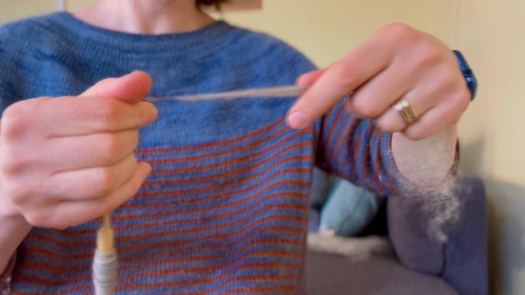
The first thing I talked about before we started spinning on suspended spindles was the twist model. In short, the twist model is about where between no twist at all and very much twist the spinner can find an amount of twist where there is enough twist for the fibers to slide past each other without coming apart. I call this the point of twist engagement.

Finding the point of twist engagement is to me essential to understanding twist and spinning. With the students’ newborn rolags and the twist model in their mind there were some first precious aha-moments in rolag carding, opening up the twist and finding the point of twist engagement.

Switching hands

Another concept I work with already from the beginning with my students is switching hands. I always encourage them to learn to use both hands as spinning hands and both hands as fiber hands. To prevents strained shoulders and to help them understand both hand roles from the perspective of both hands. And they all do it. Not always enthusiastically, but they do it and see the benefits of it.

Check out my free five-day challenge Hands on where I encourage you to switch hands and get acquainted with the roles of the hands.

Day 2: Floor spindle

On day 2 we dived into floor spindles. Here their rolags are really put to the test โ€“ spinning on a floor spindle brutally reveals any uneven rolags and the students get an understanding of what in the wool preparation process โ€“ teasing, carding or rolag shaping โ€“ that needs adjusting.

Floor spindles by Bjรถrn Peck.

With the floor spindle we practice longdraws. The long draw a spinner can make on a floor spindle are longer than on a spinning wheel โ€“ the yarn can go from the spindle shaft on one side of the body, across the torso and out in the hand of the outstretched arm on the other side of the body.

Students that on the day before have had a hard time finding and working with the point of twist engagement with the suspended spindle have understood it with a lot of joy today with the floor spindle. And who, when, going back to the suspended spindle, suddenly have come past their struggle. This really warms my wooly teaching heart.

Day 3: In-hand spindle

This is the third time I teach the A spindle a day five-day course. I know that the students usually are very tired and sometimes a bit overwhelmed on day 3, which is also the day of the most complicated spindle type: In-hand spindle with a distaff. That in combination with the large proportion of beginners made me a bit nervous. Would I be able to give them the sense of accomplishment?

I didn’t have to worry. They were working very independently by now. They analyzed, experimented and were dedicated to understanding what went wrong and why. And after just an hour or so all of them were spinning with their in-hand spindles and distaffs. I was amazed at all they had learned so far and at how they used their knowledge to understand new tools and techniques. I didn’t even have to tell them to switch hands, they did that automatically.

Day 4: Supported spindle

When I teach supported spindle spinning isolated I usually do it slowly in a step-by-step fashion. In the A spindle a day course though, the students have successively learned all the components of the technique and already know about changing the angle, opening up the twist and working with upper and lower cop. It’s just a matter of getting to know the tool and transfer the technique to a new context.

Bjรถrn Peck’s beautiful supported spindles spin like rockets.

This course was no different. Even if they were intimidated by the small motor movement and the speed of the spindles, they quite quickly got the hang of the tool and the technique and spun away happily.

Narrative spinning

At this stage, on day four, they had got to know each other and we did an exercise I call narrative spinning. This is when they sit in pairs and one students spins and tells the other what is happening in the spinning, why it is happening, what they are doing and why they are doing it. The other student listens and asks constructive questions. By narrating their spinning they put words on what may be difficult to grasp. The one listening gets inspiration from a fellow student. I was given this exercise when I was learning to drive and it always works very well in spinning courses when the students have gotten to know each other a bit.

Evenings

The students line up their precious yarn balls by one of the floor looms.

When class is dismissed for the day the students stay in the classroom and practice and/or prepare for tomorrow’s class. So much happens in these evening sessions. Hearty conversation and usually lots of progress without the teacher bothering them with questions and ideas. I’m usually still in the classroom (blogging), but I try not to bother them.

Day 5: Wool tasting and spinning meditation

Day 5 is only half a day so I don’t introduce a new spindle type this day. Instead I offer them a chance to understand how much they have actually learned, by hosting a wool tasting. In the wool tasting they get to try wool from five different breeds that they haven’t worked with before. On this A spindle a day 3 they got a brown silver medal winning Helsinge wool, chocolate brown alpaca, black Klรถvsjรถ wool with subtle silver sparkle, white silver medal winning finull wool and light grey and unusually soft gute wool.

Their task is to, for fifteen minutes per breed, prepare and spin the wool and reflect over the wool, technique and choices they make during the process. After the fifteen minutes have passed they get the next wool. We do this in silence so that they can focus on their process.

Apart from working with new wools and using what they have learned in the course, they get the chance to, in a short time, make decisions about preparation and technique without over thinking things. The students usually love this exercise and they get to go back home with the form they fill in, showing all they have learned.

The wool tasting is done in silence for 5 x 15 minutes. I love this part of the course, where I can sit and watch the students work โ€“ how they make decisions and work with the wool with the tools and techniques they have got acquainted with during the course.

Spinning meditation

The very last thing we did was a spinning meditation. I guide the students through spinning in mindfulness and without prestige. Towards the end of the meditation I encourage them to close their eyes and feel their way in the spinning. And most of them did, surprised at how much they could actually feel in a situation where they usually relied on their vision.

The wool tasting form was their diploma of what they had learned and the spinning meditation an extra treat for them to reflect over and be proud of how much they had learned.


I’m finishing this blog post on the train back home to Stockholm. I’m going home with a lighter suitcase, many insights, and a warm heart, thrilled over what I have learned and of having been able to guide my students down a new rabbit hole. I hope to come back next summer.

Thank you M, L, S, E-B, E, A, C, L, M-L, H and K for letting me guide you through wool, tools and techniques. Thank you for lots of laughs, many insights and sweet conversations. A special thought goes to M who turned ill and couldn’t make it to the course.

Happy spinning!


You can find me in several social media:

  • This blog is my main channel. This is where I write posts about spinning, but also where I explain a bit more about videos I release. Sometimes I make videos that are on the blog only. Subscribe or make an rss feed to be sure not to miss any posts.
  • My youtube channel is where I release a lot of my videos. Subscribe to be sure not to missanything!
  • I have a facebook page where I link to all my blog posts, you are welcome to follow me there.
  • I run an online spinning school, welcome to join a course! You can also check out my course page for courses in Sweden.
  • On Patreon you can get early access to new videos and other Patreon only benefits. The contributions from my patrons is an important way to cover the costs, time and energy I put into the videos and blog posts I create. Shooting and editing a 3 minute video takes about 5 hours. Writing a blog post around 3. You can read more about my Patreon page here.
  • You are also welcome to make one-off donations on my Ko-fi page.
  • Follow me on Instagram.  I announce new blog posts, share images from behind the scenes and post lots of woolliness.
  • Read the new book Knit (spin) Sweden! by Sara Wolf. I am a co-author and write in the fleece section about how I spin yarn from Swedish sheep breeds.fleece section about how I spin yarn from Swedish sheep breeds.
  • In all the social media I offer, you are more than welcome to contact me. Interacting with you helps me make better content. My private Facebook page, however, will remain private.
  • I support Centro de textiles tradicionales del Cusco, a group of talented textile artists in Cusco, Peru who dedicate their work to the empowerment of weavers through the revitalization and sustainable practice of Peruvian ancestral textiles in the Cusco region. Please consider supporting their work by donating to their causes.